
Searching for the best 85 inch TVs can feel overwhelming, but the reward is an unforgettable home theater experience. Are you ready to transform your living room into a cinematic paradise? We’ve analyzed the top models, focusing on breathtaking picture quality and smart features to eliminate your guesswork. This definitive guide will help you find the perfect massive screen for your budget and needs.
Contents
- Top 5 85 Inch TVs:
- 1. Samsung QN90D – Best 85-Inch TV Overall
- 2. TCL QM7K – Best 85-Inch TV for Gaming & Movies
- 3. Sony BRAVIA 3 – Best 85-Inch TV for Everyday Streaming
- 4. Samsung Q7F – Best 85-Inch TV for Bright Rooms
- 5. Hisense U6 – Best Budget 85-Inch TV
- Things to Consider Before Buying a 85 Inch TV:
- Understanding Types of 85 Inch TVs
- LED vs. OLED vs. QLED
- Smart TV Features
- Room Size and Viewing Distance
- Resolution and Picture Quality
- Comparing Brands and Models
- Reading Reviews and Ratings
- Checking Warranty and Support Options
- Mounting Options
- Final Words
Top 5 85 Inch TVs:
1. Samsung QN90D – Best 85-Inch TV Overall

Samsung 85-Inch Class QN90D Series If you’re in the market for a big-screen TV that stays bright, sharp and responsive in any room, Samsung has you covered with its 85-inch QN90D. Its Mini LED backlight provides ultra-precise high brightness, for breathtaking contrast and nuanced shadows from deep blacks to bright whites — perfect for anytime you’re watching a HDR movie or show. The color is still brilliantly accurate and vivid, with contrast more tuned to the output that the film creator intended rather than hiding from daylight.
You’ll get a far more intimate experience of the action. With built-in Dolby Atmos with Object Tracking Sound, audio moves with the on-screen action for a superbly immersive experience without having to lay cables or additional speakers. Fast content remains clear, thanks to a 120 Hz panel and good motion handling that means blur is kept in check and input lag stays low for gaming and live sports.
Realism and depth receive an assist from Real Depth Enhancer Pro, a feature that examines every frame to make the focal point pop for a more 3-dimensional image. The Samsung’s AI based 4K processor aims to upscale all of your content to near-4K quality; While the UHD processor works to make HD more like 4K resolution on everything you watch(2,3). Adaptive tone mapping creates picture-perfect quality by dynamically adjusting content scene-by-scene, black-levels significantly improve this already amazing image contrast with precise detail from day light to midnight.
Connectivity options are simply: there’s built-in Bluetooth and Wi-Fi for wireless use, while HDMI and USB cover the consoles, sound systems, and media side of things. If you want an 85-inch box of astounding contrast, vibrant HDR color and fine motion handling in your living room or open space, the QN90D is a premium performer for large rooms.
2. TCL QM7K – Best 85-Inch TV for Gaming & Movies

Prefer a 85-inch screen designed for gaming as well as movies? The TCL QM7K is tuned for just that. Its QD-Mini LED backlight marries the strengths of QLED with OLED-stye control to produce near pixel-level accuracy in black levels, contrast and color across your entire 4K panel.
You will see how well the picture holds up when tested in challenging scenes. TCL’s Halo Control System combines high-power LED microchips, grouped micro lenses, a high-contrast HVA panel and dynamic backlight algorithms to tame blooming and keep bright objects sharp against dark backgrounds. High HDR brightness ensures that the picture retains its punch in a wide variety of room lighting.
In gaming, native 144Hz refresh rate and the choice of either DCI-P3 98% or sRGB 99% enable you to feel the action and respond immediately with your best gear.
The CrystGlow HVA panel suppresses reflections so that even with lights on, the details are crisp, and Bang & Olufsen audio delivers sound that’s more sophisticated than what you get from most TV speakers. Google TV sorts your streaming apps and recommendations into one place, so it’s easy to switch from a late-night game to a date night movie.
So if you want one bigscreen display that’s up to both total cinematic HDR and hyperfast gaming, the QM7K gives you the brightness, control and motion all at 85 inches.
3. Sony BRAVIA 3 – Best 85-Inch TV for Everyday Streaming

If you’re looking for an 85-inch TV that is built to make day-to-day streaming easy but also enjoyable, the Sony BRAVIA 3 is on that role. What You Get You receive an LED 4K display (image contrast ratio of approximately 4,000:1), so all your movies and shows have that lifelike feel Live sports are streaming in spectacular quality with access to their favorite players in the warm glow of a 16:9 aspect ratio.
You run it like you already live. Google Assistant is built in – search for movies, series and your favorite shows, get answers to questions, and control smart home devices with easy voice commands. And as a streaming hub, it gathers Netflix, Prime Video, Disney+, YouTube and more into one place so you don’t have to bounce between devices to watch what you want.
Helping picture quality is Triluminos Pro, which can show more than a billion precise colors. That translates to brighter, more vibrant and more lifelike images, whose skin tones and landscapes look natural rather than flat or overcooked. It’s tuned for everyday content, from dramas and sports to YouTube videos and music.
If you play games, particularly on PlayStation 5, the BRAVIA 3 is of added value due to Auto HDR Tone Mapping and Auto Genre Picture Mode. These features intelligently adjust picture settings for great gaming and streamreading, reducing harsh breaks between darks and lights, sharp details that don’t require you to go into the menu every few minutes.
If you’re in the market for a super easy-to-operate 85-inch screen that serves up streaming, voice control and casual gaming at its mechanical metaphorical core then this BRAVIA should hug your living room walls nicely.
4. Samsung Q7F – Best 85-Inch TV for Bright Rooms

If you want an 85-inch TV that performs well in bright rooms, then get the Samsung Q7F. Its 4K QLED panel uses Quantum Dots to show you over a billion colors that stay open and strong, especially even when the sun is shining or lights are on. You don’t just get resolution — you gain clarity, both in color and contrast, at almost any brightness level.
And you even get some AI-based optimization on the fly. The TV reviews whatever you’re watching or listening to and upscales content toward 4K while adjusting color and sound based on what the TV senses you’re seeing — be it movies, sports, video games or streaming shows. That means: older HD sources still look razor-sharp and compelling on this big screen.
This phone comes with security baked in thanks to Samsung Knox. Triple layer protection ensures you’re protected from harmful apps, phishing sites and password snoopers that could compromise your identity or financial personal information.
Content discovery is simple. With the Samsung TV Plus free live TV service, you can explore over 2,700 channels, many with no subscription required — including 400+ channels and growing with news, sports, movies, entertainment on premium Samsung TVs. Bluetooth, Wi-Fi, Ethernet, HDMI and USB allow your consoles, soundbars and media drives to link together without the hassle.
If you want an 85-inch screen with bright-room support and bold QLED color, smart processing and strong built-in security and options for content, the Q7F is one that may be fine as a “daily” center piece.
5. Hisense U6 – Best Budget 85-Inch TV
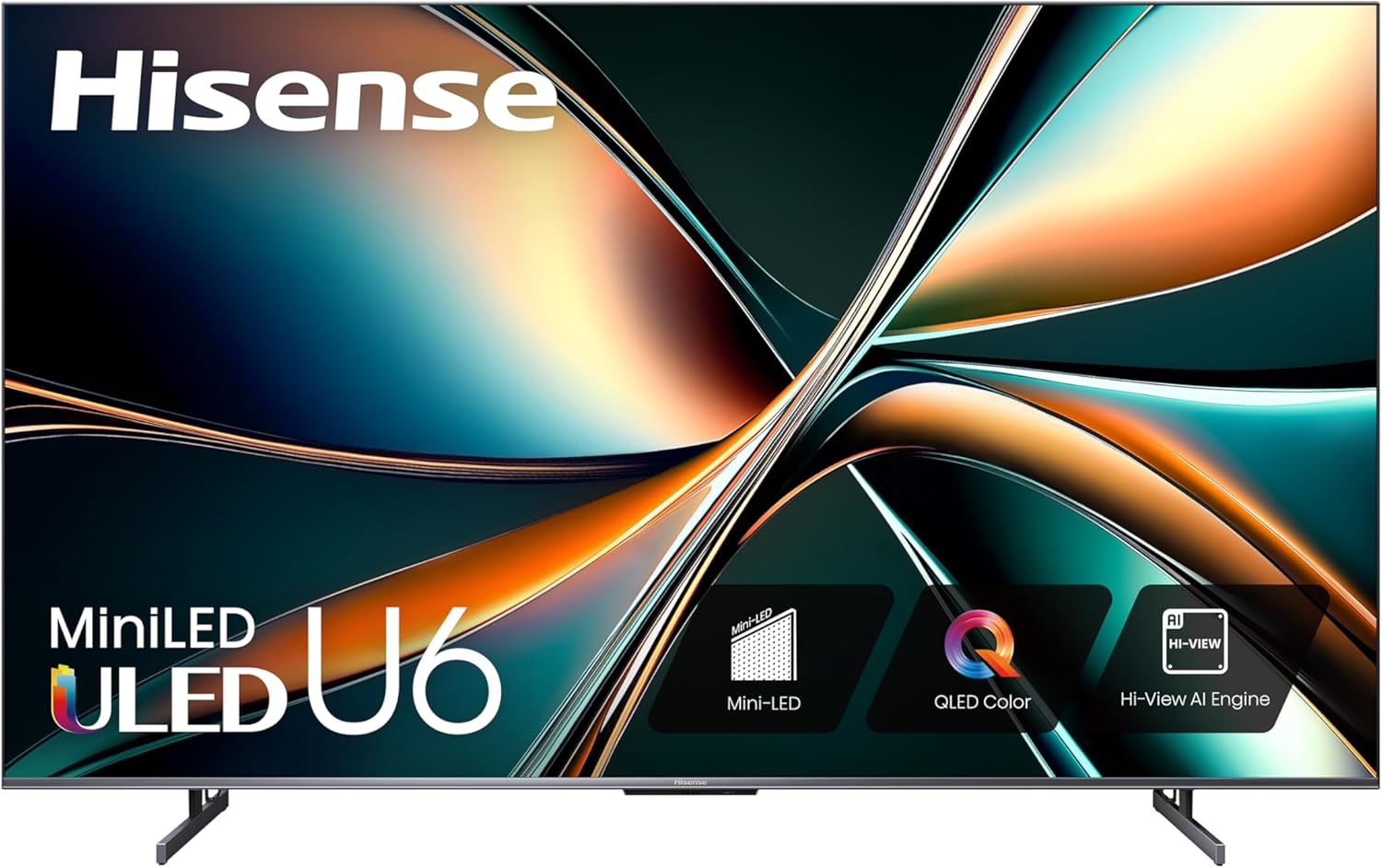
For someone who wants a premium feel in the form of an 85-inch TV without bursting their wallet, the Hisense U6 is great value. Its Mini-LED ULED backlight and Full Array Local Dimming Pro brings you deeper blacks, brighter highlights, and more well-defined contrast — so those dark scenes don’t get muddy and those bright scenes stay punchy without blooming.
You also receive rich, true colors. QLED Quantum Dot technology lets you experience images bursting with a dazzling range of over one billion colors, each upscaled to incredible clarity in a revolutionary new way thanks to the intelligent 4K processor automatically optimizing the brightness and sharpness.
Beneath the surface, everything’s being improved, Just for you Engine The Hi-View Engine AI So far as introduction to Brilliant Color Space Power Dongle. Things like Dynamic Tone Mapping Pro, AI HDR Enhancemen, AI Detail Enhancement and Face Detection optimize each frame to deliver the right content while you spend less time customizing settings and more time streaming.
Game Mode Plus If you play more than watch, Game Mode Plus optimizes frame rates for the smoothest motion, while AMD FreeSync reduces stutter and input lag in 60 Hz panels thanks to support for VRR and ALLM (Vesrsion II), so you get slicker gameplay.
HDMI, USB, Ethernet, Wi-Fi and Bluetooth are all onboard so you won’t have any trouble connecting consoles, streaming boxes or sound systems. If you want an affordable 85-inch screen that still provides great HDR, vivid color and good gaming features, the Hisense U6 will make your living room feel like a much larger venue without breaking the bank.
Things to Consider Before Buying a 85 Inch TV:
TV size demands planning: you should measure viewing distance and room layout to ensure proper scale and avoid overwhelming the space. Check resolution and panel technology for clarity at large sizes, verify brightness and HDR performance, confirm available HDMI ports and smart features, assess wall-mounting, weight and cable management, and set a realistic budget that includes delivery, installation and any calibration you may want.
Understanding Types of 85 Inch TVs
When you evaluate 85-inch sets, panel type and backlight architecture have the biggest impact on picture and price. You’ll compare black level, peak brightness, motion handling, and long-term reliability—OLEDs excel at blacks, QLED/Neo‑QLED often exceed 1000 nits for HDR, and full‑array LED or Mini‑LED balance price with strong HDR performance. Brands like LG, Samsung, and Sony optimize different strengths for living rooms or home theaters. This table and checklist highlight practical trade-offs to guide your choice.
LED vs. OLED vs. QLED
OLED uses self‑emitting pixels for unmatched blacks and wide viewing angles, with typical peak HDR brightness around 600–800 nits on large panels; QLED (quantum‑dot LCD) pairs an LED backlight with quantum dots to push peak brightness above 1000 nits on premium models, helping HDR in bright rooms. Conventional full‑array LED and Mini‑LED bridge cost and performance—Mini‑LED adds finer dimming control. You should match panel strengths to your room lighting and content habits.
Smart TV Features
You need a platform that supports the apps and ecosystem you use: WebOS, Tizen, and Google TV dominate, with voice assistants (Alexa/Google) and casting built‑in. Check for at least one HDMI 2.1 input for 4K@120Hz gaming, eARC for soundbar passthrough, and low input lag (under ~15 ms) if you play on PS5/Xbox Series X. Firmware update history and app availability determine how long the TV stays useful.
Also verify update cadence, account/profile support, and privacy settings; manufacturers typically provide OS updates for ~3–4 years on flagship lines, while cheaper models may drop support sooner. Look for unified search and universal remotes to streamline apps, and test the app store for niche services you use—if you rely on a specific streaming app or casting method, confirm it works on the exact 85″ model you’re considering.
Room Size and Viewing Distance
For an 85″ 4K screen you can sit surprisingly close: target roughly 1.0–1.5 times the screen height (about 3.5–5.5 ft / 1.1–1.7 m) to resolve full 4K detail; for 1080p content move back to 2–3× height (7–11 ft / 2.1–3.4 m). Place the screen so its center is near your seated eye level—commonly 40–42 inches from floor—and factor glare from windows when planning placement.
Resolution and Picture Quality
4K (3840×2160) on an 85″ yields ~52 PPI, so at typical living distances you get excellent detail without visible pixels; 8K doubles that density but only shows benefit if you sit very close or use native 8K content. You should prioritize a TV with strong upscaling chips (e.g., Sony X1‑style processors) and wide color gamut to make HD and streaming material look cleaner and more natural.
Delve deeper into HDR performance: look for peak brightness numbers (600–1,500+ nits) and sustained zone brightness on mini‑LED models for specular highlights, plus color volume metrics—DCI‑P3 coverage above 90% and Rec.2020 support help HDR effects pop. Contrast behavior matters too: OLEDs excel at black levels and per‑pixel dimming, while high‑zone mini‑LEDs can approach OLED shadow detail with far higher peak brightness, which impacts HDR tone mapping and perceived realism in bright scenes.
Comparing Brands and Models
When you compare, focus on panel technology, real‑world HDR performance, and software longevity: Samsung’s Neo QLEDs offer high brightness and robust Tizen apps, LG’s OLEDs deliver perfect blacks and Dolby Vision in many models, and Sony typically excels in upscaling and motion handling with Google TV on select X95L or A95 series.
Reading Reviews and Ratings
You should balance lab tests (RTINGS, Consumer Reports) that report contrast ratio, input lag and HDR peak nits with user reviews; aim for input lag under 20 ms for gaming and HDR peak brightness ≥600 nits for impactful HDR. Scan at least 50 buyer reviews to spot repeated issues like backlight blooming, firmware bugs or dead pixels, and give more weight to long-term reports (6–12 months) describing reliability.
Checking Warranty and Support Options
Start by checking warranty length and scope — most manufacturers offer a one-year parts-and-labor warranty; some promotions extend that to two years — and verify whether the panel, backlight and power supply are included. Ask if service is in-home or depot, confirm authorized service centers near you, and note the retailer’s return window so you can exchange an 85″ set if it arrives with defects.
Mounting Options
Check the TV’s VESA pattern and weight—many 85″ models use 400×400 or 600×400 and weigh 60–110 lb—so pick a mount rated above that. Fixed mounts give a near‑flush 1–2 in profile, tilting mounts allow 10–15° correction for high placements, and full‑motion arms offer up to 180° swivel for angled seating; always anchor to studs or heavy‑duty anchors and consider professional installation for tricky walls or heavier sets.
Final Words
So before you commit to an 85-inch TV, assess your room size, viewing distance, and wall or stand placement; balance resolution, HDR performance, panel type, and input lag against your budget; check smart platform, warranty, and available ports; and plan for installation and sound solutions so you get a display that fits your space and viewing habits.
Leave a Reply