
Best Bird Feeder Cameras let you catch close-up feeds of backyard birds without missing a single visit. If you’ve been frustrated by blurry footage or confusing setups, our expert-tested picks and buying tips ensure crisp video and easy setup for any feeder cam or birdwatching camera. You’ll feel thrilled and moved by crisp, heartwarming clips that bring nature to your door. Read on to find the perfect camera and simple setup tips.
Contents
- Top 7 Bird Feeder Cameras:
- 7: HARYMOR Bird Feeder with Camera
- 6: HEAPETS Bird Feeder with Camera
- 5: birdsnap PAV Bird Feeder with Camera
- 4: NETVUE Birdfy AI Smart Bird Feeder Camera
- 3: Kiwibit Smart Bird Feeder with 4K AI Camera
- 2: Birdbuddy Pro Solar Smart Bird Feeder with Camera
- 1: Birdfy 2 Pro Solar Smart Bird Feeder Camera
- Things to Consider Before Buying a Bird Feeder Camera:
- Integrated Smart Feeder Systems
- Mounted Wildlife and Trail Cameras
- Benefits of Real-time Bird Recognition
- Data Privacy and Subscription Costs
- Defining Your Observation Goals
- Evaluating Power Source Options
- Maximizing Natural Lighting for Clarity
- Implementing Squirrel Deterrents
- Final Words
Top 7 Bird Feeder Cameras:
7: HARYMOR Bird Feeder with Camera

One of the greatest low-cost options for birding with a camera is the HARYMOR Bird Feeder with Camera.You glance up, see a bird land, and then it flies away before you can even say its name. No more guesswork with this feeder.The first is a 2K live feed with color nite vision—visitors at dawn and dusk don’t show up as a muddy gray blur.The next item is a beginning feeder with a 2 liter seed hopper. There will be fewer trips skipped and refills required when it is empty.
Finally, it’s cordless thanks to the integrated solar panel, and you’ll get a notification on your phone the second anything lands.Downside: rare species have fewer reliable identification methods. A single fixed-angle lens. The software is simple.Applicable to: shoppers who are new to the process and those who are careful with their money. Folks who are looking for photo-grade stills of birds should not use this.
6: HEAPETS Bird Feeder with Camera
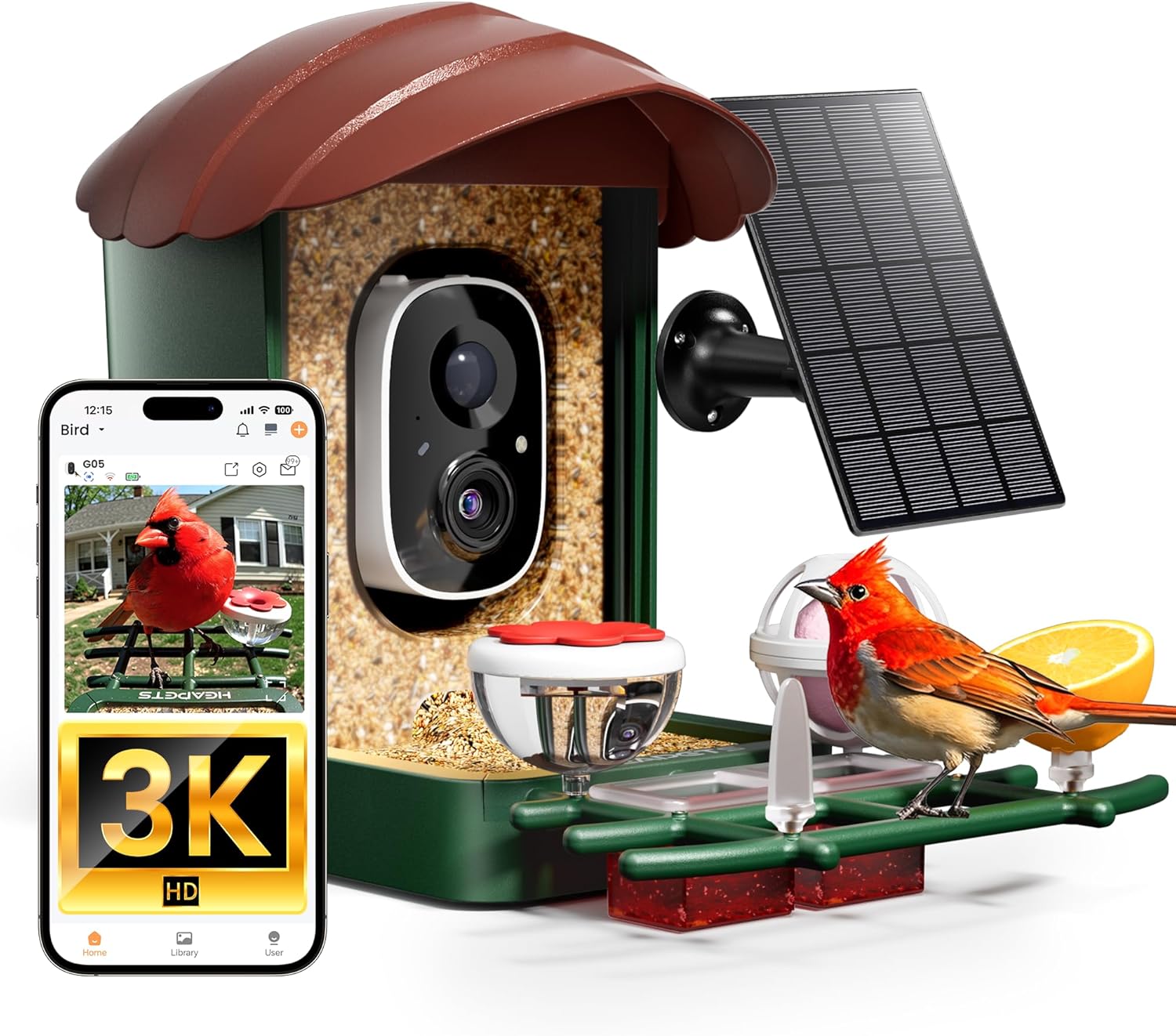
When it comes to durability and clarity, nothing beats the HEAPETS Bird Feeder with Camera.Most cheap feeder cameras have a fuzzy picture and a battery that you have to bring inside. Both are fixed by HEAPETS.To start, there’s the 3K HD footage, which is noticeably sharper than the 2K that the majority of beginner feeders settle for. The extra detail is truly remarkable.After that, a solar panel and a 5,000mAh battery. All you have to do is mount it somewhere sunny and refill the seed.
Lastly, motion detection begins recording the second a bird lands, so it captures visits even if you’re not looking.Negative: compares poorly to premium sensors in terms of image quality. Birds can be identified differently. No angles, just one camera.For those who value precision yet despise charging, this is the best option. People who require very precise identification results should not use this.
5: birdsnap PAV Bird Feeder with Camera

For those who would rather not pay a monthly subscription, the birdsnap PAV is an excellent option.A subscription wall blocking your feed video and a squirrel eating all the food by midday are the two worst things that may happen to a feeder camera.First, you may store more than 40,000 10-second films locally on the 64GB card that comes with it. What you film remains yours.What follows is an impenetrable construction with five feeding attachments and a 1.8L hopper to keep seed viable and attract desirable visitors.
Last but not least: a solar panel that tilts toward the sun and an ultra-wide lens that covers 155 degrees—constant charging, complete coverage.Negatives: coverage is sacrificed for close-up detail due to the wide lens. Two people can share up to four space. Up to 2K, the video will go.Good for: people who don’t want to subscribe and yards that are full of squirrels. Households with several members or those who constantly seek new goals should not utilize this.
4: NETVUE Birdfy AI Smart Bird Feeder Camera

The most popular and secure option here is the NETVUE Birdfy AI, which is also the greatest mainstream choice.Your investment in a smart feeder is also your investment in an app, and all too often, apps either stop updating or start charging for features that users hardly use.The first is 6,000+ species covered by free AI identification for life. Never before has the product’s redeeming feature been hidden behind a paywall.Up next: a full-HD (1080P) camera that can see in color at nite and provides a live feed anytime you launch the app.
A fully developed app and solar power, both of which have been in development for some time rather than being released just last season, are finally here.Cons: The top half of this spectrum only supports 1080P as a minimum resolution. Expiration date of free cloud storage is months. Only one lens that is permanently attached.Customer Service Preferred: Those that want it done right. This is not the right choice for: individuals seeking the highest possible resolution.
3: Kiwibit Smart Bird Feeder with 4K AI Camera

The top choice for 4K and entire homes is the Kiwibit Smart Bird Feeder with AI Camera.Watching a cardinal in 4K makes 1080P seem inadequate. Typically, true 4K is priced quite much.Starting with 4K video and 8MP images. Snippets of finch beak rings, feather texture, and eye detail are all sharp even when magnified.Moving on to the next topic: family sharing with twenty people. On their respective phones, everyone—grandparents, children, neighbors—watches the identical feed.
Lastly, AI identification integrates expert species notes, allowing you to get knowledge about the landing and its characteristics.Downside: a Kiwibit Premium membership requires identification. 4K quickly finishes storage. One vision, one camera.Ideal for: big families and especially detail-oriented birdwatchers. Do not subscribe if you fall into this category.
2: Birdbuddy Pro Solar Smart Bird Feeder with Camera

In terms of picture quality and genuine bird learning, the Birdbuddy Pro Solar is the best bet.Most feeder cams will send hundreds of nearly similar frames to your phone, with 50% of them blurred, so you’ll have to comb through them all.An HDR-enabled 1/2.7-inch sensor—almost twice the size of a standard feeding cam—is the first component. The illuminated perches are spotless.Secondly, it captures video at 2K resolution and stills at 5MP. You may choose between a wide or tight frame for each portrait.
Finally, the third benefit is that the program automatically removes incorrectly exposed or staged photos from your feed. All the goalkeepers are yours.Downside: access to all AI capabilities is restricted to premium subscribers. Rather of serving as a replacement for charging, the solar roof augments power. Reduced frame rate degrades video quality.Perfect for: birdwatchers who love taking pictures and anyone compiling a list of species. This is not for you if you want to forego receiving subscriptions.
1: Birdfy 2 Pro Solar Smart Bird Feeder Camera

If you want high-quality footage of your birds during feeding time, the Birdfy 2 Pro is the way to go.The other feeders all point their fixed lenses toward nearby perches and cross their fingers that the birds land safely. The results are often hazy.A dual-lens system is the first. A single 2K portrait camera operates autonomously, while a single 1080P wide-angle camera captures the entire feeder.Secondly, aside from the portrait lens, nothing else in this setup follows the subject—the bird itself travels about and is automatically framed.
Thirdly, slow-motion replay makes even the most uninteresting scenes, such a landing, hover, or fight on the perch, entertaining.The fourth feature is a daily highlight reel, sharing with 20+ guests, and persistent AI recognition of 6,000+ species.Drawbacks: this feeder is the priciest one available… More setup and learning curve are associated with two lenses. This is a bigger body.Ideal for: avid photographers and birdwatchers who desire precise shots without using a tripod. Forget about simple setups.
Things to Consider Before Buying a Bird Feeder Camera:
There’s a growing interest in observing birds up close, making bird feeder cameras an enticing addition to your backyard. Understanding critical features, compatibility, and purpose can greatly influence your choice, ensuring you capture engaging moments in nature.
Integrated Smart Feeder Systems
These innovative systems not only provide nourishment for birds but also allow for real-time video streaming and image capture. Many come equipped with sensors that detect when birds arrive, notifying you through a connected app. The convenience of integrated features enhances your birdwatching experience and offers insights into feeding patterns.
Mounted Wildlife and Trail Cameras
Ideal for capturing a wide range of wildlife, these cameras are typically more versatile than standard bird feeders. They can be positioned at various angles to record birds from multiple viewpoints. The durability of these cameras allows for use in different weather conditions, ensuring they remain functional year-round.
Mounted wildlife and trail cameras frequently offer versatile mounting options, allowing you to adjust the height and angle according to your landscape. Their higher frame rates can capture fast-moving birds, providing dynamic footage that highlights behavior patterns and interactions. This capability is particularly useful for documenting rare sightings or specific species you wish to observe closely.
Benefits of Real-time Bird Recognition
Real-time bird recognition allows instant feedback on feathered visitors, enriching your bird watching experience. Immediate notifications mean you won’t miss rare sightings, enhancing your engagement with avian life. This feature also supports educational opportunities, helping both novice and experienced birders learn more about their environment.
Data Privacy and Subscription Costs
Data privacy remains a concern with AI identification technologies. Many models require subscriptions for premium features, adding an ongoing cost to your birding experience. Weighing these considerations carefully is important for making a well-rounded decision.
Subscription models vary significantly; some might charge a small monthly fee, while others could command higher annual costs. Understanding the data privacy practices of the service provider is equally important, as sharing identification data could result in unintentional exposure to third parties. Conducting research on privacy policies before purchase can help avoid potential complications in the future.
Defining Your Observation Goals
Identifying observation purposes can align your purchase with expectations. Whether it’s watching rare birds, documenting feeding habits, or simply enjoying backyard wildlife, setting specific goals enhances satisfaction with your chosen model.
Evaluating Power Source Options
Power choices significantly influence camera performance and maintenance. Options may include batteries, solar panels, or direct wired connections. Evaluating your specific environment and usage frequency is key for optimal functionality.
Considering the location of your feeder camera is important for determining the best power source. For instance, remote areas lacking electricity may benefit from solar panels, while conveniently placed feeders could work well with rechargeable batteries. Dynamic usage patterns might require a hybrid approach, ensuring consistent operation regardless of environmental conditions.
Maximizing Natural Lighting for Clarity
Position your camera where natural light is abundant. Ideally, facing east or southeast ensures that morning light enhances clarity in your videos and images. Avoid shaded areas which can result in grainy footage.
Implementing Squirrel Deterrents
Implementing effective squirrel deterrents is important for preserving your bird feeder camera’s intended focus. Use squirrel-proof feeders or baffles designed to thwart intruding rodents.
Many strategies exist to keep squirrels at bay. Applying grease or vaseline to poles can prevent them from climbing. Additionally, using bird feeders with weight-activated perches ensures that only birds can access the food, while heavier animals like squirrels are deterred. Regularly checking and reinforcing these measures will result in a more successful birdwatching experience.
Final Words
Choosing a bird feeder camera involves careful consideration of several factors, including image quality, connectivity, and ease of installation. Assess features like night vision and AI capabilities to enhance your birdwatching experience. Evaluating these aspects will lead to a more fulfilling journey in attracting and observing various bird species.
Leave a Reply