
Finding the best budget action camera shouldn’t feel like a struggle. You want crisp 4K video and solid stabilization without draining your wallet on a pricey brand. We tested the market to help you capture your most thrilling adventures with total confidence. Forget overpaying for fancy features you will never use. Let’s look at the top affordable picks that truly deliver epic results.
Contents
- Top 5 Budget Action Camera:
- 1. GoPro HERO – Best Budget Action Camera Overall
- 2. DJI Osmo Action 3 – Best Budget Durable Action Camera
- 3. Insta360 ONE X2 – Best Budget 360-Degree Action Camera
- 4. AKASO Brave 7 LE – Best Budget Vlogging Action Camera
- 5. AKASO EK7000 – Best Budget Underwater Action Camera
- Things to Consider Before Buying a Budget Action Camera:
- Compact Cameras
- Action Cameras with 4K Capability
- Sports Cameras
- Video Quality
- Durability and Build Quality
- Battery Life
- Mounting Options
- Read Reviews and Recommendations
- Compare Features
- Neglecting After-Sales Support
- To wrap up
Top 5 Budget Action Camera:
1. GoPro HERO – Best Budget Action Camera Overall

For real travel and exploration, the GoPro HERO is the way to go if you’re looking for an affordable action camera that won’t feel cumbersome or heavy. You may carry it in your pocket, throw it in your bag, or attach it to your body or equipment without any discomfort thanks to its 86g weight, much reduced volume, and bulk compared to the HERO12 Black.
You won’t need to worry about it when the weather changes or the terrain becomes difficult. In addition to being waterproof to a depth of 16 feet (5 meters), the HERO is constructed with GoPro’s renowned toughness. Feel free to record without worry no matter the terrain: swimming in water, biking in snow, pushing through muddy trails, or exploring a new city.
You can also obtain decent results without fiddling with sophisticated settings. All you have to do is set up your shot and hit the shutter button; the controls are that easy. Ultra HD 4K video for clear action footage and 12MP images for clean snapshots—impressive quality even with that simplicity. And if you’re ever in need of a flawless still from a fast-moving movie, the GoPro Quik app allows you to capture 8MP frames from your videos.
Connectivity options like built-in Wi-Fi and Bluetooth make clip management and transmission a breeze, allowing you to share your highlights more quickly and spend less time editing and more time doing what you love.
2. DJI Osmo Action 3 – Best Budget Durable Action Camera
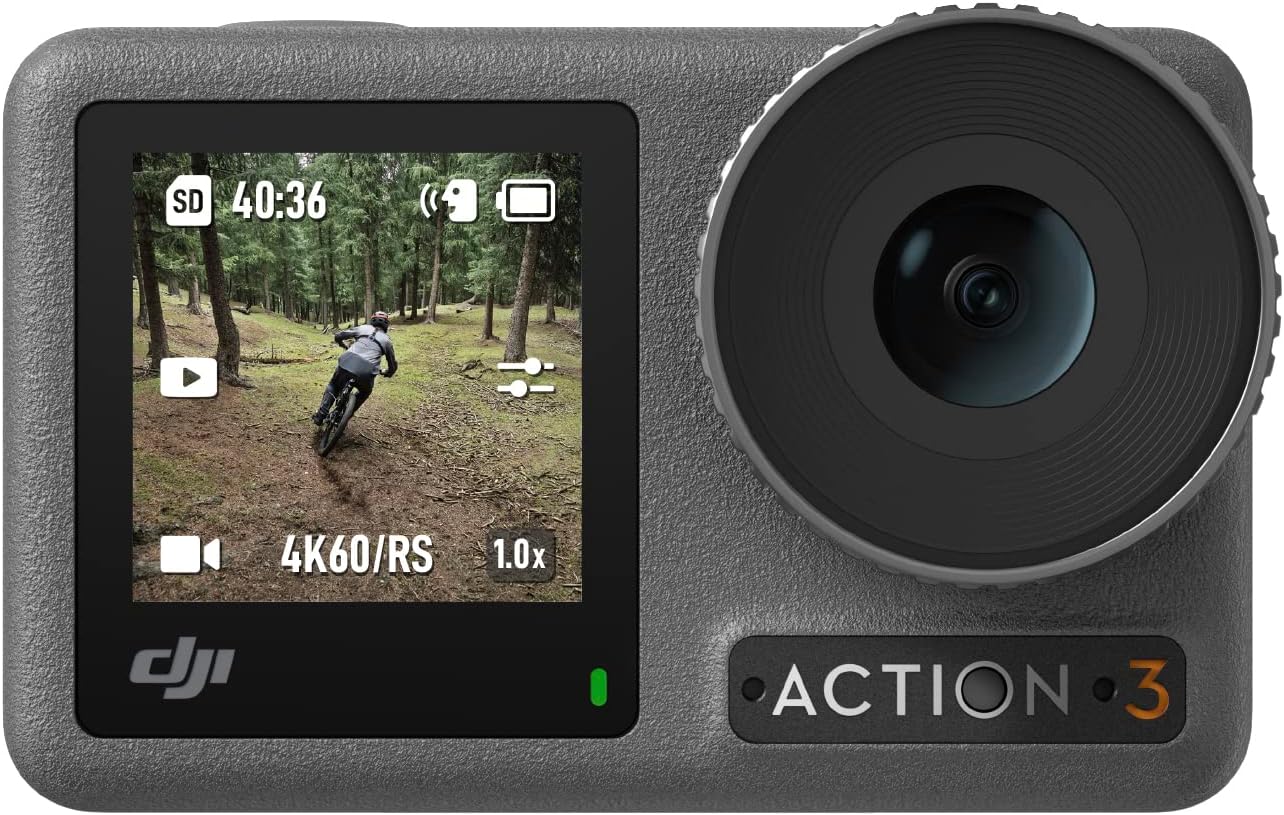
The DJI Osmo Action 3 is an affordable and durable action camera that can withstand real-life experiences and refuse to give up when things go difficult. When filming in strong sunlight, snowy slopes, or mixed lighting, you can preserve brilliant highlights and shadows with realistic 4K HDR recording. Your footage will look richer and more realistic with 10-bit color capturing over a billion hues, so your edits won’t feel flat.
Stabilization saves the day when your ride goes haywire. Even when you’re filming fast-paced action, sharp turns, or uneven terrain, HorizonSteady will keep your footage flat and steady. You can capture smoother, more aesthetically pleasing footage without any additional equipment when riding a bike, skiing, or capturing anything else that moves.
There is no need to be concerned about the battery life being too short. With a maximum runtime of 160 minutes and the ability to record for about 150 minutes in temperatures as low as -20°C, the Action 3 is made to withstand. For those days when you’d rather not interrupt your outside activities to change batteries, it is a major advantage.
Additionally, mounting is both fast and versatile. You may quickly and easily attach it to your preferred gear—reels, shorts, and vertical content—thanks to its quick-release construction and easy vertical mounting. You may dive in and keep filming with confidence if your activities take you underwater because it is waterproof up to 16 meters without the need for additional housing.
3. Insta360 ONE X2 – Best Budget 360-Degree Action Camera

If you’re looking for an affordable camera that can record your entire environment and then let you choose the “best shot”—the Insta360 ONE X2 is a great option. It captures crisp 5.7K 360 video, so you won’t have to worry about getting the framing just right—you can edit your footage afterwards. When time is of the essence, whether on a bike ride, a family outing, or an action scene, that works wonderfully.
For ultra-stable, wide-angle filming when full 360 isn’t necessary, toggle to Steady Cam mode and employ a single lens. Here you have the best of both worlds—a cinematic wide shot for when you want it simple and a 360-degree immersive shot for when you want it all.
For regular creators, its strength is in its stability. With FlowState Stabilization with horizon leveling, you can say goodbye to shaky videos and hello to smooth, level clips—all without the hassle of carrying around a gimbal. Your footage remains easier to watch and share regardless of where you’re filming—a city street, a path, or even a moving car.
Additionally, you shouldn’t freak out if the weather changes. Perfect for rainy days at the beach or surf or boating, the ONE X2 can withstand water pressures up to 10 meters without a case thanks to its IPX8 waterproof classification.
4. AKASO Brave 7 LE – Best Budget Vlogging Action Camera

You can’t go wrong with the AKASO Brave 7 LE if you’re looking for an affordable action camera that can withstand real-life situations, not just ideal ones. If you’re filming outdoors, you won’t have to worry about it getting wet thanks to its IPX7 water-resistant build. This underwater camera is perfect for trips to the beach, snorkeling, or taking pictures in the pool because of the accompanying housing, which allows you to dive down to 131 feet.
Thanks to its dual-display arrangement, the Brave 7 LE makes it easy to see yourself when vlogging. You have a 2-inch rear touch screen for fast settings and playing, and a front color screen for selfies and framing. If you’re recording while on the go, you can quickly switch between viewpoints by pressing and holding the Mode button.
With crisp 4K video at 30fps and 20MP images, your budget-friendly recordings will look clean and detailed. For images taken while jogging, biking, or filming fast action, Electronic Image Stabilization 2.0 with increased 6-axis EIS can help level down camera shake like a gimbal.
In addition to digital zoom for versatile framing, useful creative modes include time-lapse, burst, and fast motion. Out of the box, you’re prepared to capture more scenarios without spending extra thanks to the two rechargeable batteries, remote control, waterproof case, and mounting accessories provided.
5. AKASO EK7000 – Best Budget Underwater Action Camera

The AKASO EK7000 offers a lot of features without the premium pricing, making it an affordable action camera that is truly fit for underwater excursions. Your snorkeling adventures, pool parties, and beach days won’t seem grainy or washed out thanks to the crisp 20MP images and sharp 4K at 30fps recording. When you want high-quality footage that you’ll actually like watching afterwards, it’s a fantastic option.
The built-in Electronic Image Stabilization (EIS) enhances the steadiness and smoothness of your movies when you’re moving quickly, like swimming, riding, skiing, or simply filming on the fly. This results in less unsteady “rollercoaster cam” and more practical footage that may be shared, saved, or edited.
The EK7000 is built to confidently withstand depth, making it ideal for usage underwater. If you’re looking for an affordable option for diving, surfing, or any activity where your camera could get wet or submerged, this is a great choice thanks to the accompanying robust waterproof cover and its rating of up to 131 feet. The included adapters allow you to install it for a variety of uses, including indoor workouts, outdoor rides, helmets, boards, and more—making it versatile enough to adapt to any filming situation.
When the camera is on a high mount and out of reach, the included wireless wrist remote makes filming a breeze. Instead than fiddling with buttons mid-action, you may start and pause video or take images with a simple press. When you include in the fact that it supports HDMI and has built-in Wi-Fi, you have a simple setup for sharing, watching, and transferring your favorite moments.
Things to Consider Before Buying a Budget Action Camera:
There’s more to choosing a budget action camera than price alone; you need to assess image quality, stabilization, battery life, and waterproofing to match your activities. Check available resolutions and frame rates, low-light performance, mounting options, and codec/storage compatibility, and balance feature trade-offs against real-world battery and accessory costs. Prioritize reliable firmware updates, warranty support, and user reviews so your purchase delivers the durability and results you expect.
Compact Cameras
You get a lightweight body that fits your pocket, straightforward menus, and steady performance for travel clips; many compact models deliver 1080p at 30-60fps, basic electronic stabilization, and battery life around 60-120 minutes depending on settings and use.
Action Cameras with 4K Capability
You can find budget 4K models that record 4K@30fps-handy for detailed shots-though you should expect shorter runtimes and larger microSD demands compared with 1080p; check for EIS and firmware updates when comparing models.
When you choose a 4K budget unit, inspect the sensor size and listed bitrates since those determine image quality; pick UHS‑I U3/V30 microSD cards, note that 4K recording typically multiplies file sizes and battery draw by roughly 2-3× versus 1080p, and prioritize models with removable batteries or external power options for longer shoots.
Sports Cameras
You need ruggedness and high frame rates for action: many sports-focused budget cams offer 60-120fps at 1080p for slow motion, multiple mounting points, and waterproof housings to handle crashes and wet conditions without complex setups.
Beyond fps and housing, evaluate lens distortion and field of view-wide angles capture context but exaggerate motion-and look for reliable mount ecosystems and spare batteries to avoid downtime; This helps ensure you capture the full run, ride, or wave without missing critical moments.
Video Quality
You’ll want to compare real-world 4K30 vs 1080p60 footage, sensor size (1/2.3″ vs 1/1.7″), and bitrate-budget cams often record 40-100 Mbps; higher bitrates preserve detail and reduce compression artifacts. Test low-light performance and rolling shutter: a small sensor can wash out shadows and skew fast panning. Look for 120fps at 1080p for usable slow motion and check sample clips from the exact firmware version you intend to buy.
Durability and Build Quality
You should inspect materials and ingress protection: polycarbonate bodies survive drops but metal frames resist bending; many models list IP67 or IP68 without housing, which means water resistance to 1-3 meters for limited times. Check button feel and port covers-flimsy seals are where leaks and sand ingress start. Verify whether the camera ships with a protective housing for deeper diving.
For more depth, evaluate actual drop and waterproof testing: some budget cameras survive 1.5-2 m drops to concrete, others only handle bumps. A hard case or included housing can extend depth to 30 m, but hinges, O-rings and micro-USB ports are common failure points; inspect gaskets and replaceable seals. Read user forums for model-specific failure modes after hiking, saltwater use, or cold-weather sessions.
Battery Life
You’ll typically see 900-1500 mAh cells in budget action cams, translating to roughly 40-60 minutes at 4K30 and 70-120 minutes at 1080p60 depending on stabilization and Wi‑Fi. Cold conditions can cut runtime by up to half, and enabling EIS or Wi‑Fi reduces endurance significantly. Plan for at least one spare battery or a USB-C power bank if you shoot long sessions.
To extend runtime, swap to 1080p and lower bitrates when possible, disable Wi‑Fi and GPS, and carry 2-3 spare batteries (most cost each). Alternatively, run from a USB-C power bank: a 10,000 mAh pack can provide multiple hours if the camera supports pass-through charging-verify that charging while recording is allowed by the firmware.
Mounting Options
You should confirm mount compatibility: GoPro-style three-prong mounts are the industry standard, while a 1/4″-20 tripod thread adds versatility for tripods and gimbals. Adhesive mounts, chest harnesses and handlebar clamps are common; ensure included mounts match the activities you do and check for quick-release bases to swap setups fast.
When choosing mounts, prefer models with reinforced bases and 3M VHB adhesive for helmets, use padded chest mounts for comfort on long rides, and select anti‑vibration arms or dampeners for motorcycle use. If you need multi-platform use, buy a small adapter kit (three-prong to 1/4″-20, suction to clamp) to avoid re-buying cameras for different mounts.
Read Reviews and Recommendations
You should prioritize hands-on reviews and sample footage from reviewers like Gerald Undone, DSLR Video Shooter and TechRadar; check measured battery runtime, stabilization tests and low-light clips to see how a model performs beyond specs.
Dig into long-term user threads on Reddit and manufacturer forums to find firmware update frequency, real-world heat/overheat reports, and common failure points; compare measured bitrates (60 Mbps vs 100+ Mbps), rolling shutter tests and actual battery cycle counts reported by owners.
Compare Features
You want to compare resolution, frame rates, field of view, stabilization type, waterproof rating and external mic support side-by-side to spot tradeoffs-for example, 4K60 often costs more and drains battery faster than 4K30, while larger sensors (1/1.7″) improve low-light by ~1-1.5 stops over 1/2.3″.
Neglecting After-Sales Support
Don’t assume all budget brands provide reliable support-you should verify warranty length (many offer 6-12 months), spare-part availability, and the frequency of firmware updates. If a camera has a short warranty and no visible update history, you risk getting stuck with a nonfunctional unit or compatibility issues with future accessories.
Confirm predictability by checking whether the manufacturer has local service centers, active support forums, or a documented update cadence (monthly or quarterly updates indicate commitment). Also confirm return policies from the seller-third-party warranties or import-only listings often complicate repairs and replacements.
To wrap up
To wrap up, weigh image stabilization, resolution, battery life, mounting options, durability, and accessory availability against your intended use and budget; prioritize features that match how you shoot, check handling and water resistance, and choose the camera that gives the best balance of performance, reliability and value for your needs.
Leave a Reply