
Finding the best canister vacuum shouldn’t feel like a chore. If you’re tired of struggling with heavy uprights that miss tight corners, you deserve a change. We’ve tested the top models to find machines with incredible suction power that glide across hardwood floors effortlessly. Stop settling for a dusty home and transform your cleaning routine into a total breeze today. Let’s look at the most reliable options to find your perfect match.
Contents
- Top 5 Canister Vacuum:
- 1. Kenmore 200 Series – Best Canister Vacuum Overall
- 2. Miele Classic C1 Turbo Team – Best Premium Canister Vacuum for Hard Floors
- 3. Kenmore 700 Series – Best Canister Vacuum for Pet Hair
- 4. Eureka Mighty Mite – Best Lightweight Canister Vacuum
- 5. BISSELL Zing Canister – Best Budget Canister Vacuum
- Things to Consider Before Buying a Canister Vacuum:
- Standard Canister
- Bagless Canister
- Heavy-Duty Canister
- Lightweight Canister
- Suction Power
- Filtration System
- Capacity and Size
- Noise Levels
- Check for Attachments and Accessories
- Look for User-Friendly Features
- Advantages
- Cleaning Filters
- Checking Hoses and Attachments
- Summing up
Top 5 Canister Vacuum:
1. Kenmore 200 Series – Best Canister Vacuum Overall

One option for a whole-house vacuum that won’t feel complicated is the Kenmore 200 Series canister, which is designed to keep cleaning simple and effective. You may use it on hard floors, carpet, upholstery, stairs, and even in your car or garage thanks to its bagged canister design, which keeps dust contained throughout disposal.
You will love the upgraded HEPA filtration system if you suffer from allergies or are extremely sensitive to dust. It effectively captures nearly all fine particles and helps prevent allergens and dust from re-entering the air, leaving your room feeling cleaner than when you first started.
This type is well-known for its performance. You can tailor the airflow to various surfaces with the four height settings, and the powerful 2-motor system provides strong suction. This allows you to go from carpets to bare floors without sacrificing efficiency or tracking dirt and grime.
Day-to-day operations will also become apparent to you. With a weight of less than 20 pounds, the canister design remains nimble and easy to move around obstacles like furniture and tight corners. The dusting brush, crevice tool, and bare-floor tool are all part of the set, and they come in handy for those times when you need to get into tight spaces, such as between baseboards, cushions, and open floors. All of the attachments are conveniently stored on the vacuum, making them easy to access whenever needed.
2. Miele Classic C1 Turbo Team – Best Premium Canister Vacuum for Hard Floors

The Miele Classic C1 Turbo Team is a high-end canister vacuum that offers a “clean and controlled” experience, making short work of low to medium pile rugs while maintaining a refined feel on hard floors. If you value neat dust disposal and a vacuum that remains consistent from room to room, this bagged model, designed by German engineers, is a great choice.
You may avoid damaging sensitive surfaces or having trouble cleaning thicker areas by adjusting the six suction levels to your liking. Whether you’re picking up crumbs from the kitchen, dust from hardwood floors, or trash that settles into a rug, that control makes ordinary cleaning easier.
Another notable feature that makes this model stand out is its maneuverability. You can easily navigate under sofas, around legs of furniture, and into tight spaces with the help of the vacuum’s tiny canister design. You can easily clean upholstery, edges, corners, and other hard-to-reach areas with the provided accessories that clip on when you need to get into the finer details.
An excellent investment if indoor air quality is important to you is Miele’s AirClean system. An authentic Miele FilterBag, a motor protection filter, and an AirClean exhaust filter work together in a three-stage filtering system to collect and confine dust. After you complete, the room will feel cleaner because less debris will be blown back into it. This is a powerful addition for houses with hard floors that desire top-notch performance and cleaner air.
3. Kenmore 700 Series – Best Canister Vacuum for Pet Hair

The Kenmore 700 Series is designed to assist you in keeping ahead of pet hair, which has a knack for appearing everywhere—including on carpets, corners, stairs, and upholstery. For locations that regular tools can’t reach, including carpet fibers, the motorized Pet PowerMate attachment can extract even the most entrenched hair and dust. Additionally, the Ultra Plush nozzle utilizes enhanced airflow to penetrate thicker flooring and clean plush carpet more thoroughly.
A cleaner home atmosphere is supported by the filtration that you will also receive. As you move waste around, you’re actually helping to confine it, thanks to the HEPA media filter, which captures 99.97% of fine dust and common allergens like pollen and pet dander. You can easily maintain strong suction without guesswork thanks to a performance indicator that lets you know when the bag is full or when to check for clogs.
With its double-wall design, the Kenmore can maintain powerful and consistent airflow as you clean from room to room, ensuring consistent power. The canister is easier to manage when traversing tight corners and around furniture thanks to the Swivel+ Steering system. With the Stair Grip function, your vacuum can stay put on stairs as you clean, making the job much easier.
The variable power option allows you to dial back the suction for gentler cleaning on fragile rugs or softer carpet, giving you more flexibility without losing results.
4. Eureka Mighty Mite – Best Lightweight Canister Vacuum

Designed to be lightweight and easy to grip, the Eureka Mighty Mite is a great canister vacuum for rapid cleanups. Ideal for cleaning numerous places at once, its 2.5-liter dust capacity and small size allow you to handle common messes without pausing.
You won’t feel like you’re lugging about a hefty machine when you use it around the house or in your car because of how easy it is to carry and maneuver. Thanks to its 10-amp power, it can clean hard floors with ease and light carpets and upholstery with ease, making it ideal for situations where you need to revive rugs, furniture, or stairs.
The blower port is an additional feature that provides more versatility. You can switch to blowing waste out where it’s easier to collect when vacuuming isn’t the greatest option, such as when clearing dust from tight corners, garage areas, or specific workspaces.
Control on a daily basis is also easy. You can make adjustments while you clean without interrupting your flow thanks to the power-touch handle, which places controls at the tips of your fingers where your hand naturally rests. The bare-floor nozzle and deluxe floor brush make quick work of cleaning hard floors and other surfaces.
The Mighty Mite is an excellent choice if you’re looking for a canister vacuum that’s easy to operate, lightweight, and convenient for regular cleaning.
5. BISSELL Zing Canister – Best Budget Canister Vacuum
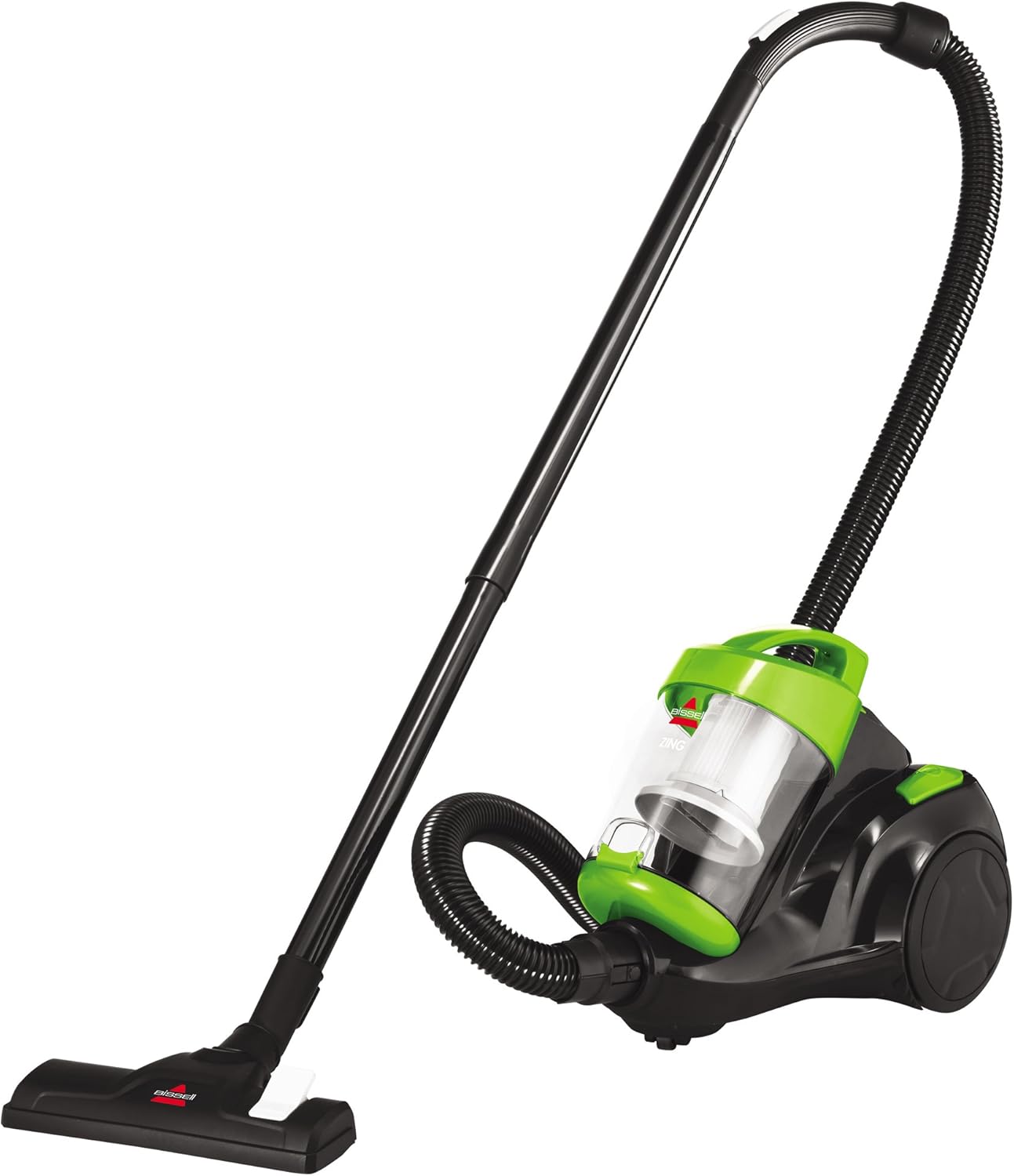
Get the BISSELL Zing if you’re looking for an affordable canister vacuum that can handle regular messiness. The 2-liter dirt cup allows you to clean numerous rooms before emptying, and the bagless design saves you money on bags. So you don’t have to continuously pausing to clean the same locations, the cyclonic movement helps maintain consistent suction as the bin fills.
It is easy to switch surfaces. Switching between carpet and hard flooring is as easy as flipping a switch; no fiddling with settings is required. That’s great if you’re in a hurry and your home has a variety of flooring types.
A post-motor filter and dirt cup filters work together in a multi-stage system to trap even more microscopic dust and particles. The filters are washable and reusable, which means you can keep them in good working order without constantly buying new ones.
This vacuum is perfect for those on a low budget because of how convenient it is. The 15-foot cable provides ample reach for medium to small settings, and it can be easily retracted with the press of a button for convenient storage when not in use. Great for those times when you want something lightweight that won’t feel like a pain to use—at under eight pounds with an inbuilt carrying handle, it’s easy to lift, move up stairs, and navigate around furniture.
Things to Consider Before Buying a Canister Vacuum:
Just assess how your floors, pets, and allergy needs align with suction power, filtration (HEPA if you need it), brush and hose attachments, noise and weight for handling, cord or battery life, dust capacity and ease of emptying, and long-term maintenance costs; choosing features that match your home’s layout and cleaning habits ensures efficient, lasting performance.
Standard Canister
You’ll find standard canisters deliver consistent suction and versatility, typically with 1,200-1,800 W motors, 2-3.5 L dust capacity, and universal floor heads; brands often include sealed HEPA options and extension wands for high-reach cleaning. You should expect 7-9 m total reach and mid-range weight (about 5-7 kg), making them suitable for mixed flooring and household cleaning schedules.
Bagless Canister
You’ll appreciate bagless canisters for visible dust cups (commonly 1-2.5 L) and cyclonic stages that reduce bag purchases; however, suction can drop as debris accumulates, so you need to empty and clean filters every 1-3 months depending on use and pets. You should check for washable pre-filters and sealed systems if allergies are a concern.
For more detail, you should evaluate the dust-separation design: multi-stage cyclones maintain suction better than single-stage models, and transparent bins let you monitor clogging. Expect typical dust-cup volumes of 1.2-2.5 L, filter replacement intervals of 6-12 months for non-washable HEPA, and slightly higher maintenance time-emptying over an outdoor trash or using a sanitizing wipe prevents dust clouds during disposal.
Heavy-Duty Canister
You’ll pick heavy-duty canisters when tackling renovation debris or commercial spaces; they often feature 1,800-2,800 W motors, metal housings, larger inlets, and specialized coarse-debris tools, with noise levels around 75-85 dB and reinforced wheels for rough floors. You should budget for higher weight and maintenance but gain longevity and airflow measured in airwatts for demanding jobs.
In practice, you should look at airflow ratings (airwatts) and inlet diameter-professional units may offer 40-80 mm ports for larger debris-and confirm serviceability: replaceable brushings, metal impellers, and accessible motors reduce downtime. Also factor in filtration: cartridge or bag systems with secondary cyclone stages extend filter life when collecting fine dust or drywall particles.
Lightweight Canister
You’ll favor lightweight canisters when mobility matters-stairs, apartments, or quick cleanups-since they typically weigh 2-4 kg, run on 600-1,200 W motors, and feature smaller 0.8-1.5 L bins with simplified toolkits; expect shorter hose lengths (4-6 m) and compact storage. You should trade some suction and dust capacity for portability and ease of carrying between floors.
When choosing one, you should check the actual suction (airwatts) rather than motor wattage alone, and verify hose length and cord reach for your layout-some lightweight models compensate with efficient brushrolls and sealed airflow to maintain effective pickup despite lower motor ratings. Battery-powered canister-style options are emerging but usually sacrifice run time for weight savings.
Suction Power
Assess suction by looking at air watts (AW) and actual pickup tests: target roughly 200-300 AW for deep-cleaning high-pile carpet and 100-150 AW for hard floors. You’ll also note motor ratings-many canisters list 1,200-2,000 W-yet AW and sealed-suction tests more directly reflect cleaning ability; a model with 220 AW typically outperforms one at 120 AW on pet hair and embedded debris.
Filtration System
You should prefer true HEPA if allergies matter: H13 filters capture about 99.95% of 0.3 µm particles, and a sealed airflow design prevents bypass. Some models pair HEPA with activated carbon to cut odors; expect HEPA cartridge replacements roughly every 6-12 months depending on use and manufacturer guidance.
Capacity and Size
Compare dustbin volumes-most canisters hold 2-4 liters; a 3L bin typically covers several weekly cleans for a family of four before emptying. You’ll also consider weight: compact models run about 4-6 kg while heavy-duty canisters reach 8-10 kg, which affects stair use and storage footprint; choose based on how often you want to empty and how mobile you must be.
Balance capacity against maneuverability and storage: larger 4L bins reduce emptying but can add 1-2 kg and increase footprint by 10-20 cm. Check hose length (common 2.5-4.0 m) and power cord length (6-8 m) to estimate reach without switching outlets. If you live in a small apartment, a 2-2.5L model with a retractable cord and compact footprint often makes practical sense.
Noise Levels
Check manufacturer dB(A) specs-canister vacuums typically range 60-75 dB; aim for under ~65 dB if you need quiet operation. You’ll notice that many models offer a low-power or “quiet” mode which can reduce noise by 8-15 dB at the expense of suction, useful for evening cleaning or households with infants.
Understand measurements and real-world impact: dB ratings are often taken at 1 meter and can vary by room acoustics, so a unit listed at 62 dB may sound louder in a tiled kitchen. Brushroll noise and airflow whine add to motor dB, so test models in-store when possible and look for sound-dampening features or acoustic insulation if you plan frequent or late-hour use.
Check for Attachments and Accessories
Check that included tools match tasks: crevice tool for tight gaps, upholstery brush for sofas, motorized pet tool for hair removal, and a soft parquet brush for wood. Many models include 3-6 accessories; you should verify onboard storage and whether the wand diameter (commonly 32 mm or 35 mm) fits aftermarket tools.
Pay attention to motorized versus passive tools: motorized heads lift embedded hair on stairs and car interiors, while passive brushes protect delicate floors. Also verify tool compatibility-some brands use proprietary 32/35 mm fittings-and whether extras like anti-tangle brushrolls or replaceable brush strips are available for long-term maintenance.
Look for User-Friendly Features
Prioritize features that simplify daily use: one-touch cord rewind, fingertip suction control on the handle, telescoping wands for compact storage, and a dustbin you can empty without clouding the air. Noise levels typically run 60-75 dB; if you run overnight, target lower decibel models and easy-access filters for quick upkeep.
Decide between bagged (better containment for allergies) and bagless (lower ongoing cost); bags often hold 2-4 liters and reduce dust exposure during disposal. Also check weight distribution-a 10-12 lb canister with smooth casters is easier to pull up stairs-and confirm warranty length and local service center availability before buying.
Advantages
You benefit from targeted cleaning: variable suction, low-profile heads and specialized tools let you clean baseboards, drapes and tight staircases without dragging the main body over delicate floors. Brands like Miele and Sebo often deliver long service life-10+ years with regular maintenance-so a higher upfront price can translate into lower cost-per-year for heavy users.
Cleaning Filters
You should check and clean pre-motor and exhaust filters every 1-3 months; washable foam can be rinsed under cold water and air-dried for 24 hours, while HEPA or pleated filters typically need replacement every 6-12 months to maintain ~99.97% capture of 0.3 µm particles. Tap out pleated pre-filters monthly and avoid detergents that damage the media; if you notice dust escaping the exhaust or declining suction, swap filters immediately.
Checking Hoses and Attachments
Inspect hoses every 3 months for cracks, pinholes, or loose cuffs and run a long brush or broom handle through to dislodge clogs; a 1-2 cm blockage can reduce suction by 20-30%. Check electrical connectors on powered tools for worn insulation and ensure attachment seals fit snugly-air leaks at cuffs often cause noticeable performance drops. Replace hoses with kinks, collapses, or multiple tears to restore peak suction.
For deeper checks, detach the hose and shine a flashlight through to spot small tears or compacted debris; push a flexible 1.5-2 cm diameter brush or plumber’s snake to clear obstructions, or rinse non-electrical hoses in warm soapy water for 20-30 minutes and hang to dry 24-48 hours. Patch minor punctures with silicone sealant or a hose-repair sleeve, but swap hoses showing internal collapse or repeated failures to avoid recurring suction loss.
Summing up
Drawing together, you should weigh suction power, filtration, attachments, noise, weight, cord length or cordless runtime, and bagged versus bagless design against your budget, storage space, and maintenance preferences so you select the canister vacuum that best fits your floors, allergies, and daily routine.
Leave a Reply