
Finding the best car battery charger shouldn’t feel like a chore, yet it’s your only defense against a dead engine. Imagine the sheer panic of a car that won’t start when you’re already running late. Whether you need a smart trickle charger or a battery maintainer, we’ve analyzed the most reliable equipment to save you time. Stay powered up and enjoy total peace of mind. Here are our top recommendations.
Contents
- Top 7 Car Battery Charger:
- 7: NOCO GENIUS1 1A Smart Battery Charger
- 6: NEXPEAK NC201 10A Battery Charger
- 5: Battery Tender Plus 1.25A Charger & Maintainer
- 4: Schumacher SC1280 12V/6V Charger & Maintainer
- 3: NOCO GENIUS5 5A Smart Battery Charger
- 2: Clore Automotive PL2320 20A Smart Charger
- 1: Schumacher SC1281 6A Charger + 100A Engine Starter
- Things to Consider Before Buying a Car Battery Charger:
- Standard Lead-Acid and AGM Batteries
- Deep Cycle and Lithium-Ion Compatibility
- Voltage Output and Amperage Ratings
- Charging Speed and Capacity Matching
- Automatic vs. Manual Operation
- Trickle Chargers vs. Fast Charging Units
- Analyzing Your Vehicle’s Specific Power Demands
- Verifying Safety Certifications and Build Quality
- Reverse Polarity and Spark Protection
- Proper Storage and Cable Care
- Conclusion
Top 7 Car Battery Charger:
7: NOCO GENIUS1 1A Smart Battery Charger

The most effective little smart charger for regular maintenance is the NOCO GENIUS1.As the car sits, the battery drains, and eventually, you wake up to find that it won’t start. That cannot happen due to the GENIUS1.Plug it in, and it will automatically charge 6-volt and 12-volt batteries with a 1-amp current.The next step is to restore capacity by removing the accumulation that degrades older batteries, thanks to an integrated desulfator.
At last, it can handle both lead-acid and lithium batteries, and it can compensate for temperature to avoid overcharging during the summer.The 1 amp rating makes it more of a maintainer than a rapid charger; even recharging a dead battery takes some time. Rather than a screen, status is shown by lights.Who it’s best for: Motorcyclists, seasonal drivers, and those who desire a car that needs no maintenance other than keeping it running. Use not: quickly charging a dead battery.
6: NEXPEAK NC201 10A Battery Charger
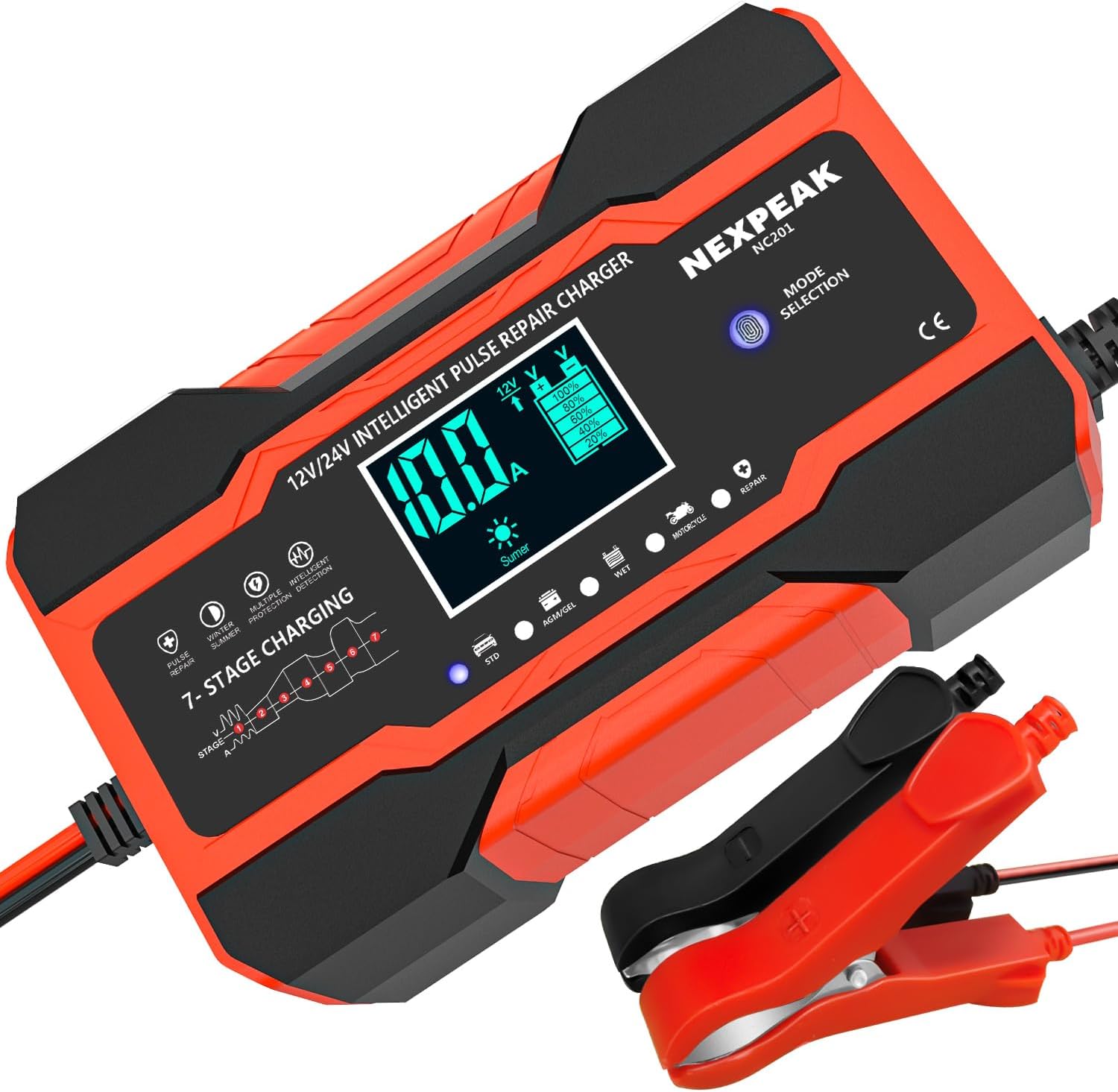
One of the most cost-effective options for quickly recharging a dead battery is the NEXPEAK NC201.If your battery is actually dead and you need juice immediately, a trickle charger won’t charge it. The NC201 quickly restores power.You can charge a dead battery in a matter of hours, not overnight, thanks to the 12-volt 10-amp output (5 amps at 24 volts).You may leave it plugged in all day long without worrying about overcharging it because of its 7-stage automated cycle that charges and maintains.
In conclusion, it has a desulfator and winter mode to keep it operational in cold weather and to restore sulfated batteries.Disadvantages: choose the right size because it has a maximum current limit of 15 amps. Turn off the engine. The structure is as simple as it appears.This is the best option for drivers looking for affordable charging power. Premium build and jumpstart are not compatible.
5: Battery Tender Plus 1.25A Charger & Maintainer

If your vehicle spends most of its time sitting, the Battery Tender Plus is the way to go for float maintenance.They kill their own battery while parked for weeks—a second car, a classic, a winter project. A+ prevents that.So that it remains charged for months, a 4-step approach first fully charges it and then maintains a safe float.The next thing is a fast-disconnect strap that you may fasten once and then use to quickly turn the charger on or off.
Finally, it’s small, totally automatic, and perfect for stowing away in the off-season.The 1.25 amps draw means it can only keep the battery charged and will not revive a dead one. Use just 12 volts. There is no show.Ideal for: occasional riders, those with vintage cars, motorcycles, or second cars. Not suitable for: rapid charging or recharging a dead battery.
4: Schumacher SC1280 12V/6V Charger & Maintainer

If you’re a motorist who values legibility in your charger, look no further than the Schumacher SC1280.A pair of flashing LEDs are usually all the charger leaves you to guess with. You can see everything that’s happening with the SC1280.First, there are no complicated LEDs to decipher; instead, a digital display gives you the rundown on the battery’s charge and voltage.The following is an automatic maintain mode with a 15-amp rapid charger that quickly charges a dead battery and keeps it there without risk.
At long last: built-in voltage detection for both 6-volt and 12-volt batteries, with charge selection controlled by a microcontroller.Disadvantage: larger than the little smart chargers. Only lead-acid, acid-gate, gel, and deep-cycle batteries are allowed.Turn off the engine.The ideal choice for regular drivers who value speed and a clear display is this model. Owners of lithium batteries or those seeking the smallest unit should not use it.
3: NOCO GENIUS5 5A Smart Battery Charger

This list’s top pick for a premium all-purpose smart charger is the NOCO GENIUS5.This is the next level, designed to accommodate all of your batteries for years to come.To start, there’s 5-amp charging, which is powerful enough to recharge but soft enough to keep in good working order for 6-volt and 12-volt batteries.Next up: a thermal sensor that automatically adjusts each charge based on the temperature, and lead-acid and lithium support.
Last but not least, a Force Mode may bring life to completely dead batteries—the kind that a standard charger would pass up—down to zero volts.Having more charger than necessary for basic top-ups is a drawback. Not a screen, but lights indicate status. Inbuilt, short cable.Ideal for: those who like to have a single high-quality charger for their vehicle, boat, or powersports batteries. Only for simple seasonal maintenance.
2: Clore Automotive PL2320 20A Smart Charger

For drivers seeking extreme power and professional-level adaptability, the Clore PL2320 is the ideal heavy-duty option.A tiny charger is insufficient for large trucks, deep-cycle, and marine batteries. With a secret weapon that its competitors don’t have, the PL2320 can lift huge objects.First, it has three different amp rates that you can choose from: 2, 10, and 20. Soak up some juice to keep things running smoothly, or punch out 20 amps to quickly charge a large battery.
After that, 6-volt and 12-volt batteries are securely charged using an automated multi-phase procedure that accounts for temperature.As a last point, your radio codes will remain intact even after switching batteries thanks to an integrated power-supply mode that maintains a constant voltage.Negatives: not as lightweight or compact as the regular choices. Without a lithium base. To much power for a single tiny vehicle battery.Auto electronics do-it-yourselfers, truck, RV, and boat owners will love it. One tiny battery is not enough.
1: Schumacher SC1281 6A Charger + 100A Engine Starter

In 2026, the Schumacher SC1281—the only all-in-one package that rescues and diagnoses—was ranked as the greatest automobile battery charger.All other chargers only tell you if the battery is charged or not. It can’t tell you if the alternator or battery is at fault when the engine won’t start.Firstly, a dead car can be started with a 100-amp engine start without the requirement for a second vehicle.Second, it has an integrated tester that will tell you if the charging system or the battery is malfunctioning, so you can fix the correct one.Thirdly, intelligent charging; going from 30 amps to 2 amps, gradually decreasing power from fast recharge to trickle.
Up next, we have a desulfation reconditioning mode, as well as compatibility for gas and diesel vehicles running on 6-volt and 12-volt systems.Negative: more cumbersome than a regular charger. There is no lithium; only lead acid. No, the tester isn’t a replacement for a professional mechanic’s opinion.Ideal for: drivers and do-it-yourselfers seeking a multi-function equipment for rescue, charging, and diagnosis. Reserved for those with minimal needs or who own lithium.
Things to Consider Before Buying a Car Battery Charger:
Charger types vary significantly, affecting how well they meet your needs. Understanding power requirements, compatibility with battery types, and additional features will guide your selection process, ensuring you choose the right charger for your vehicle.
Standard Lead-Acid and AGM Batteries
Standard lead-acid batteries and AGM batteries differ in design and usage. Both types require specific charging profiles, but AGM batteries can handle quicker charging rates.
Deep Cycle and Lithium-Ion Compatibility
Deep cycle batteries are suited for longer discharge periods, while lithium-ion batteries deliver high power in shorter bursts. Understanding these distinctions helps in selecting an appropriate charger.
Deep cycle batteries typically offer robust performance, ideal for applications requiring sustained energy. In contrast, lithium-ion batteries excel in applications needing rapid energy delivery. Each battery type’s charging needs vary significantly, impacting overall longevity and efficiency. Selecting a charger designed for each specific chemistry is important for maintaining battery health.
Voltage Output and Amperage Ratings
Voltage output and amperage ratings are key specifications affecting charger functionality. Ensure the charger matches your battery’s voltage to optimize charging efficiency and prolong battery life.
Charging Speed and Capacity Matching
Charging speed must align with battery capacity for optimal performance. Choosing a charger that delivers the right amperage prevents overcharging while maximizing battery recovery.
Matching charging speed with battery capacity not only enhances efficiency but also significantly extends battery life. By selecting a charger that operates within your battery’s optimal range, you minimize the risks of damage and ensure consistent performance over time. Make sure to read the specs carefully to find the best fit.
Automatic vs. Manual Operation
Choosing between automatic and manual operation depends on your preference for convenience versus control. Automatic chargers simplify the process by adjusting settings on their own, while manual chargers require you to monitor the charging process. Understanding your comfort level will help you select the right type.
Trickle Chargers vs. Fast Charging Units
Trickle chargers provide a slow but steady charge, ideal for maintaining battery health. In contrast, fast charging units deliver quick power but risk damaging certain batteries if used excessively. Your needs will dictate the best option, balancing speed with care.
Trickle chargers excel in long-term battery maintenance, delivering a low amp output that ensures batteries remain topped off without risk of overcharge. Fast charging units, while efficient for quick power-ups, can generate heat that may lead to battery degradation over time. Prioritizing battery health over speed will guide your choice.
Analyzing Your Vehicle’s Specific Power Demands
Determining your vehicle’s power needs ensures you choose the right charger. Review your owner’s manual for specifications, and note the battery type and size, which affect charging requirements and compatibility.
Verifying Safety Certifications and Build Quality
Assessing safety features is necessary for ensuring reliability. Look for recognized safety certifications such as UL or CE, indicating conformance to industry standards and minimizing risks associated with battery charging.
Strong safety certifications reflect a commitment to quality and precaution. Evaluate the build quality of the charger by examining materials and design; devices made from durable components are more likely to withstand wear and function properly over time. Prioritizing these factors helps prevent hazards like overheating or electrical failures during use.
Reverse Polarity and Spark Protection
Choose a charger with reverse polarity and spark protection features. This prevents accidental damage to your vehicle and the charger itself. Ensuring these functionalities help maintain safe operation during charging sessions.
Proper Storage and Cable Care
Store your charger in a dry, cool place away from direct sunlight. Avoid tight coils when organizing cables; instead, loop them loosely to prevent damage. Keeping everything organized promotes longevity.
Using storage containers or bags can further protect your charger and cables from dust and moisture. This practice prevents wear and tear, ensuring your equipment remains functional for future use. Check your charger regularly for any signs of deterioration or fraying in the cables to address issues promptly.
Conclusion
With these considerations in mind, evaluate your specific needs, the charger’s features, and compatibility with your vehicle. Assess the charging speed, safety features, and brand reliability. A well-informed choice ensures efficient charging and prolongs battery life, ultimately enhancing your vehicle’s performance.
Leave a Reply