
Finding the best coffee grinders is tough when cheap blades constantly ruin your morning ritual. To unlock real flavor from fresh beans, you need consistent precision. Stop settling for bitter, uneven brews and finally experience the sensational coffee you truly crave. We tested top-rated burr models to help you find the perfect upgrade for your daily routine. Here are the top picks for every budget.
Contents
- Top 5 Coffee Grinders:
- 1. Baratza Encore ESP – Best Coffee Grinder Overall
- 2. Breville Smart Grinder Pro – Best Coffee Grinder for Espresso
- 3. Baratza Encore – Best Coffee Grinder for Drip
- 4. OXO Brew Conical Burr – Best Coffee Grinder for Heavy Use
- 5. Cuisinart DBM-8P1 – Best Budget Coffee Grinder
- Things to Consider Before Buying a Coffee Grinder:
- Manual Grinders
- Electric Grinders
- Grind Size Consistency
- Capacity and Size
- Advantages of Manual Grinders
- Disadvantages of Electric Grinders
- Testing and Comparison
- Cleaning Instructions
- Troubleshooting Common Issues
- Final Words
Top 5 Coffee Grinders:
1. Baratza Encore ESP – Best Coffee Grinder Overall

To simplify your routine, the Baratza Encore ESP is a dependable all-around grinder that can cover espresso and filter coffee. You are beginning with a grinder that is known for dependable and repeatable results—a Baratza—because the brand is well-known in the specialty coffee industry, trusted by professionals, and recommended by major review sites.
For you, the most notable aspect is the dual-range adjustment system. The first 20 settings allow for more precise espresso fine-tuning with smaller micro-steps, while the next 21–40 move to macro-steps optimized for filter methods such as drip, pour-over, and others. That eliminates the need to fiddle with the grinder or guess the appropriate grind when switching brew methods.
On a daily basis, it’s also straightforward to use. Grind size is easily adjustable with a one-handed twist of the hopper. For rapid control, use the front pulse button. To grind hands-free, use the ON/OFF switch. Because of this, it is ideal for hectic mornings when you need a cup of coffee quickly.
Also, maintenance is easier. You can keep performance consistent and tastes clean without using any additional equipment because to the quick-release burr system, which allows you to remove the burr for cleaning without disassembling the entire grinder. The Encore ESP is a great addition to your routine if you’re excited to have greater control over your brew and improved flavor.
2. Breville Smart Grinder Pro – Best Coffee Grinder for Espresso

The Breville Smart Grinder Pro is designed to assist you in consistently grinding espresso shots, leaving you with true control and removing the element of guesswork from your morning ritual. Whether your schedule or your cravings vary, you can effortlessly choose between the 60 grind settings to make the perfect espresso.
The Dosing IQ system from Breville is one of the main benefits for you. You may achieve a consistent dosage from shot to shot by programming the grind time in exact 0.2-second increments. If you want to avoid waste beans during dial-in, improve the crema, or tweak the extraction, consistency like that is key.
Additionally, the grinder is compatible with many brewing processes. For espresso, you can either grind right into the portafilter or use a paper filter, a filter basket with a gold hue, or an airtight container. You won’t have to reset everything every time you adjust the grind size thanks to the pre-programmed settings.
The LCD screen makes everything easy to see and understand. You can always see what the grinder is doing thanks to the display that indicates your grind setting, grind time, and the amount of shots or cups you’ve selected. This way, you can achieve the same results tomorrow.
This provides accuracy, versatility, and a more streamlined daily workflow for espresso connoisseurs who desire a single grinder capable of handling several brewing types.
3. Baratza Encore – Best Coffee Grinder for Drip

The Baratza Encore is a reliable choice for home usage if you mostly utilize drip brewing and are looking for a grinder that is easy to operate, consistent, and has a straightforward design. For good reason, it’s one of Baratza’s best-selling models: it offers dependable burr grinding without taking up too much room on your counter, and the brand is well-known for its strong support in the specialty coffee community.
In terms of your regular schedule, the Encore maintains a minimalist approach. When you want more control, you may grind in short bursts with the front-mounted pulse button. Running a full grind is a breeze with the simple ON/OFF switch. That’s great for those mornings when you’re only partially awake, but you still want your coffee to have fresh grounds for a better taste and better balance.
Your growth will be greatly aided by the Encore’s range. You may adjust the 40 grind settings and 40mm commercial-grade conical burrs to suit your drip machine and your evolving tastes. Experiment with pour-over and French press brewing methods as well. Rather than being limited to a single “close enough” grind size, you have the freedom to experiment until you find the perfect grind for a consistent, sweet, and smooth cup of coffee.
If you’re looking to elevate your coffee-brewing experience from pre-ground beans or a blade grinder, the Encore is a reliable upgrade that will allow you to enjoy café-quality brews every day without sacrificing efficiency.
4. OXO Brew Conical Burr – Best Coffee Grinder for Heavy Use
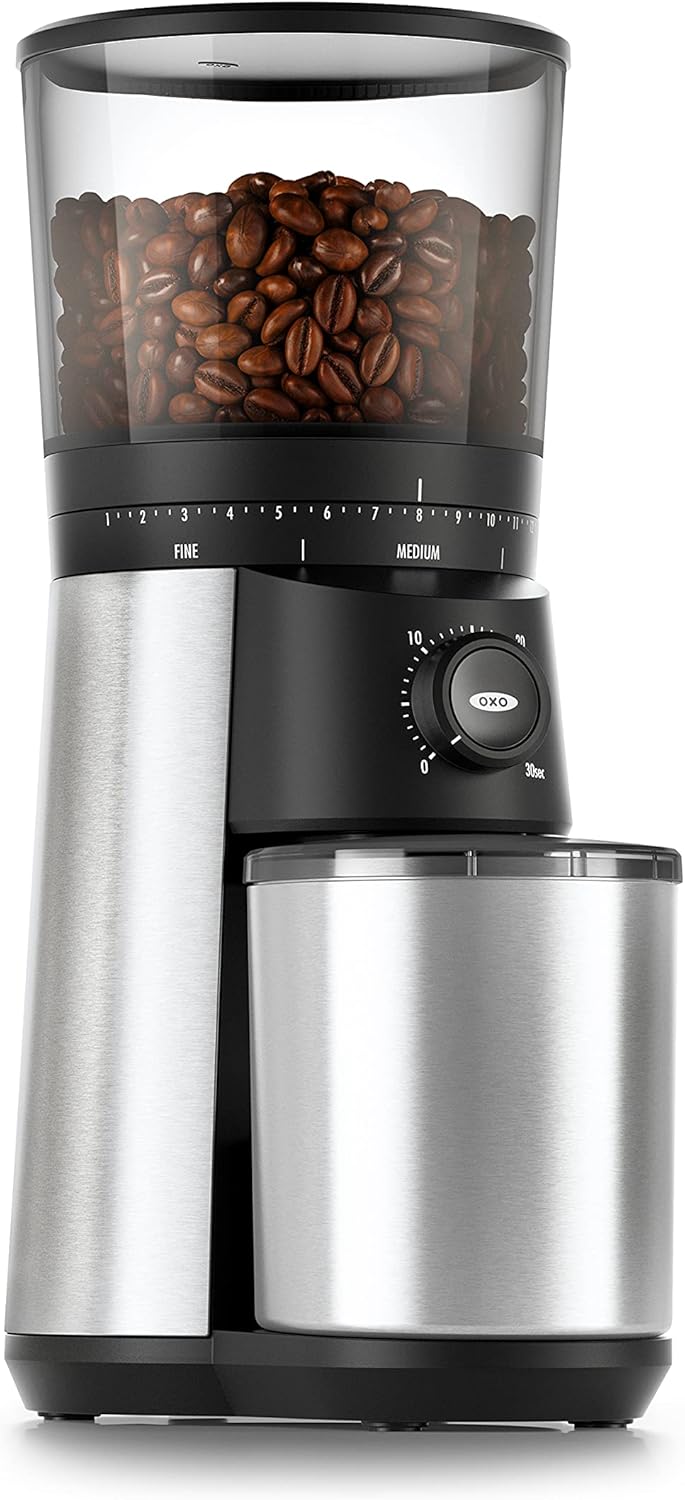
The OXO Brew Conical Burr can withstand daily (or even several times daily) grinding without making a mess. It’s a great choice for heavy-duty coffee grinders. Its conical burrs made of stainless steel grind more evenly, so the coffee tastes better overall and has less bitterness due to uneven grinding.
To ensure the perfect grind for your espresso, drip, pour-over, French press, or cold brew, you can choose from fifteen primary grind settings in addition to micro-adjustments. If you’re ever in the desire to try a different bag of beans or alter your brewing process, that adaptability will come in handy. And because it remembers your last setting, this grinder keeps your routine simple—just click the start button once to grind without having to reset everything.
The huge, detachable hopper can contain up to 12 ounces of beans, so it’s great for households that are always on the go or for those that brew coffee frequently. Even in well-lit kitchens, the UV-blocking hue can keep beans’ flavorful texture and color from fading. The static-fighting stainless steel container decreases cling, so grounds pour out neatly instead of clinging and scattering, and a trap door helps keep beans from spilling when you remove the hopper, both of which are minor elements that OXO adds to make daily use simpler.This grinder is an indispensable tool for anyone who values reliability, ease of use, and minimal mess when preparing their morning coffee.
5. Cuisinart DBM-8P1 – Best Budget Coffee Grinder

The Cuisinart DBM-8P1 is an excellent substitute for a cheap blade grinder if you’re looking to enhance the taste and consistency of your coffee without breaking the bank. With its 18-position slide-dial selection and flat burr design, you can tailor the grind to your preferred brewing method. Having that additional control allows for a more consistent extraction, which in turn produces coffee with less bitterness and more body.
It’s designed to be easy to use on a daily basis. Because the 8-ounce bean hopper and chamber are completely detachable, cleaning is a breeze and refilling is a breeze. Because coffee grounds and oils can degrade flavor over time, it’s important to keep the components clean. This design makes it easy to do so without requiring a disassembly.
Depending on your preferred brewing method, the replaceable grind chamber can carry enough ground coffee to make 4 to 18 cups of coffee. A “cup” is around 5 ounces. You won’t have to ground the beans in many tiny batches, which is great for when you’re making coffee for a large group or when you’re preparing food for a party.
Grind time comes and goes with no fuss. The built-in timer turns off the grinder automatically when the cycle is over; all you have to do is touch the power bar to start and stop the cycle. That way, you won’t have to worry about the grinder first thing in the morning and you’ll have a more regular schedule.
Things to Consider Before Buying a Coffee Grinder:
Just assess how you brew and how much control you need: choose burr over blade for consistent grind sizes, check grind settings for your preferred methods, consider capacity and motor speed to avoid heat buildup, weigh build quality, ease of cleaning, noise level and maintenance costs so your grinder fits your routine and delivers consistent results for years.
Manual Grinders
If you favor control and portability, manual grinders let you grind with minimal heat and low retention; many conical-burr handmills deliver 10-20 g per minute and offer stepped or stepless adjustments so you can dial in espresso or filter. You’ll often see ceramic burrs for longevity, and models like the Porlex Mini or Hario Skerton reliably produce single-serve doses with consistent results during travel or low-volume use.
Electric Grinders
If you prepare multiple cups or need speed, electric grinders handle larger doses-consumer models can output 100-120 g/min and commercial units far more-while offering timed doses, grind-by-weight, and quick switching between settings. You should compare conical versus flat burr geometry, motor wattage, and whether the machine is doserless for cleaner transfer to portafilter or bag.
When evaluating electric options, pay attention to burr size (40 mm is common for home use, 50-65 mm for pros), retention (aim for under ~3 g if you dial espresso), and whether the grinder uses stepped clicks or stepless micrometrics for adjustments; stepped is repeatable for brewed methods, stepless gives micro-tuning for espresso. You’ll also consider burr material-hardened steel lasts longer, ceramic resists corrosion-and features like timed dosing, weight-based dosing, and sound levels when mapping to your daily workflow.
Grind Size Consistency
You want a grinder that produces uniform particles because extraction hinges on distribution; variance of a few clicks can shift brew time and flavor. Many home burr grinders offer 40-60 discrete steps or stepless micro‑adjustment for espresso‑level tuning, and review labs compare particle‑size distribution to rank models. If you pursue reliable espresso, prioritize units with tight adjustment increments and low fines for predictable shots.
Capacity and Size
You should match hopper size and footprint to your routine: home hoppers commonly hold 100-300 g, prosumer models 400-800 g, and commercial units exceed 1 kg. Compact grinders are roughly 15-20 cm wide and fit under cabinets, while larger doserless or flat‑burr machines require 25-30 cm of counter space and add 2-4 kg of weight for stability.
If you brew 1-2 cups daily (10-36 g of beans), a 100-200 g hopper keeps beans fresher and reduces waste; for households or offices brewing 500 g+ per day, a 500-1,000 g hopper or commercial doserless grinder prevents constant refilling. Also check portafilter clearance-many home grinders leave 60-70 mm from chute to counter-so verify measurements if you grind straight into a basket. Larger grinders often trade portability for heavier flywheels that stabilize output and reduce retention.
Advantages of Manual Grinders
You get exceptional control with a manual grinder: top-tier models like Comandante or 1Zpresso deliver uniform particle distribution suitable for pour-over and, in many cases, espresso. They typically cost $80-$300, weigh 300-700 g, and let you produce a 20 g dose in roughly 20-40 seconds depending on burr size. Because they run at very low speed, you’ll see minimal heat and often under 1 g retention, which benefits freshness and single-origin clarity.
Disadvantages of Electric Grinders
You should consider noise, heat, and consistency issues: many budget electric grinders run burrs at high RPMs (often >1,500-3,000 RPM), which can increase fines and raise bean temperature by several degrees during long grinds, altering flavor. Additionally, cheaper motors and burr alignment lead to variable particle size-problematic if you need repeatable espresso shots or precise pour-over profiles.
Digging deeper, motor type and RPM matter a lot: low-speed gear-driven motors (~100-500 RPM) and direct-drive designs reduce heat and static, while high-speed AC motors push throughput at the cost of clarity. You’ll also encounter differences in burr diameter-50-83 mm burrs scale better for espresso and café volume, whereas 38-48 mm burrs suit portable or low-volume use. Finally, expect more maintenance with electric units: burr replacement, recalibration, and occasional motor service factor into lifetime cost and performance.
Testing and Comparison
You should run side-by-side tests with the same beans and doses: weigh 18-20 g for espresso or 15 g per 250 ml for pour-over, grind for identical brew times, and taste for balance and clarity. Note shot timing (25-30 s espresso) and pour-over brew time (2:30-3:30). Track retention grams and how repeatable settings are between sessions.
Cleaning Instructions
Use a stiff brush after each use to clear grounds from the burrs and chute, and empty the hopper weekly to avoid stale oils. Deep-clean by disassembling per the manual every 1-3 months; run a manufacturer-approved cleaner (e.g., Grindz) every 2-4 weeks if you use oily beans. Avoid submerging burrs in water unless allowed, wipe with a microfiber cloth, and vacuum crevices. Check burr alignment and wear every 6 months and plan replacements every 1-5 years depending on your volume.
Troubleshooting Common Issues
When you see inconsistent grind size, first clean the burrs and make micro-adjustments of 1-2 steps; test with a few doses. If static flings grounds, tap the chute, wipe with a slightly damp cloth, or try a short run of wetter-roasted beans. Should the motor overheat, limit continuous runs to under 60 seconds and allow 10-20 minutes to cool. If it won’t start, verify power, hopper lock, and safety switches, then clear any jam.
If your espresso shots extract too fast or too slow, adjust the grind one notch at a time and pull 3 consecutive shots to evaluate-aim for 25-30 seconds for a standard single/double extraction. For persistent clogging from oily beans, run one packet of grinder-cleaner per directions then purge 20-30 g of beans to clear residue. Excessive noise often signals misaligned or worn burrs; measure output consistency and contact support if alignment checks fail. Track changes and document settings so you can revert after fixes.
Final Words
Following this, you should weigh grind consistency, burr vs blade designs, and how grind range matches your preferred brew method; consider capacity, motor speed and heat generation, build quality and durability, ease of cleaning and adjustments, noise level, and whether features like timed dosing or stepless adjustment benefit your routine; balance these against your budget and space so you get a grinder that reliably delivers the flavor and convenience you value.
Leave a Reply