
Finding the best garage heaters is crucial when winter temperatures finally drop. Don’t let a freezing workshop numb your fingers or crush your motivation to build. You deserve a comfortable space to tackle your projects all season long. We identified powerful heating solutions that will instantly transform your icy garage into a toasty haven. Let’s fire up the warmth with these top-rated picks.
Contents
- Top 5 Garage Heaters:
- 1. Briza Infrared Electric Heater – Best Garage Heater Overall
- 2. Mr. Heater Big Buddy – Best Portable Propane Garage Heater
- 3. Dewalt Hybrid Portable Heater – Best Versatile Garage Heater
- 4. Heat Storm Wifi Infrared Heater – Best Smart Garage Heater
- 5. Comfort Zone CZ220BK – Best Budget Garage Heater
- Things to Consider Before Buying a Garage Heater:
- Electric Heaters
- Gas Heaters
- Infrared Heaters
- Insulation Quality
- Heater Efficiency
- Propane Heaters
- Infrared Heaters
- Intended Use
- Read Consumer Reviews
- Safety Precautions
- Conclusion
Top 5 Garage Heaters:
1. Briza Infrared Electric Heater – Best Garage Heater Overall
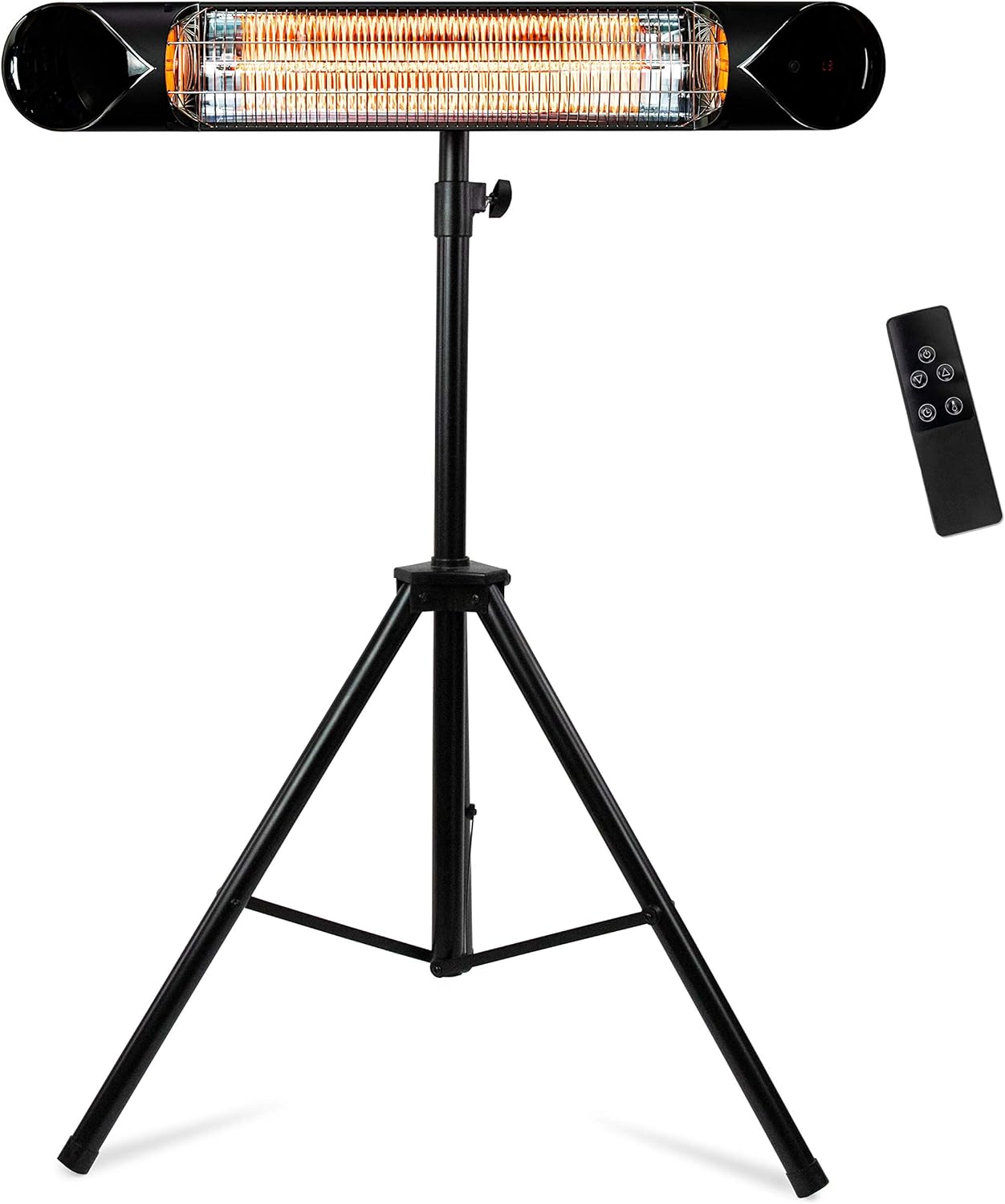
The versatile Briza Infrared Electric Heater is perfect for use any time of year and is a dependable option for quickly warming up your garage without the trouble of permanent installation. You can use the provided hardware to mount it on a wall or ceiling, or you can use the adjustable tripod platform to set it up anywhere you need portable heat.
The control is easy to use and very practical. So you don’t have to interrupt what you’re doing simply to change the temperature, the remote allows you to turn the heater on or off, change the heat level, and set the timer. Whether you’re working on a fast project or spending hours in the garage, you can easily dial in comfort with the three heat settings (900W, 1200W, and 1500W).
Instead of depending solely on blowing hot air, the Briza makes use of carbon infrared technology, which warms things and surfaces more directly, much like the sun’s radiant heat. A tip-over sensor cuts power to the device in the event of a fall, further reducing the possibility of a fire, because it was designed with safety in mind.
The IP55 certification ensures that it can withstand dust, rain, and other harsh environments, making it ideal for usage in covered outdoor spaces such as garages, sheds, and workshops. Plus, it has an integrated timer that lets you set it and forget about it; after 1–9 hours, it will turn off automatically.
2. Mr. Heater Big Buddy – Best Portable Propane Garage Heater

The Mr. Heater Big Buddy is an adaptable propane heater that can provide significant heat without requiring permanent installation; it is perfect for use in garages and other similar spaces. You won’t have to blast full blast when a little boost will do the trick thanks to the three different BTU options (4,000, 9,000, or 18,000). With an enclosed space heating capacity of up to 450 square feet at its highest setting, it is an excellent choice for cold work areas such as garages and workshops.
You can also save time and effort during setup with this bundle. An additional brass propane tank refill adapter and a 10-foot propane hose assembly are included with the heater, allowing you greater freedom of movement when it comes to fuel connections and heater placement.
It is simple to use. With its fold-down handle, swivel-out fuel connection, and easy-start four-position control, you can swiftly change output and make hook-ups a breeze. Quickly feel the warmth as you work thanks to a broad heating surface that helps create intense radiant heat.
Ensuring safety is also our top priority. Both the built-in Oxygen Depletion Sensor (ODS) and the tip-over detection feature work together to turn off the device in the event that the oxygen levels drop too low. If you’re looking for a heater that is both dependable and portable, with handy safety features, this one is perfect for you.
3. Dewalt Hybrid Portable Heater – Best Versatile Garage Heater

The DEWALT Hybrid Portable Heater is an excellent choice if you need a heater for your garage that can adapt to your working environment. You can use the 20V MAX battery while you’re on the go or not near an outlet, and then switch to 120V AC power when you’re stationary and need a steady stream of juice. So, you won’t have to rethink your entire system to accommodate a single power source—you can concentrate heat where it’s needed.
This heater is designed to be more aesthetically pleasing, which is important when you’re attempting to maintain concentration. If you’re concerned about background noise while you’re working, DEWALT has developed Quiet Burner Technology, which can cut down on noise by as much as half compared to competing models. If your heater has ever been too noisy for you to concentrate on your job, this is a sensible update for you.
The bundle also includes safety measures. In addition to a thermoelectric safety valve, factory-installed high-limit switches aid in the prevention of overheating. That way, you can feel comfortable and confident, even in hectic workplaces.
The 10-foot hose and regulator are designed to be factory-matched, making setup a breeze. This allows you to connect the heater fast and keep it positioned where it is most practical. Its well-ventilated design makes it ideal for places like garages, barns, warehouses, workshops, and construction sites where you need reliable heat on the go without a lot of fuss.
4. Heat Storm Wifi Infrared Heater – Best Smart Garage Heater
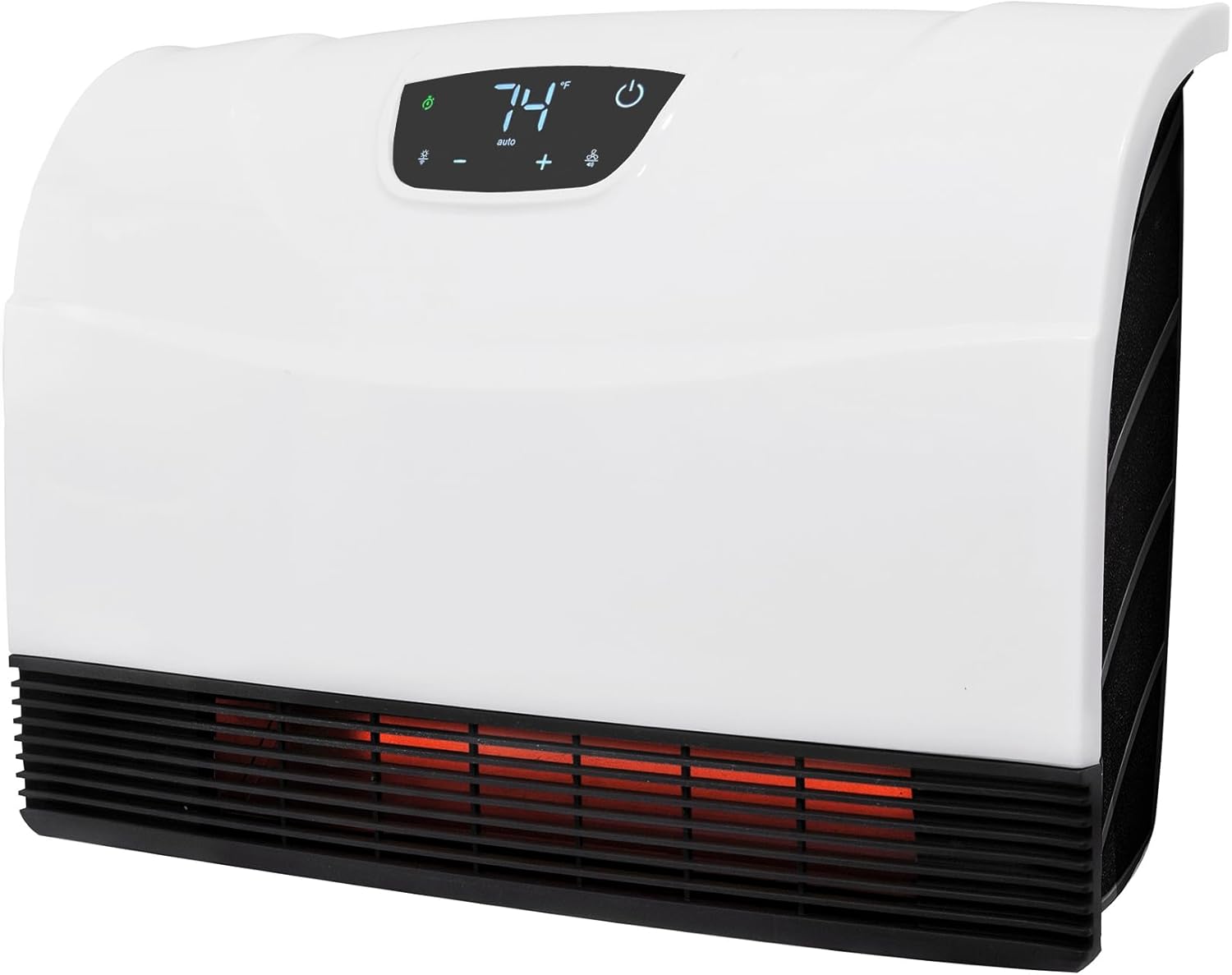
The Heat Storm WiFi Infrared Heater is perfect for the “smart” home because it is contemporary, compact, and easy to use from any location. If you want the garage to be warm before you come in or if you want to lower the temperature without stopping what you’re doing, you can regulate it from your phone thanks to its Wi-Fi capability.
Because it is wall-mounted, you won’t have to cram a big heater next to your tools, workstation, or storage, freeing up valuable floor space. Use it indoors in places like kitchens, bedrooms, workplaces, or garages; it operates on regular 110V power. When you put it above an outlet, you can conceal the cord within the heater for a cleaner, more finished look. The cord management is a handy addition.
The controls are simple and quite versatile. A digital thermostat with a touchscreen and a remote allow you to make quick adjustments from a distance. The unit has a built-in safety feature that turns off if it tips over, and it stays cold to the touch—even the grill—to help minimize the danger of burns in high-traffic areas.
It comes with washable filters, which reduces maintenance and improves the heater’s performance over time. In terms of space-saving and user-friendly operation, this Heat Storm model is an excellent choice for an infrared heater that is wall-mounted.
5. Comfort Zone CZ220BK – Best Budget Garage Heater

The Comfort Zone CZ220BK is an affordable option for garage heaters that are meant to mount overhead and perform efficiently in busy locations, all while saving floor space. When your garage, warehouse, or storage area is already crowded with tools, shelves, or equipment, its ceiling-mount, hardwired installation is a great choice because it doesn’t take up any room on the ground.
It is also suitable for use in a workshop because of its durability. The housing, made of heavy-gauge steel, can withstand harsh conditions and the extreme temperature changes that result from inadequate insulation. Its sturdy build ensures it will endure the cold mornings and warm afternoons that your garage experiences.
As an added bonus, you won’t have to worry about heating the entire space uniformly unless you really want to. You can direct the airflow toward your workbench, parking area, or any spot where you spend the most time thanks to the adjustable louvers and variable installation angle. Instead of having a hot spot and a cold spot, the room will be warmer all the way through thanks to the fan-forced design’s effective heat distribution.
The control is simple. Quick on/off functionality and a dual-knob thermostat make it easy to dial in comfort regardless of the weather, and the latter also eliminates the need for confusing menus. Plus, it has a cool-touch exterior and overheat protection, so you can use it with confidence in a hands-on setting.
Things to Consider Before Buying a Garage Heater:
Many factors – garage size, insulation, heating type, ventilation, and electrical or fuel capacity – determine which heater suits you best; evaluate how you use the space, desired warm-up speed, efficiency, noise, safety features, and installation costs, and choose between forced-air, infrared, or convection units while verifying clearances, local codes, and ongoing operating expenses to protect your tools, vehicles, and comfort.
Electric Heaters
You’ll find electric garage heaters are simple to install, often hardwired or plug-in, and deliver predictable output-1,500 W (~5,100 BTU) models suit up to ~100 sq ft while 4,500-5,000 W units can handle 300-500 sq ft; pay attention to breaker capacity, and expect quiet operation with near-instant warm-up for intermittent use.
Gas Heaters
You can rely on natural-gas heaters for whole-bay warmth where a gas line exists, with typical outputs of 30,000-100,000 BTU giving fast recovery and lower running costs per BTU than electricity; verify venting or direct-vent models and required clearances before buying.
Installation requires a licensed gas hookup, correct venting or sealed-combustion design, and adherence to code clearances-models with direct-spark ignition avoid standby pilot flame and improve efficiency, and choosing the right BTU per square foot (roughly 40-60 BTU per sq ft for uninsulated garages) will prevent under- or oversizing.
Infrared Heaters
You’ll get direct radiant warmth from infrared heaters that heat people and objects instead of the air, making them efficient for spot heating workbenches or partially open garages; a properly aimed 1,500-5,000 W infrared unit can provide comfortable warmth in a 100-300 sq ft zone while reducing perceived chill.
Because infrared reduces convective losses, you’ll save energy for intermittent tasks and avoid long warm-up times; position fixtures to cover work areas, account for distance (effective range often 6-12 feet), and combine with a supplemental system if you need whole-space comfort.
After evaluating BTU/W requirements, fuel availability, installation cost, and whether you need spot versus full-bay heating, choose the system that matches your garage size, ventilation options, and how you use the space.
Insulation Quality
If your walls and ceiling are insulated to R-13 or better and your garage door has an R-value above R-6, you’ll need far less heat than an uninsulated space. Evaluate gaps around doors and windows, since air leakage can dominate heat loss even with decent insulation.
Upgrade options that deliver big returns include insulating the garage door with foam panels, adding weatherstripping, and sealing rim joists; typical improvements can cut heat loss by 20-40%. Target R-13 in walls and R-30 in ceilings where practical, and test blower-door or infrared scans to find major leaks before upsizing your heater.
Heater Efficiency
Compare AFUE for gas units and input-to-output for electric heaters: gas furnaces can reach 80-95% AFUE, while electric heaters convert nearly 100% of energy to heat at the point of use. Also consider modulating burners, variable fans, and smart thermostats, which can reduce fuel use by 10-30% in real operation.
Translate ratings into operating cost by using energy content: 1 kW equals 3,412 BTU/hr, so a 1.5 kW space heater produces ~5,118 BTU/hr; for gas, check BTU input versus AFUE to find usable heat. Run the math with local energy prices to compare lifecycle costs rather than just sticker efficiency.
Propane Heaters
You’ll appreciate propane heaters for jobsite flexibility and a wide BTU range (typically 9,000-60,000 BTU). They’re useful where natural gas isn’t available, but you’ll manage tank swaps and higher per-BTU fuel costs; ensure adequate ventilation and choose models with tip-over and low-oxygen shutoffs for indoor use.
You can expect a common 20-lb cylinder to run a mid-sized propane heater for several hours-often in the 6-12 hour range depending on BTU output-so plan refills accordingly. Additionally, keep tanks outside when possible, mount heaters to avoid obstructions, and follow manufacturer run-time charts to avoid surprises.
Infrared Heaters
You’ll get direct radiant warmth from infrared units that heat people and surfaces rather than the air, making them efficient for spot heating in drafty garages or open bays. Typical units range from 1,500W for small benches to 4,000-6,000W for larger work areas, and they deliver fast comfort without waiting to warm the whole volume of the space.
You should distinguish near- and far-infrared models when selecting one: far-infrared can reach 20-30 feet and is better for heating larger workstations, while short-wave units offer immediate, intense heat for close-up tasks. Positioning matters-aim beams at the work area and avoid blocked lines-of-sight for consistent performance.
Intended Use
If you use the garage as a workshop with power tools, prioritize steady ambient heat and circulation-forced-air or unit heaters with fan controls work well; for hobby benches or quick tasks, infrared panels that heat objects directly are more efficient. For example, a 4,000W infrared can noticeably warm a 400 sq ft area in 10-15 minutes, while a unit heater may take longer to raise ambient air temperature.
When you weld, paint, or store temperature-sensitive items, control humidity and ventilation: gas heaters add combustion moisture and require exhaust, while electric infrared does not. If you spend long shifts in the space, you should add a programmable thermostat and consider zone heating-case studies show workshops using targeted infrared reduced energy use by 20-30% compared with whole-space electric heating.
Read Consumer Reviews
You should filter reviews by verified purchases and recent dates, scanning for repeated issues like thermostat failure, noisy fans, or short warranties. Pay attention to photos and user-supplied runtime data (months/years) to gauge long-term reliability rather than single-instance praise or complaints.
Dig into the distribution of ratings: if more than ~15% of reviewers cite the same mechanical failure within two years (thermostat, fan motor, or ignition), that pattern is a red flag. Also check service experiences-how quickly the manufacturer honored warranty claims-and note models with consistent low-noise reports if you plan a workshop near the heater.
Safety Precautions
You must install a working carbon monoxide (CO) alarm near the garage entry and on every level of your home because CO is colorless and odorless. Use GFCI-protected outlets for electric heaters and avoid extension cords-typical 1500 W portable heaters draw about 12.5 A at 120 V. Never operate unvented combustion heaters in a closed garage; store flammable liquids at least 10 ft (3 m) away and maintain the manufacturer-specified clearances.
If you smell gas, evacuate immediately, avoid switching lights or using phones inside the garage, and call the gas company or emergency services from a safe location. Have a qualified technician perform annual combustion-efficiency and CO output checks and tighten or replace gas fittings as needed. Keep manufacturer manuals, service receipts, and replacement-part timelines accessible so you and any technician can make informed, timely decisions.
Conclusion
Summing up, you should assess the size and insulation of your garage, heating capacity and energy efficiency, fuel type and installation costs, safety features, airflow and placement, and maintenance requirements; choose a model that matches your budget, climate, and intended use to ensure reliable, efficient warmth and long-term value.
Leave a Reply