
Best Grain Mills help home bakers get fresher, healthier flour and stop paying for bland store-bought bags. Our hands-on testing and clear buying tips spotlight top flour mills and grain grinders so you can save money, boost flavor, and bake with confidence. You’ll love the amazing, life-changing smell of warm bread made from freshly milled wheat berries. Ready to pick the right mill? Let’s dive into the top choices.
Contents
- Top 7 Grain Mills:
- 7: LEJIEYIN 150g High Speed Electric Grain Mill
- 6: Victoria Manual Cast Iron Grain Mill 2400g with High Hopper
- 5: Kitchen Crop Hand Crank Grain Mill Wheat Flour Grinder
- 4: LEJIEYIN 750g High Speed Electric Grain Mill Grinder
- 3: Coolcook Grain Mill Attachment for KitchenAid
- 2: Kitchen Mill Electric Grain Mill
- 1: NutriMill Harvest Electric Stone Grain Mill, 450 Watt
- Things to Consider Before Buying a Grain Mill:
- Impact Mills vs. Burr Mills
- Manual Hand-Crank Models for Off-Grid Use
- Micron Range and Flour Fineness
- Noise Levels and Motor Durability
- Superior Flavor and Nutrient Density
- Countertop Footprint and Upfront Expense
- Identifying Your Weekly Volume Requirements
- Verifying Grain Versatility and Limitations
- Routine Cleaning and Clog Prevention
- Optimal Storage Conditions for Whole Grains
- Summing up
Top 7 Grain Mills:
7: LEJIEYIN 150g High Speed Electric Grain Mill

The most cost-effective method to experiment with homemade flour—the LEJIEYIN 150g High Speed Grain Mill.Interested in trying freshly milled flour but can’t justify shelling out hundreds? This small grinder puts an end to it.At 22,000 RPM, there is a 900-watt motor. Dry maize or wheat can be ground into a powder in less than a minute using three stacked blades.Next up: a fineness of 50 to 300 mesh. To get finer flour, run it longer. To get coarse meal, run it shorter.
As a last point, overload protection. If you press down too firmly, power will be taken off until you hit reset.Downside: there are a lot of rounds per loaf because the 150-gram jar is so small. A five- to ten-minute break should be provided in between sessions. Burrs provide more uniform grinding than blades.Recommend to: inquisitive beginners and those who want to bake in smaller batches. Avoid: people who bake bread every week.
6: Victoria Manual Cast Iron Grain Mill 2400g with High Hopper

The long-lasting, top-rated, and power-free Victoria Manual Cast Iron Grain Mill.When the electricity goes out, electric grinders stop working. Your arm is all that the Victoria needs to run.The first is the use of double-plated tin on heavy-duty cast-iron. There is no electricity to fail or motor to overheat.Up next: a set of adjustable-screw white iron grinding disks. Secure for finer cornmeal or masa, and loosen for other types.The set concludes with a rubberized grip and a clamp that can hold tables as thick as two inches.
Downside: you’ll need a lot of strength and time to hand crank enough flour to make a loaf. When compared to real bread flour, the grind produced by cast iron plate mills is coarser.Who it’s best for: people who make cornmeal or masa, those who live in off-grid kitchens, and those who like rustic baking. Not for: those looking for quick batches or fine pastry flour.
5: Kitchen Crop Hand Crank Grain Mill Wheat Flour Grinder
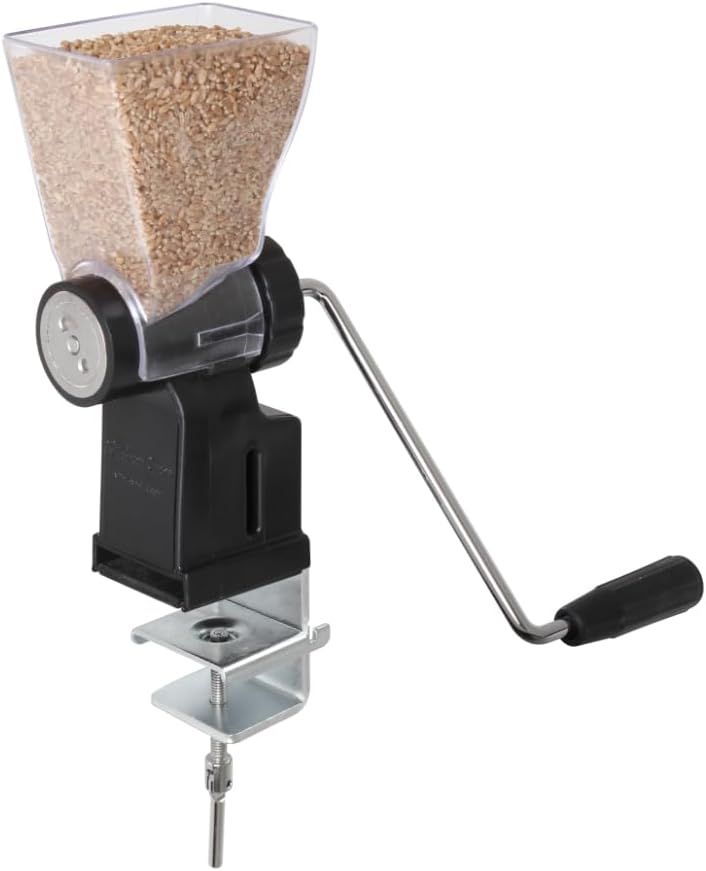
If you have a tiny kitchen and just need to grind a few grains at a time, the Kitchen Crop Hand Crank Grain Mill is the way to go.Heavy and coarse, cast iron mills produce ground material. Lighter and more accurate is the Kitchen Crop.An adjustment dial is located on the first set of stainless steel burrs. Flour made from wheat, rye, oats, and other grains can be transformed from coarse cracked cereal to fine bread flour.
Second, it is less than three pounds in weight. Secure it with a clamp and put it away.Last but not least: you can buy an electric drive motor separately if you want. Starting cranking, then motorizing.Downside: you’ll have to reload the two-cup hopper quite a bit. It takes a long time to spin out fine flour by hand. It won’t work with oily seeds, and the motor is expensive.Ideal for those who bake from home sometimes or in small apartments. No, it’s not designed for big families or frequent grinding.
4: LEJIEYIN 750g High Speed Electric Grain Mill Grinder

For larger quantities that do not require cranking, the LEJIEYIN 750g High Speed Electric Grain Mill is the ideal inexpensive option.Hand mills are exhausting. Instead than using muscle, this one uses raw motor power.Starting with a 2,000-watt motor running at 25,000 RPM. In less than a minute, three blades may crush an entire jar.The next one has a capacity of 750 grams, which is five times that of the 7-number pick’s jar. Makes one loaf of bread from the grain.
Last but not least: overload protection and food-grade stainless steel construction. It can process coffee beans, spices, cereals, and herbs.Downside: you have to wait five to ten minutes in between uses. Once you fill it up past two-thirds, the grinding won’t be uniform.The texture is time-dependent; there is no grind setting.Spice grinders and thrifty bakers who want a lot would love this. Avoid if you’re a baker who values consistent flour texture.
3: Coolcook Grain Mill Attachment for KitchenAid

If you possess a stand mixer and are a baker, you should get the Coolcook Grain Mill Attachment for KitchenAid.On your counter, you already have a powerful motor. This add-on activates the mixer.It is compatible with every single model of KitchenAid stand mixer. Put it into the power outlet; you won’t need any tools or an additional motor.What follows is a list of nine different grind settings. Level one represents extremely fine powder, and level nine represents coarse broken grain.
At last, a 10-cup capacity per session die-cast aluminum body made entirely of metal.Downside: a KitchenAid mixer is required for its use. When you finish a long workout, give it a 30-to 45-minute break. Your best bet is to start on the coarsest setting and work your way down; even that can become clogged.Who it’s best for: People who own KitchenAid appliances and those who bake bread from time to time.Avoid if you don’t have access to a mixer or often grind grains in large quantities.
2: Kitchen Mill Electric Grain Mill

The ideal option for quickly processing large quantities of grain is the Kitchen Mill electric grain mill.Pounds of flour are required weekly for family baking. A specialized, high-speed flour mill, the Kitchen Mill is perfect for busy kitchens.One, you can make 24 cups of whole-grain flour in less than 10 minutes with a 1,000-watt motor. A week’s worth of bread, ground just before the oven gets hot.Up next: a 304-grade stainless Our micronetic milling chamber is designed to be gum-, jam-, and glaze-proof. Beans, rice, wheat, and maize are all good for it.
Last but not least: it’s small, with a transparent pan and a weight of around 8 pounds and a length of about 10 inches.The noise level of impact mills like this is notoriously high. It’s not designed for coarse cereals or broken grain, but rather flour. Separate the grains.Ideal for: folks who bake bread in bulk and have a big family. Avoid if you live in a quiet neighborhood or prefer coarse flour for your baking.
1: NutriMill Harvest Electric Stone Grain Mill, 450 Watt

Built to withstand the rigors of everyday countertop use, the NutriMill Harvest Electric Stone Grain Mill is the finest grain mill for home bakers.Metal is used by every other mill in this area to crush, shear, or cut grain. Mills have been using this method between stones for generations, and the Harvest is no exception.First, the Grainmaster milling stones made of corundum, which are nearly as hard as diamonds. Flour that is soft and fine is highly prized by traditional bakers.
Next, there’s a texture control knob that has a patent. No more guesswork: just twist the dial to the fine setting for bread and pastry flour, and back to the cracked grain setting.Third, a heavy-duty motor with an automatic shutoff feature and 450 watts of power. It safeguards itself if it gets too hot.Lastly, the body is made in the USA using bamboo and aluminum. It’s the kind of mill that should be left out, not hidden.Downside: this mill is the priciest one in the area. The 18.7-pound weight makes it stable. We only accept dry, non-oily grains.Those who mill many times a week and those who prepare bread frequently would benefit most from this. People on a tight budget or who aren’t very good bakers should definitely pass.
Things to Consider Before Buying a Grain Mill:
Choosing the right grain mill can significantly enhance your home milling experience. Factors such as milling capacity, grain type compatibility, and ease of use should inform your decision. Understanding these elements will help you select a mill that meets your specific needs and preferences.
Impact Mills vs. Burr Mills
Two significant types of grain mills include impact mills and burr mills. Impact mills, utilizing high-speed blades, are designed for quick grinding and can handle a variety of grains, though they may generate heat that can alter flavor. Burr mills, on the other hand, crush grains between two surfaces, providing a more consistent flour texture. Many bakers prefer burr mills for their ability to offer finer control over the grind quality, influencing end-product textures.
Manual Hand-Crank Models for Off-Grid Use
For those living off the grid, manual hand-crank models serve as a reliable milling solution. These mills do not require electricity, making them perfect for rural settings where power may be inconsistent. Typically lighter and more portable, they allow for versatile use, such as milling during camping trips. Many users appreciate their simplicity and lower cost, while still delivering satisfactory performance with minimal maintenance needs.
Micron Range and Flour Fineness
Flour fineness, measured in microns, can significantly impact the quality of your baked goods. A lower micron range produces finer flour, which can be beneficial for certain recipes, such as pastries and cakes. Many home mills offer various settings to achieve the desired fineness, allowing you to tailor your flour to specific baking needs. Consider models that provide precise control over micron settings for consistent results in your culinary endeavors.
Noise Levels and Motor Durability
Noise levels during operation can affect the overall milling experience. Quiet motors usually make the process more pleasant, particularly in residential settings. Look for grain mills with motor durability to ensure longevity; some models boast lifetime warranties or superior motor construction. Investing in a quieter, more robust motor not only enhances your kitchen environment but also ensures reliable performance over time.
Superior Flavor and Nutrient Density
Flavor and nutrient density often surpass commercially milled grains when choosing home milling. Freshly ground flour retains essential oils and nutrients that diminish during storage. For example, whole grains can lose significant nutritional value over a few weeks of sitting on store shelves. Grinding at home can also allow for immediate use, preserving flavor and maintaining a higher level of vitamins and minerals in your baked goods, leading to both tastier and healthier meals.
Countertop Footprint and Upfront Expense
Initial investment in a home grain mill varies significantly, influencing the decision for many. Quality mills can range from a few hundred dollars to over a thousand, which may strain a tighter budget. Moreover, these machines can occupy valuable kitchen counter space, especially in smaller kitchens. While the long-term savings and benefits can justify the cost, the upfront expense often causes hesitation among potential buyers considering their kitchen layout and budget constraints.
Identifying Your Weekly Volume Requirements
Estimate your weekly grain usage to determine the appropriate mill capacity. Smaller mills, often handling one to two pounds per batch, suit occasional home bakers. If your household consumes a significant amount of whole grain products or engages in regular baking, a mid-sized mill would be more efficient, offering a capacity of five to ten pounds at a time. Knowing your needs will help streamline the milling process, ensuring that you do not run out of freshly milled flour when you need it.
Verifying Grain Versatility and Limitations
Investigate the types of grains your potential mill can handle, as not all mills manage every grain effectively. Some models may excel with wheat yet struggle with harder varieties like corn or grains with high oil content, like flaxseed. Evaluating the mill’s specifications is necessary to confirm its performance across a range of grains. Selecting a versatile option allows for a broader array of grains in your pantry, promoting a varied and nutritious diet.
Routine Cleaning and Clog Prevention
Maintaining cleanliness is essential for optimal performance. After each use, thoroughly clean the milling chamber and any components that come into contact with grains. Utilize a soft brush to remove residual flour and debris, preventing clogs during subsequent use. Regularly checking for buildup ensures consistent grinding quality, so schedule cleaning every few uses, especially if milling sticky or oily grains. Use a vacuum to reach areas that are hard to clean, keeping your mill in top condition.
Optimal Storage Conditions for Whole Grains
Selecting the right storage conditions for whole grains can significantly extend their shelf life. Store grains in airtight containers to protect against moisture and pests, ideally in a cool, dark place. Avoid direct sunlight and fluctuating temperatures, which can compromise grain quality. Consider using food-grade buckets or glass jars for optimal storage. A consistent environment can maintain flavor and nutritional value, ensuring grains remain fresh longer for milling.
Summing up
Factors like your budget, intended use, and mill type play a fundamental role in your purchasing decision. Evaluating the variety of grain mills available, from manual to electric, along with their grinding capabilities, will ensure you find a machine that matches your needs. Prioritizing features such as ease of cleaning and noise levels can enhance your overall milling experience. By thoroughly considering these aspects, you can make a knowledgeable choice that aligns with your grain processing requirements.
Leave a Reply