
Best Heated Jackets can end frozen commutes and make cold days enjoyable again. Our gear experts tested battery-powered jackets and heated vests to find warm, reliable winter gear that lasts. You’ll get game-changing picks that bring fast, cozy warmth and smart battery life so you can stay outside longer. This guide promises honest reviews and buying tips you can trust-read on to find your perfect fit.
Contents
- Top 7 Heated Jackets:
- 7: CHANGEOWN Dual-Control Heated Jacket, 15 Heating Zones
- 6: ARRIS Men’s Heated Jacket, 8 Heating Areas
- 5: Wulcea Graphene Heated Fleece Jacket for Men
- 4: Venustas Unisex Heated Hoodie, Full-Zip
- 3: ORORO Men’s Classic Heated Jacket
- 2: DEWBU Heated Jacket for Men with 12V Battery Pack
- 1: Milwaukee 2391-M M12 Heated Jacket Kit
- Things to Consider Before Buying a Heated Jacket:
- Battery Life and Voltage Specifications
- Heating Element Placement and Material Quality
- Softshell vs. Hardshell Performance
- Specialized Designs for Work and Recreation
- Advantages of Active Thermal Regulation
- Potential Limitations in Weight and Portability
- Measuring for Maximum Heat Transfer
- Evaluating Layering and Mobility Requirements
- Proper Washing and Storage Procedures
- Guidelines for Safe Battery Management
- Final Words
Top 7 Heated Jackets:
7: CHANGEOWN Dual-Control Heated Jacket, 15 Heating Zones

One of the greatest heated jackets for beginners on a budget is the Changeown Dual-Control.For the most part, inexpensive heated coats just use two chest cushions and that’s it. Your spine remains immobile.To start, there are fifteen carbon fiber heating zones, which is more panels than twice as expensive coats. The entire upper body is warmed.On to the next topic: dual control that operates independently. Press your back against a chilly wall to generate heat as you turn off the front.
Last but not least, a 10,000mAh battery that includes protection against overvoltage, overcurrent, and short circuits—a safety feature that inexpensive jackets omit.Negative: cleaning it by hand is a major pain in a dusty profession. Instead of being waterproof, the nylon shell may withstand light rain. Sizes are standard.Recommendation: commuting and first-time buyers. Avoid working in wet or muddy conditions.
6: ARRIS Men’s Heated Jacket, 8 Heating Areas

The Arris 8-Area is ideal for shifts that begin cold and finish hot.The majority of heated jackets tend to have three settings: off, too hot, and too cold. Life isn’t that easy.Firstly, there is a genuine range of five temperature settings, from barely-on to full blast, rather than the standard three.The last step involves using an LED controller to independently heat the chest, belly, back, waist, and neck zones.
Lastly, a thermal layer covered in watertight and windproof fabric, with an overheat protection module included in.The removable hood isn’t very sturdy and loses its form as the wind blows. The controller is constantly on the go. The sizes are petite.Warehouse workers and delivery people will love it. This is not the right choice for customers looking for a simpler button.
5: Wulcea Graphene Heated Fleece Jacket for Men

The finest heated underlayer for your own coat is the Wulcea Graphene Fleece.A work shell cost you actual cash. Warming it up is more important than replacing it.One alternative to carbon fiber is graphene heating film. Rather of sending heat down a wire, it disperses it evenly across a surface.The next item is the highest capacity fast-charge battery on our list, a 12V 18,400mAh unit. Leave the high setting alone.
So, to wrap things up: it’s washable and cotton. Manual or automated, no need to remove panels, no specific cycle.Downside: you’ll need a shell to wear fleece outside since it doesn’t keep the wind or water out. The fitting coat makes it bulk up even more.Ideal for: employees that have a sturdy exterior. Those looking for a versatile jacket should look elsewhere.
4: Venustas Unisex Heated Hoodie, Full-Zip

The Venustas Heated Hoodie is the ideal option since it does not resemble workwear.So far, every choice seems to be a piece of equipment. Perfect on location, but clumsy off it. This one, you persevere with.As a first step, you should create five zones of carbon fiber: the mid-back, both sides of your abdomen, and your shoulders. The majority of coats exclude shoulder heat.After that, there are two USB ports that can charge your phone and a little 36Wh battery that can last up to ten hours.
Last but not least: fully zippable, machine washable, fleece inner, cotton-blend exterior. For all intents and purposes, it is a hoodie.The 20-watt adapter that is required for rapid charging is not provided. The rain is absorbed by cotton blend. Cannot adjust the hood.Opt for this if you’re a commuter or warehouse worker. Avoid in the rain and when working hard outdoors.
3: ORORO Men’s Classic Heated Jacket

Our best-scoring option is the Ororo Men’s Classic, a top-tier heated jacket that will keep you warm all day long.By the four-hour mark, the majority of heated jackets have lost their performance. By lunchtime, you’ll have a coat if your day goes longer than the batteries.We start with a 7.38V 4800mAh battery that has been UL approved. It has a maximum low-power rating of 10 hours, which is more than enough time for a full shift and two commutes.
The following section will cover the four heating zones: the hand pockets, collar, and mid-back. A person’s neck temperature affects how chilly everything is.At last, a softshell that can withstand wind and water with a simple, everyday silhouette. It looks like any other jacket.Negative: compared to higher levels, it has fewer zones, four. Unheated arms. It does not seal it, but rather resists weather.Who it’s best for: site supervisors and commuters. Avoid in the event of persistent rain or zone counters.
2: DEWBU Heated Jacket for Men with 12V Battery Pack

For the longest, chiliest days spent outdoors, nothing beats the Dewbu 12V heated jacket.Even if your hands are cold, your core can be toasty. Up there, you’ll find jackets that keep your core warm but leave your fingers cold.To start, there are five heating zones, two of which are located in the wrist pockets up front. Get your hands warm by pushing them in.Now, a 12V 54Powering the elements to 140°F in a matter of seconds, the Wh battery can run on low for 9 to 10 hours. A USB-C port may also charge your phone.
Lastly: a durable, windproof, and breathable softshell with a detachable hood, zip pockets on the chest and arms, and resistance to scratches and water.Limitation: the battery dies in less than four hours when exposed to intense heat. The rain falls from the shell, but it won’t pour down. When using gloves, the controller feels clumsy.Ideal for: people who work in cold climates, hunters, and motorcyclists. Avoid if you have mild winters or if you become hot easily.
1: Milwaukee 2391-M M12 Heated Jacket Kit
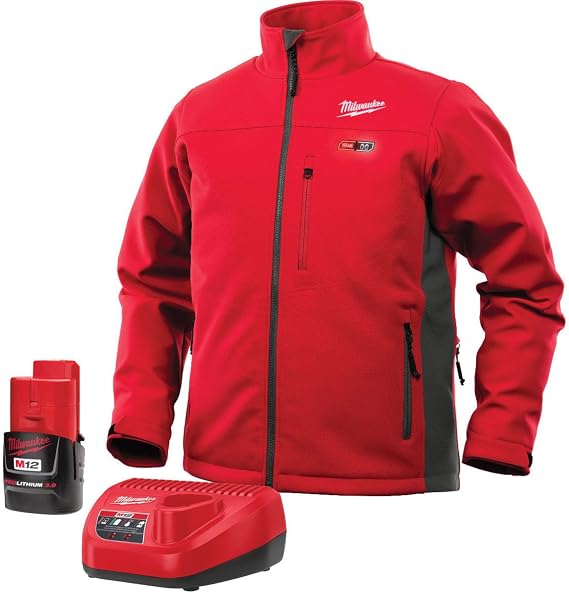
For those who already have their batteries on hand, the Milwaukee M12 Kit is the finest heated jacket.As an extra piece of luggage, every jacket here comes with its own proprietary charger and pack. It wasn’t invented in Milwaukee.This device is compatible with M12 REDLITHIUM batteries as well as all M18 REDLITHIUM packs. Your drill’s driving cells will warm up your jacket.Also included is a charger and battery pack, the M12 REDLITHIUM 2.0, which can last for up to 8 hours.
And lastly, there’s an LED controller that you can touch to change the heat in three zones: chest, back, and pockets.The fourth benefit is a drop-tail back, FreeFlex gussets, and a ToughShell stretch polyester exterior with a 5X longer life rating.Downside: it’s the priciest option. Cheap jackets that reach 140°F are hotter than this peak heat. The pack is located in one pocket, making it easy to feel.To whom it may concern: professionals currently using Milwaukee’s battery platform. This product is not suitable for customers who do not own any cordless instruments.
Things to Consider Before Buying a Heated Jacket:
Most buyers overlook several key factors when selecting a heated jacket. Understanding battery life, heating zones, and material quality can dramatically impact your comfort and satisfaction. Each element plays a significant role in ensuring you make an informed choice that suits your specific needs.
Battery Life and Voltage Specifications
Examining battery life is important, as it directly impacts how long your heated jacket will keep you warm. Look for models that offer at least several hours of heating on a full charge, especially for extended outdoor activities.
Heating Element Placement and Material Quality
Placement of heating elements can significantly affect warmth distribution. Jackets with strategically placed elements (such as on the back and chest) tend to provide better overall comfort. Additionally, higher-quality materials ensure durability and enhance insulation.
Quality materials bolster the effectiveness of heating elements. Fabrics that trap warmth, like polyester or specialized insulative materials, work best in conjunction with strategically positioned heating wires. An arrangement that spans important areas (torso and core) can optimize warmth retention, ensuring that the user stays cozy during cold outings. This attention to detail in both material and design leads to a better overall experience in extreme temperatures.
Softshell vs. Hardshell Performance
Softshell jackets offer flexibility and breathability, making them suitable for active pursuits such as hiking and skiing. In contrast, hardshell jackets excel in weather resistance and durability, providing excellent protection against rain and wind. Understanding these distinctions helps in choosing the right jacket for specific conditions.
Specialized Designs for Work and Recreation
Specialized heated jackets can cater to both work and leisure. Designs may include features such as reinforced seams for durability, pockets for tools, or lightweight construction for recreation. Assessing these functionalities aligns your choice with practical applications.
In the work sector, insulated jackets often incorporate safety features, while recreational styles might favor aesthetics and mobility. For instance, construction workers may benefit from a rugged, heated jacket that withstands demanding environments, while outdoor enthusiasts may prioritize jackets that are stylish yet functional. This differentiation ensures that the right garment enhances both performance and comfort in various activities.
Advantages of Active Thermal Regulation
Active thermal regulation allows you to customize your warmth according to the conditions outside. This feature can significantly enhance comfort during varying activities, whether you’re hiking or waiting at a bus stop. Personalizing heat settings makes it suitable for diverse outdoor scenarios.
Potential Limitations in Weight and Portability
Increased weight and reduced portability can occur with heated jackets. Designs may include batteries and wiring, adding bulk compared to traditional options. Selecting a model that balances heating capability with manageable weight is necessary for comfort and ease of movement.
Heated jackets, while convenient, often come with trade-offs in weight and portability. Models with robust heating elements may feel heavy over long periods, particularly when participating in active pursuits. Finding a lightweight option that still delivers adequate heat without compromising comfort is a priority for many outdoor enthusiasts.
Measuring for Maximum Heat Transfer
To maximize heat transfer, take precise measurements of your body dimensions, focusing on the chest, waist, and sleeves. An accurate fit allows the heating elements to work optimally, ensuring warmth is effectively distributed across your body without excess bulk or gaps.
Evaluating Layering and Mobility Requirements
Choosing a heated jacket should include consideration of layering beneath it. Ensuring sufficient space for base layers without compromising the jacket’s fit or mobility aids in overall comfort and warmth during outdoor activities.
Fitting for layering involves not only your size but also the types of underlayers you might wear. Lightweight thermal tops, for instance, can be combined effectively with a heated jacket without hindering your movement. Testing the jacket while simulating activities, such as stretching your arms or bending, provides insight into whether the jacket meets both warmth and flexibility needs.
Proper Washing and Storage Procedures
Washing your heated jacket must be approached with care. Follow the manufacturer’s instructions for cleaning, ideally using a gentle cycle and mild detergent to prevent damage to sensitive heating elements.
Guidelines for Safe Battery Management
Safe battery management extends the life of your heated jacket. Charging should be performed with compatible chargers and monitored to prevent overcharging, which can lead to battery degradation and potential safety concerns.
Understanding battery safety is crucial for any heated jacket user’s peace of mind. Always inspect the battery for any signs of swelling or damage before use. If the jacket includes a removable battery, store it separately in a dry, cool environment when not in use. Charging should occur on a non-flammable surface, and never leave it unattended while connected to power. Following these precautions allows for safe and efficient operation.
Final Words
Evaluating a heated jacket involves carefully considering factors like battery life, insulation material, and comfort level. Assessing these aspects ensures that you select a jacket that meets your specific needs, whether for outdoor activities or daily wear. Prioritize features that align with your lifestyle for optimal satisfaction and performance.
Leave a Reply