
Finding the best hidden camera detector is vital when you feel like someone is watching your every move. Your privacy is sacred, yet tiny spy cameras can hide anywhere from hotel clocks to shower heads. Don’t let a creepy intruder steal your peace of mind. Our guide offers ultimate privacy protection by revealing top-rated tools that expose these devices instantly. Stop worrying and start feeling safe again with these expert picks.
Contents
- Top 7 Hidden Camera Detector:
- 7: Dronewing AI Hidden Camera Detector
- 6: DancingColors Hidden Camera Detector
- 5: CountureMode 7-in-1 Hidden Camera Detector
- 4: JMDHKK K18+ Hidden Camera Detector
- 3: JAXTIN G9 Pro Hidden Camera Detector
- 2: JAXTIN G66 Pro Hidden Camera Detector
- 1: JMDHKK M8000 Hidden Camera Detector
- Things to Consider Before Buying a Hidden Camera Detector:
- Radio Frequency (RF) Signal Scanners
- Optical Lens and Infrared Finders
- Frequency Range and Sensitivity Levels
- Detection Distance and Signal Accuracy
- Portable Consumer-Grade Devices
- Professional-Grade Surveillance Equipment
- Calibrating the Detector for the Environment
- Conducting a Systematic Room Sweep
- Identifying Common Concealment Locations
- Minimizing Interference from Legitimate Electronics
- Summing up
Top 7 Hidden Camera Detector:
7: Dronewing AI Hidden Camera Detector

For those on a tight budget who are just starting out on their travels, we recommend the Dronewing AI Hidden Camera Detector.You can’t see a single wired pinhole in that room using your phone’s camera-finder app. Assuming you’re secure, you wave the screen and see nothing. That is resolved by the Dronewing.To start, there are four different types of detection: radio frequency signal, infrared pinhole, magnetic GPS tracker, and spotlight. Make quick work of a hotel room.
Followed by that, a silent vibration alert and five sensitivity levels. Scanning an Airbnb with it in your hand won’t alert the host to your presence.Lastly: a 30-day standby time and a 25-hour battery life. Put it in your checked baggage and put it out of your mind for a month. Downside: only LED bars, no screen. It takes time to get the hang of beeps. One-button menu.Weekenders and first-time homebuyers will love it. Those who prefer a graphical representation should not use this.
6: DancingColors Hidden Camera Detector
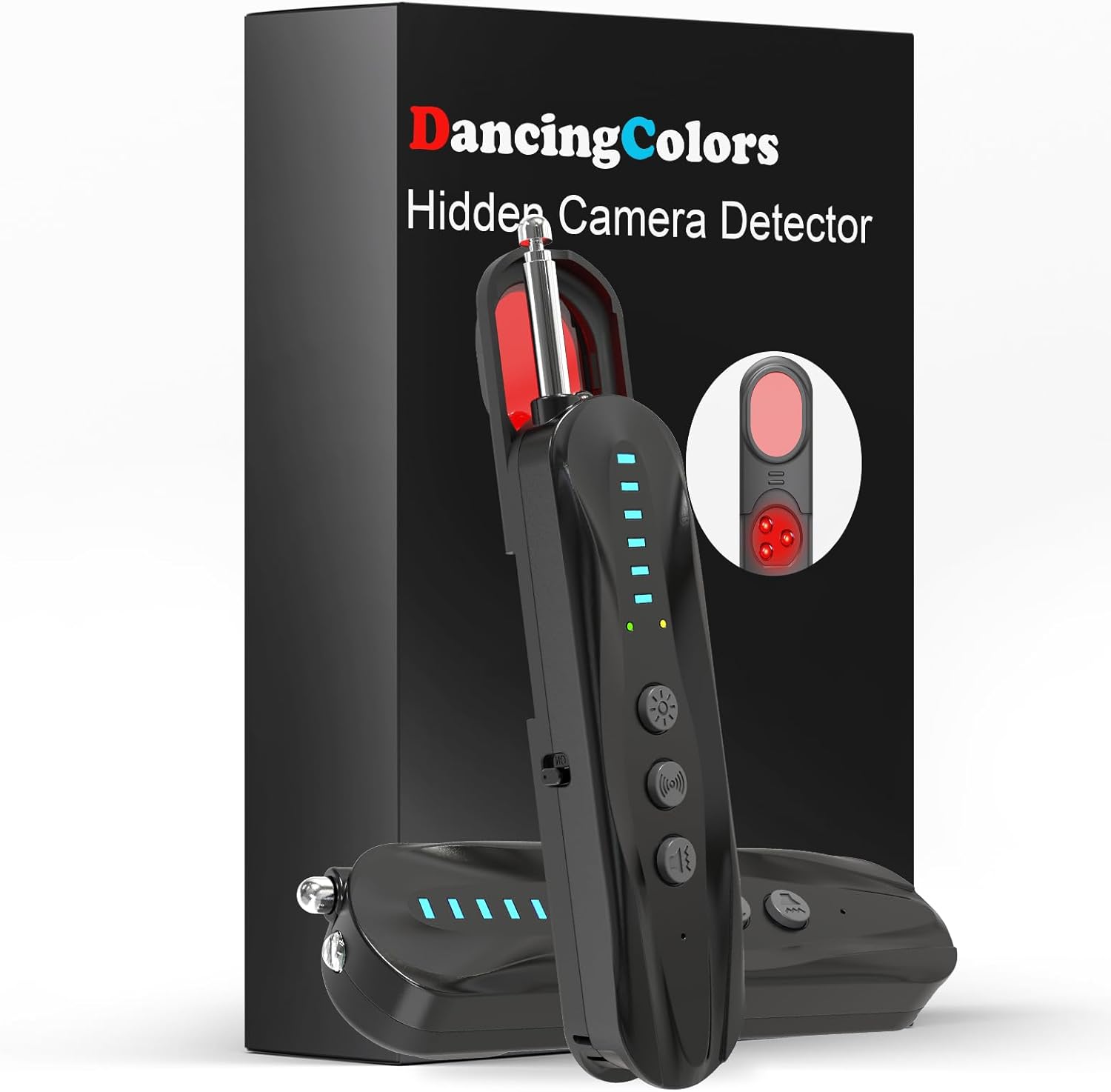
The most cost-effective option for discovering hidden cameras is the DancingColors Hidden Camera Detector.A cheap RF-only scanner will not pick up any camera that isn’t online or pings for a short period of time. While sweeping, you don’t hear a thing, and you pass the camera that’s keeping tabs on you.To begin, there is the red-lens infrared scope, which works by reflecting light from a hidden lens when viewed through a red filter. You can use this method without batteries.
Next up: an RF signal scanner that uses an LED bar display. Detects and captures wireless webcams, bug listeners, and Wi-Fi access points.Last but not least: a mode for GPS tracking and locating vehicles and bags. Works as a sweep device for stalkers as well as for hotel rooms.Drawbacks: lack of a screen readout, narrow grip, and lesser battery life compared to premium options.Ideal for: vacationers who prefer to see things for themselves. Intended use: not for use with radio frequency alone.
5: CountureMode 7-in-1 Hidden Camera Detector

For the money, the best mid-range option is the CountureMode7-in-1 Hidden Camera Detector, which has the most detecting modes.Most inexpensive scanners only pick up on a few of signal types. Is that the vibration-activated camera? Not seen. The 5GHz wireless condenser? Not seen. You can capture both with the CountureMode.To begin, there are seven distinct detection modes: infrared pinhole, concealed camera, anti-spy, GPS tracker, listening device, and RF bug. All typical dangers are addressed by a single gadget.
The red IR scope window is next, and it’s broader than the windows of competing pen scanners, so locating the lens reflection doesn’t take minutes, but seconds.Last but not least: a disguised pen that appears like a stylus. Effortlessly breezes through airport and hotel security checks.The size of the internal antenna is limited by the pen body. Manual sweep only; no auto-scan. You can’t just swap out rechargeable batteries.This rental is ideal for people who travel frequently or who create content. Buyers on a tight budget should not purchase this.
4: JMDHKK K18+ Hidden Camera Detector
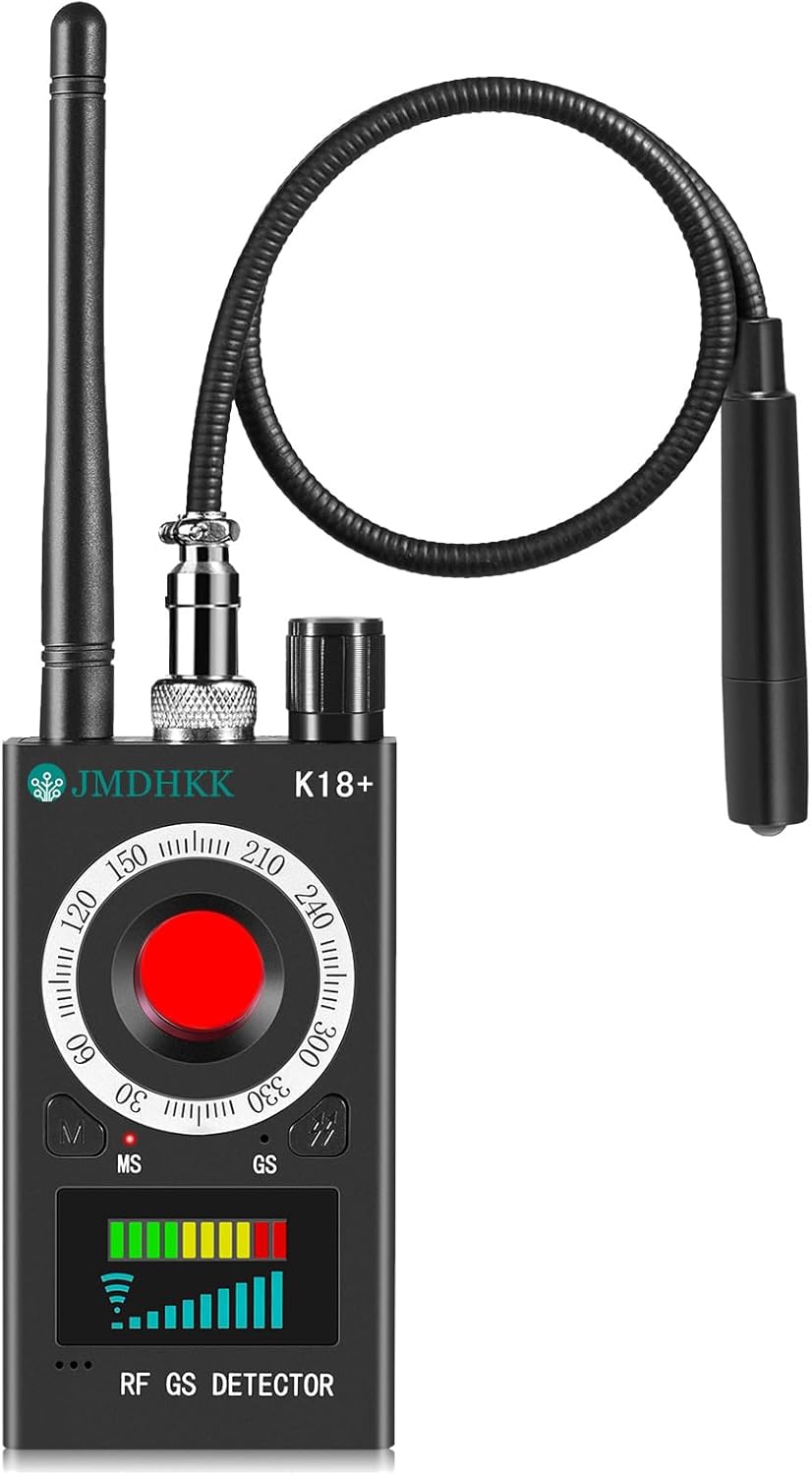
Among consumer hidden camera detectors, the JMDHKK K18+ stands out as a classic bestseller.Despite their sleek appearance, new detectors only have field data dating back months, not years. The K18+ has been making rounds in rooms long before this became a TikTok issue.The first tool is a flexible gooseneck antenna, which can be bent into any tight spot, such as behind cabinets, into air conditioning vents, or outlets. This is the only shape that reaches to such a degree.After that, there’s an integrated red-lens optical scope that you may use to see through any powered or unpowered pinhole camera lens reflection.
The last step is a combination of radio frequency (RF) and magnetic detection, which can locate hidden wireless cameras and GPS trackers.Disadvantages: Microwaves and WiFi routers cause false positives. Warnings only, no option to silence them. Past menu.Vehicle sweepers and users with a hands-on approach will find this the best option. Avoid using silent hotel scanners.
3: JAXTIN G9 Pro Hidden Camera Detector

If you’re a serious traveler who despises dead batteries, you need the JAXTIN G9 Pro, the greatest pen-style detector upgrade.After a weekend away, the majority of pocket scanners perish. After three days of vacation, the device is completely useless. The G9 Pro takes care of it.At the top of the list is the longest battery life of any pen-style detector here at 72 hours. An entire week of hotel sweepstakes without using any electricity.After that, there are six sensitivity levels, an audible one, and a silent one. To hear live wireless cams, turn the volume up; to block out hotel WiFi, turn the volume down.
The long-awaited disguised stylus that mimics the appearance of a premium pen is now available. Hangs from a shirt pocket. It goes unquestioned.Downside: only LED bars, no screen. Sweep by hand is necessary. False positive for magnetic GPS.Who it’s best for: regular fliers and business travelers. Do not use if you require a graphical representation of the data.
2: JAXTIN G66 Pro Hidden Camera Detector

The top-tier JAXTIN G66 Pro detector has an integrated screen and an artificial intelligence auto-scan feature that interprets scan findings automatically.Simply beeping is all most detectors do. You understand the pattern of pulses, pitch, and frequency. What you’re hearing is completely foreign to someone who has never swept for bugs. It is read aloud by the G66 Pro.First, activate the AI auto-scan mode; then, put it down, go to the door, and come back 90 seconds later. The gadget detects objects in the room and sounds an alarm if it finds them.Secondly, there is an integrated LED screen that shows the strength of the signal—no need to guess the number of beeps ever again.The frequency band hit and intensity are displayed on the screen in real time.
At last, a combination of an infrared red-lens scope with a magnetic GPS tracker mode. Pinhole optics, vehicle trackers, and wireless cams are all covered by one tool.Downside: not as compact as pen-style picks. Progress through more complex phases requires time and effort.Greater than average pricing.The ideal target audience consists of real estate agents showing rental properties and those who are not technically savvy. Avoid if you’re looking for a small, portable bag.
1: JMDHKK M8000 Hidden Camera Detector

If you’re a traveler or security professional looking for the best hidden camera detector in 2026, go no further than the JMDHKK M8000.A three-foot radius is the range of a pocket detector. If you don’t keep your arm near the lens, you can miss it. Even when you’re not close, the M8000 can detect objects.The first is an exterior antenna with a high gain, which can simultaneously gather RF signals from all throughout a hotel suite. This is the furthest range observed.
Second, a dual-mode probe doesn’t require bending the device to fit into tight spaces like vents, behind picture frames, or outlets.Thirdly, we have expert LED bar signal visualization, which is the same style as bug-sweeping gear. It shows exact strength on a multi-segment scale.Downside: bigger and heftier compared to pen-style picks. Expensive in comparison to all of the other detectors. Learn the ropes slowly.Ideal for: real estate inspectors and serious travelers. Avoid if you’re a light traveler looking for a compact bag.
Things to Consider Before Buying a Hidden Camera Detector:
The technology used to detect hidden cameras varies significantly. Each type serves a unique purpose, ideal for different environments. Assessing your specific needs will help in choosing the right detector. The effectiveness of these devices depends on the type of surveillance equipment being used.
Radio Frequency (RF) Signal Scanners
RF signal scanners excel in identifying hidden cameras that utilize wireless signals. Capable of detecting various frequencies, these devices can indicate the presence of active wireless surveillance equipment. While effective, installation materials and surrounding electronics may affect sensitivity.
Optical Lens and Infrared Finders
Optical lens finders focus on spotting reflective surfaces of camera lenses, while infrared finders detect heat signatures emitted by electronics. These methods require different approaches, offering distinct advantages based on the environment. Understanding their strengths can enhance your overall detection strategy. Optical lens finders work by analyzing reflections and glints, making them effective in rooms with sufficient lighting. They are often compact, portable, and easy to use. Infrared finders provide a different approach by sensing heat emitted by electronic devices, offering reliable results even in low-light conditions. A combination of both can significantly improve your chances of successful surveillance detection.
Frequency Range and Sensitivity Levels
Frequency range plays a significant role in detecting various camera types. High sensitivity levels will improve detection rates, ensuring you don’t overlook hidden devices.
Detection Distance and Signal Accuracy
Detection distance is vital as it indicates how far away the detector can effectively recognize signals. Combining this with signal accuracy ensures you pinpoint hidden cameras more reliably.
Expect a detector with good signal accuracy to differentiate between genuine threats and benign devices, which minimizes false alarms. Balancing detection distance with accuracy will give you a comprehensive understanding of your surroundings, making your device more effective.
Portable Consumer-Grade Devices
Portable consumer-grade hidden camera detectors are typically lightweight and easy to carry. Designed for everyday users, these devices often include basic functionality, making them ideal for quick checks in various locations. Their affordability and straightforward use make them popular among non-professionals seeking peace of mind.
Professional-Grade Surveillance Equipment
Professional-grade surveillance equipment offers heightened sensitivity and advanced features tailored for thorough inspection. These devices are engineered for serious users, such as security professionals or investigators, requiring reliable and precise detection capabilities. Functions may include real-time monitoring and analysis, ensuring comprehensive coverage of potential surveillance threats.
Investing in professional-grade surveillance equipment provides confidence that you’re protected against hidden cameras and other unauthorized recording devices. These models often come with enhanced battery life, extended detection ranges, and detailed reporting features. While the higher price point may be a consideration, the advanced technology and greater efficiency contribute significantly to operational success in critical environments.
Calibrating the Detector for the Environment
Adjust settings according to your environment’s conditions. Factors like lighting and nearby electronics can affect detection accuracy. Aim for the ideal balance to enhance performance.
Conducting a Systematic Room Sweep
Begin in one corner of the room and move slowly while scanning in straight lines. Check behind furniture, electronic devices, and other common hiding spots to ensure no area is overlooked.
Room sweeps require methodical observation and a careful approach. Ensure you check all angles, including ceilings, corners, and unoccupied spaces that could conceal cameras. Use a steady hand to keep the detector’s readings accurate and be mindful of sudden signals indicating hidden devices.
Identifying Common Concealment Locations
Hidden cameras are often placed in unobtrusive spots. Check areas like smoke detectors, air purifiers, and even electrical outlets. Pay attention to everyday objects, like picture frames or houseplants, as they can serve as clever disguises.
Minimizing Interference from Legitimate Electronics
Some electronics can emit signals that interfere with your hidden camera detector. Position the detector away from devices like routers, televisions, and wireless speakers during scans. This step ensures that you receive accurate readings and don’t miss potential threats.
Turning off or disconnecting any nearby electronic devices enhances your hidden camera detector’s accuracy. Among common culprits, Wi-Fi signal transmitters often generate interference, leading to false alarms. Reducing such electronic noise allows for a clearer and more reliable detection experience, ensuring you catch potential surveillance devices without distractions.
Summing up
Taking this into account, evaluate factors such as detection range, types of signals, user reviews, and device compatibility before purchasing a hidden camera detector. Understanding these aspects will enhance your ability to select an effective tool for privacy protection and ensure it meets your specific needs in different environments.
Leave a Reply