
Best Multimeter buyers guide: Stop guessing with flaky tools and get accurate results fast. Our experts tested these picks to help DIYers and pros choose a reliable digital multimeter or voltage tester. We promise clear, easy-to-read recommendations that save time and prevent costly mistakes. Feel confident and safe tackling electrical jobs with a powerful, must-have meter. Read on to find the right model for you.
Contents
- Top 7 Multimeter:
- 7: KAIWEETS Digital Multimeter
- 6: TESMEN TM-510 Digital Multimeter
- 5: AstroAI M4K0R Digital Multimeter
- 4: AstroAI True RMS 6000 Multimeter
- 3: Klein Tools MM420 Multimeter
- 2: Fluke 15B+ Digital Multimeter
- 1: FNIRSI 2C53T Oscilloscope Multimeter
- Things to Consider Before Buying a Multimeter:
- Analog Multimeters for Specialized Signal Tracking
- Digital Multimeters for High-Precision Measurements
- Manual vs. Auto-Ranging Functionality
- True RMS vs. Average Responding Technology
- Assessing Your Specific Electrical Needs
- Balancing Budget with Brand Reliability
- Selecting High-Quality Probes and Accessories
- Best Practices for Calibration and Storage
- Final Words
Top 7 Multimeter:
7: KAIWEETS Digital Multimeter
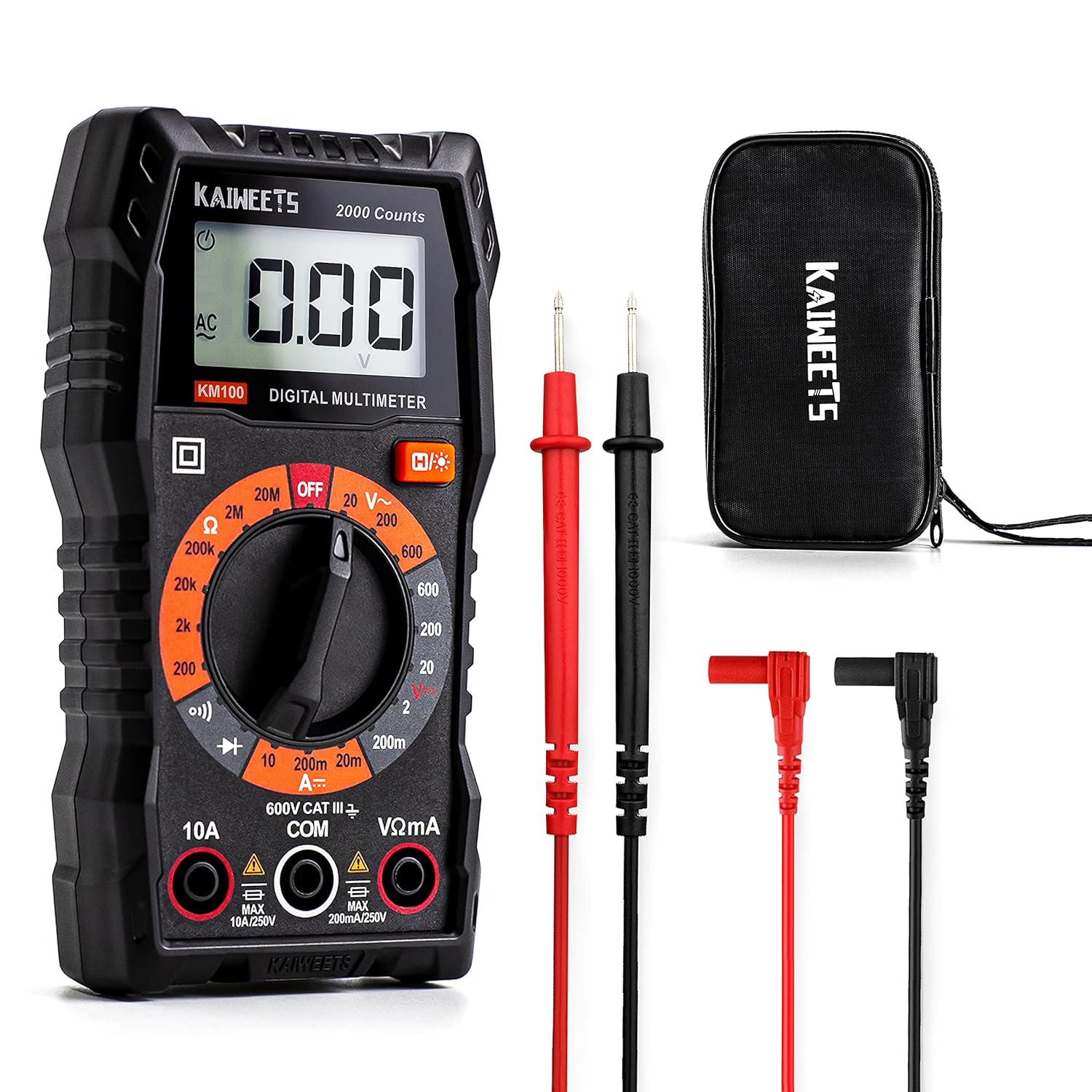
For those on a tight budget, we recommend the KAIWEETS Digital Multimeter as a first meter.A lot of people avoid using cheap meters because they are afraid they would explode in their hands if they probe the wrong thing. It is removed by KAIWEETS.To start, it has CAT III 600V certification and two ceramic fuses, which provide anti-burn protection that can handle an amateur’s slip-up.Up next: a powerful light and data hold, a feature that lets you save a reading for later review.
And lastly, it comes with a sturdy case and covers all the basics: AC/DC voltage, resistance, continuity, and diode.Unfortunately, it is unable to detect AC current. You can manually adjust the range with a manual ranging mode. Not detecting non-contact events.Recommend for: anyone doing basic house inspections or buyers who are purchasing their first property. Use not intended for: applications requiring auto-ranging or AC-amperage solutions.
6: TESMEN TM-510 Digital Multimeter

For those on a tight budget who nevertheless want a meter capable of doing calculations, the TESMEN TM-510 is your best bet.Improperly selecting the appropriate dial setting is common. The TM-510 can detect the object under test.Smart Auto Mode is the first option; simply touching the probes to a wire triggers the automatic detection of voltage, resistance, or continuity.After that, it has an integrated voltage detector that doesn’t require touching anything; just wave it close to a live wire to make sure.
Lastly, for use in dark panels or crawlspaces, a top flashlight, a backlight, and four thousand counts are available.Negative: CAT II 600V isn’t up to par with what the pros recommend. No reading for temperature. With low voltages, auto mode can seek.Recommended for: careful do-it-yourselfers and rapid live-wire inspections. Users requiring a higher level of safety should not use this.
5: AstroAI M4K0R Digital Multimeter

When it comes to automobile batteries and electrical repairs in the garage, nothing beats the AstroAI M4K0R.Guesswork without the proper meter results in a dead vehicle. It is quickly diagnosed by the M4K0R.Start with the specific modes for testing batteries: 1.5V, 9V, and 12V. Use them to check the battery life of your keychain, smoke detector, or automobile.The next step is to find a live wire and illuminate the engine compartment using non-contact voltage and a flashlight.
Lastly, True RMS 4000 is accurate on modern electronics, not basic circuits, because it counts capacitance.Drawbacks: A 10A current limit, typical of handheld devices. Your battery’s modes only show voltage, not its overall load health. After auto-ranging, the system takes a while to settle.Ideal for: examining batteries, car owners, and those who work in garages. Use caution when working with strong currents or bench electronics.
4: AstroAI True RMS 6000 Multimeter

The greatest all-around meter that most DIYers should actually buy is the AstroAI True RMS 6000.To get a cheaper meter, you have to sacrifice something. It performs almost all tasks, unlike the other one.To start, genuine RMS 6000 counts, not textbook signals, provide realistic estimates of the chaotic power in actual residences.After that, it has a temperature probe, capacitance, frequency, and duty cycle all integrated into it; it can also diagnose HVAC and appliance problems.
The huge, illuminated screen with data hold and the kickstand for hands-free viewing are the finishing touches.Drawback: zero options for non-contact voltage detection. Not suitable for use in CAT IV industrial settings. A simple temperature probe.Recommended for: households with just one meter, appliance repair enthusiasts, and hardcore do-it-yourselfers. Who this isn’t for: minimalists or industrial electricians.
3: Klein Tools MM420 Multimeter

If you’re a do-it-yourselfer looking for a reliable meter for use on the job, go no further than the Klein Tools MM420.Cheap meters are fragile and break easily when dropped from a great height. The MM420 is up to the mark for professionals.To start, a body that can withstand a fall of 6.6 feet to a hard floor with auto-ranging True RMS accuracy.As a second point, a real shock-and-blown-fuse preventer, lead-alert LEDs illuminate if the test leads are in the incorrect connectors.
Lastly, it has a 50 megohm resistance, lead holders, and a kickstand in addition to 600 V AC/DC and 10 A current.Limitation: no voltage that does not involve physical touch. Not a temperature setting. Next to auto meters is a menu that relies heavily on manual processing.Optimal for: low-stakes DIY projects, aspiring professionals, and hazardous work environments. This is not for people looking for NCV or the cheapest option.
2: Fluke 15B+ Digital Multimeter

For those who would rather not repurchase a premium meter, the Fluke 15B+ is an excellent choice.You’ve had rental tools that broke down inside a year. You should never have to replace this meter, and Fluke has earned your trust.First, the renowned accuracy and build quality of Fluke, which is trusted on job sites worldwide with a CAT III 600V rating.Following that, it detects AC/DC voltages up to 1000V and currents up to 10A, providing ample space for heavy circuits, pumps, and solar power.
At last: a diode, resistance, continuity, and dust-and drop-resistant sealed housing.Downside: cannot measure temperature or voltage without touching the object. Using simply manual ranging. With fewer additional modes, the price goes up.Ideal for: homeowners looking to make a permanent investment, house renovations, solar panels, and pumps. This is not for you if you are a gadget nut who demands every possible output mode.
1: FNIRSI 2C53T Oscilloscope Multimeter

The most powerful instrument here is the FNIRSI 2C53T, designed for the amateur physicist who is curious about the effects of electricity.You get a reading from every other meter. You can’t help but wonder why it’s incorrect. Let me show you this one.The first is an integrated 50 MHz 2-channel oscilloscope that displays the current waveform on the screen and highlights irregularities that most other instruments miss.The second item is a 19999-count True RMS multimeter, which is just as accurate as the first three choices. It measures voltage, current, resistance, capacitance, and diode.
Thirdly, there is an integrated signal generator that includes thirteen different waveforms; this allows you to test the circuit’s response by feeding it a signal.Fourth, you can use USB-C to save any screen and return to it later to investigate a problem.The downside is that there is a genuine learning curve if all you know is basic metering. Display is smaller compared to a benchtop scope. You may charge the battery.Who it’s best for: the curious, the creator, the do-it-yourselfer who wants to know how a circuit works. Who this isn’t for: those who require a simple voltage tester.
Things to Consider Before Buying a Multimeter:
Over time, the right multimeter can transform your troubleshooting and electronic projects. Knowing the vital features, types, and specifications will help you make an informed choice that suits your needs, whether you’re a hobbyist or a professional in the field.
Analog Multimeters for Specialized Signal Tracking
Analog multimeters remain popular for specialized applications, such as monitoring fluctuating signals. Their needle movement allows you to visualize changes, which can be beneficial in audio equipment testing or sensitive electronics. Users appreciate the ability to detect small variations in electrical parameters that digital displays may overlook.
Digital Multimeters for High-Precision Measurements
Digital multimeters excel in providing accurate measurements necessary for complex electrical tasks. With superior resolution and often multiple functions, they cater to detailed tasks such as component testing or power audits. Their numerical displays offer clarity, reducing the risk of misinterpretation during readings.
Advanced features in digital multimeters, such as data logging and enhanced measurement functions, add significant value. These models often feature multi-functional buttons and varying measurement modes, enabling you to conduct specialized tests with ease. Selecting a unit with these capabilities can play a crucial role in ensuring the precision needed in professional or advanced hobbyist settings.
Manual vs. Auto-Ranging Functionality
Choosing between manual and auto-ranging multimeters can be significant. Auto-ranging models simplify measurement by automatically selecting the appropriate range, while manual options offer greater control for experienced users who prefer to select ranges themselves.
True RMS vs. Average Responding Technology
Understanding True RMS and average responding technology is crucial for accurate readings. True RMS multimeters measure AC voltage and current accurately regardless of wave shape, while average responding models provide less precise results for non-sinusoidal waveforms.
True RMS technology is particularly beneficial when working with complex waveforms or variable frequency drives. It ensures accurate measurements are maintained even in non-linear environments, which can often produce distorted signals. For instance, in industries using electronic devices, instruments with True RMS capability are indispensable for quality assurance.
Assessing Your Specific Electrical Needs
Identifying your specific electrical requirements is important for choosing the right multimeter. Consider whether you will primarily measure voltage, current, or resistance. For example, automotive technicians often need a model capable of diagnosing vehicle electrical systems.
Balancing Budget with Brand Reliability
Evaluating both budget constraints and brand reputation can guide your multimeter selection. Reliable brands often provide better support and warranty services, influencing the long-term value of your investment.
Quality tends to correlate with brand reliability. Mid-range models from established manufacturers often perform better than cheaper alternatives in terms of accuracy and durability. For instance, while investing more upfront may seem daunting, consider the savings from purchasing a dependable multimeter that lasts longer, thereby avoiding frequent replacements.
Selecting High-Quality Probes and Accessories
Investing in high-quality probes and accessories ensures precise readings and enhances safety. Choose probes that fit your measurement needs, whether it be for high voltage or low current applications. Functionality and flexibility are paramount in selecting accessories that will serve effectively in various technical scenarios.
Best Practices for Calibration and Storage
Proper calibration and storage of your multimeter contribute to consistent performance. Always follow the manufacturer’s guidelines for calibration frequency and techniques. Additionally, avoid exposure to extreme temperatures or moisture, as these conditions can compromise device accuracy and functionality.
Proper calibration typically involves both zeroing the instrument and verifying it against a known standard. Regularly checking calibration helps ensure that readings remain reliable, leading to more accurate measurements in your projects. Store the multimeter in a designated, dry area, preferably in its original packaging or a suitable case to protect it from dust and physical damage.
Final Words
Prioritize imperative factors such as accuracy, range, and build quality when selecting a multimeter. Consider your specific applications, whether for basic household tasks or more advanced electrical work. Selecting the right model ensures reliability and efficiency, ultimately enhancing your overall experience in any measurement scenario.
Leave a Reply