
Searching for the best over ear headphones to escape distractions and truly feel your music? It’s frustrating when poor sound quality or an uncomfortable fit ruins the experience. We’ve tested dozens of models to uncover the pairs that deliver incredible, immersive audio and all-day comfort. Forget the confusion—we’ve made it simple to discover your perfect match. Let’s explore the top contenders and find the right pair for you.
Contents
- Top 5 Over Ear Headphones:
- 1. Sony WH-1000XM6 – Best Over Ear Headphone Overall
- 2. Apple AirPods Max – Best Over Ear Headphone for iPhone Spatial Audio
- 3. Sennheiser MOMENTUM 4 – Best Over Ear Headphone for Battery Life
- 4. Bose QuietComfort Ultra – Best Noise Cancelling Over Ear Headphone for Comfort
- 5. Soundcore Life Q30 – Best Budget Over Ear Headphone
- Things to Consider Before Buying a Over Ear Headphone:
- Open-back vs. Closed-back
- Wired vs. Wireless
- Sound Quality
- Comfort and Fit
- Battery Life (for Wireless)
- Durability
- Read Reviews and Ratings
- Test Before You Buy
- Advantages
- Disadvantages
- Make Your Purchase
- To wrap up
Top 5 Over Ear Headphones:
1. Sony WH-1000XM6 – Best Over Ear Headphone Overall

If you’re after best-in-class noise cancellation with improved sound and all-day comfort, the Sony WH-1000XM6 is a complete upgrade. Built-in advanced processors and an adaptive mic system create a unique listening experience by adjusting to your surroundings – whether you’re at home, on the go, or in the office.
Sound quality is adjusted on the basis of feedback from mastering audio engineers. A dedicated driver featuring a carbon-fiber dome and copper ring combines to preserve detail for a truly high resolution audio, allowing you to hear everything from bass lines to subtle sounds like accord fingers and breaths that adds sophistication and delicacy of music even when noise canceling is turned on.
Calls are crystal clear wherever you are. AI noise reduction, a six-microphone beamforming array and wind-resistant screen allow your voice to come through clear and natural across policy on both sides.
No doubt comfort and portability are being taken into consideration here. New features such as a wider, asymmetric headband and larger earcups with smooth synthetic leather pads provide the best combination of comfort and sound quality. Stepless slider and stable fully-adjustable headband adjust to your head size an shape for perfect fit Swiveling earcups make moving them out of the way or resting them on your shoulders a breeze The single-sided cable is designed to prevent tangles Freedom of movement 3m / 9.8f single sided (exchangeable) cable. Stylish design that folds neatly away into a small hard case with a magnetic closure.
Battery life is long — up to 30 hours on a charge — enough for coast-to-coast flights and packed workweeks. When the battery is running low, it needs to be charged via USB for easy charging on the go. Delivering superb ANC, accurate, enjoyable sound and with the best travel-ready build going around, if you want just a single pair of over-ear headphones that are excellent everywhere then there is no better pick than the WH-1000XM6.
2. Apple AirPods Max – Best Over Ear Headphone for iPhone Spatial Audio

If you are looking for the best in completely over-ear convenience with your iPhone, especially for Spatial Audio, AirPods Max offers great sound and control in a package that integrates deeply into the Apple ecosystem. You even get high-fidelity sound, thanks to a custom-designed Apple dynamic driver paired with computational audio that delivers precise break beats, pulsing synth and everything in between with fine-tuned clarity, depth and balance.
Noise never gets in the way. Active Noise Cancellation delivers top-tier blocking of outside noise so you can feel it at both low and high frequencies, while Transparency mode lets the outside sound in with a press so you can hear announcements or order a coffee without removing your headphones.
These are where Spatial Audio really shines with the iPhone and Apple TV. Custom calibration synced to your individual anatomy, along with the golden ticket of head-tracking (Nuraphone-assisted headphones do something similar), are what help create a 3D stage that places instruments and effects all around you.
Long sessions are a cinch with comfort built in. The knit-mesh canopy maintains low weight and provides the perfect clamping force, so they’re comfortable on the largest of heads, between the fabric of the ear pads and their memory foam inner.Closure: Memory foam Construction:Knit meshOne charge is equal to 20 hours playtime even with active noise cancelling or if you work out and exercise.Firmly tuck them into your travel bag along with its portable carrying case.
3. Sennheiser MOMENTUM 4 – Best Over Ear Headphone for Battery Life

If you’re after some over-ear cans that will last for days between charges but not let you down with the sound, it’s got to be Sennheiser MOMENTUM 4. With fast charging, you enjoy up to 60 hours of playtime, so red-eye flights, marathon class sessions, or spontaneous road trips can be covered by as much power as you won’t know what to do with.
Featuring Sennheiser’s 42 mm transducer system, the Superior level sound technology includes it signature clean bass, natural mids and clear, detailed treble performance – that remains so even when using bluetooth mode thanks to the aptX Adaptive support. And you can customize the tone to your liking with the Smart Control app’s built-in EQ, presets and Sound Modes; for songs, films, podcasts or even when making a call.
Noise control is also flexible and intuitive. Adaptive Noise Cancellation silences the world put on full Transparency to hear it all around you.
Everything else was easy: a lightweight, collapsible frame; comfortable padded headband; and ultra soft memory foam earcups reduce pressure on the skull for all day comfort. Calls come in clear on a four-mic beamforming array with wind-noise reduction while your voice-assistant remains one touch away.
Everything you need for flexible listening is here — a carry case, USB-C charging cable, simply plug the audio cables in as needed to hear music, movies or games with ease. From a wide range 6 Hz–22 kHz frequency response, to long-haul battery life and refined controls for changing the track, volume or making phone calls with ease through the push of a button, the MOMENTUM 4 gives you rich sound and unflinching power when it’s time to recharge your battery.
4. Bose QuietComfort Ultra – Best Noise Cancelling Over Ear Headphone for Comfort
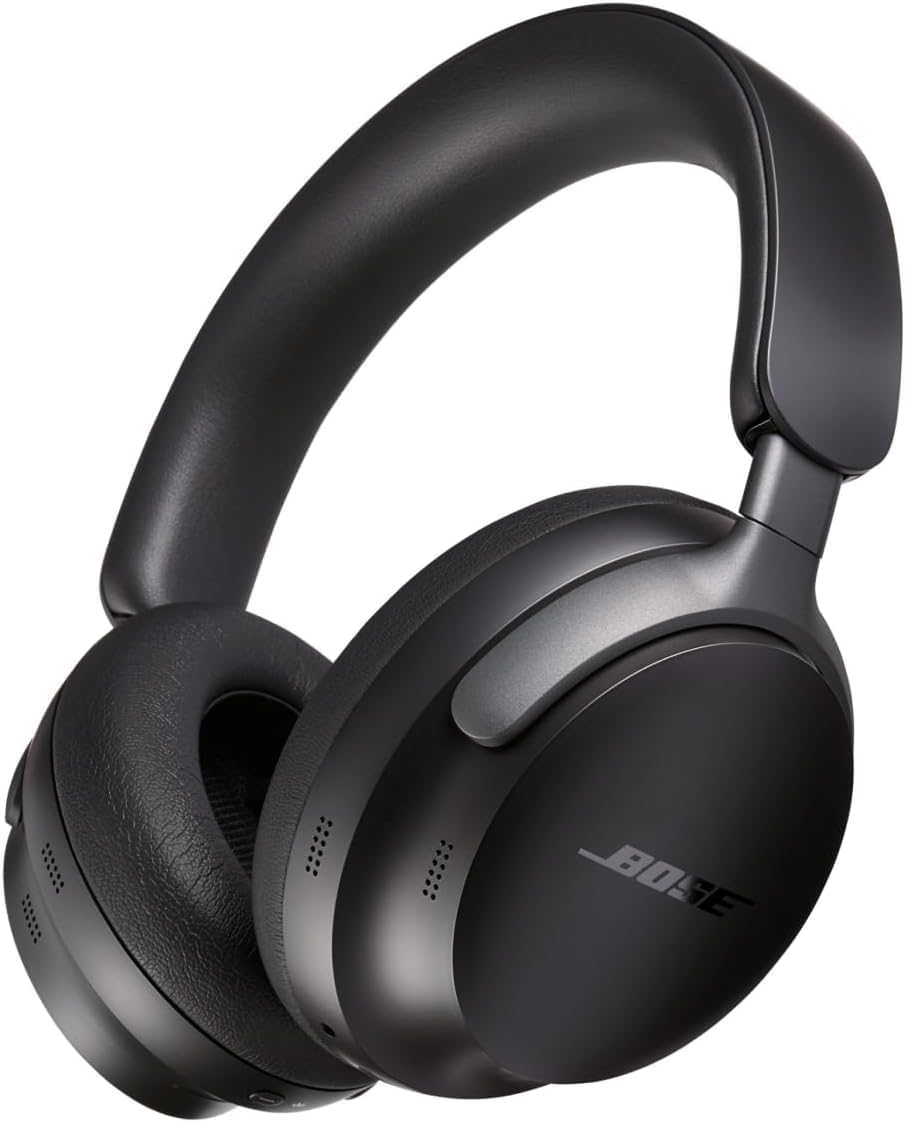
If you seek the most comfortable way to block out the world and bathe in fabulously rich, spacious sound, the Bose QuietComfort Ultra ticks all the boxes. Spatial audio through Bose Immersive Audio offers a transcendent soundscape, and CustomTune provides sound that matches output to your ears for a balanced, all-out detailed performance no matter where you are.
You’re pulling the noise as you like it. The addition of Quiet Mode lets you drown out the world around you with maximum noise cancellation for a commute, or focus in the office. Aware Mode lets outside sound in for awareness.
Calls come through cleanly. And multi-microphone beamforming zeroes in on your voice while filtering out external noise, so you’ll dazzle conversations even when you’re walking down a crowded street or at a bustling café. Comfort is also a highlight: Plush ear cushions mold to your ears, and the headband distributes pressure evenly so you can wear them for hours without hot spots.
It’s easy to connect wherever you are with Bluetooth 5.3 and reliable wireless with a range up to 30 feet. SimpleSync allows you to pair your SoundLink Revolve II with a compatible Bose smart soundbar for an even better listening and TV viewing experience. Battery life goes up to 24 hours. When you’re running dry, a 15-minute quick charge will get you up to 2.5 hours of play time so that you can speed back to your playlist.
Controls are all touch-based on each earcup for volume, tracks, calls and mode switching, and you can even power them sweeping a hand near your head. For those who prioritize comfort and best-in-class ANC, and an immersive listening experience, the QuietComfort Ultra provides a premium, all-day option.
5. Soundcore Life Q30 – Best Budget Over Ear Headphone
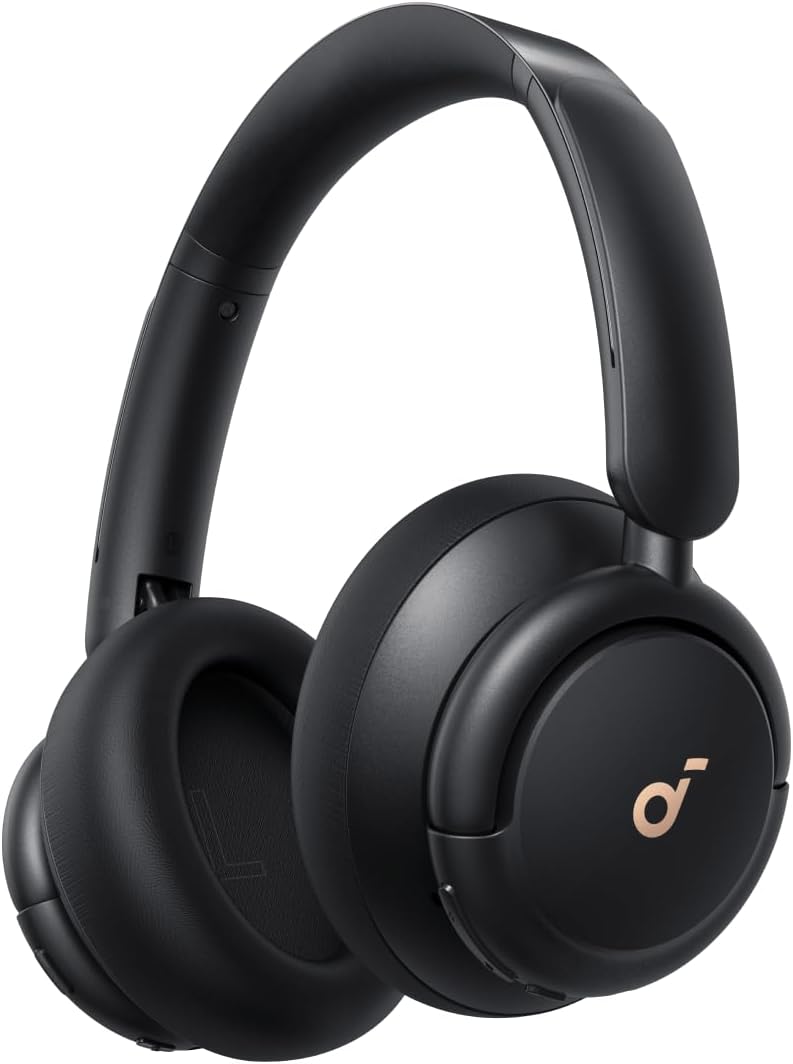
If you’re after a budget-friendly pair of over-ear headphones that give more than their price-point suggests then the Soundcore Life Q30 are an easy buy. You get active noise cancellation with ambient sound mode that is a hybrid of 2 microphones reducing upto 95% of low frequency background noise; Turn down the noise— or for those moments when you need to hear it all, work— with the press of a button; Impedance (Ohm) : 32 ohm (1 kilohertz). Use the three buttons on the headphones to turn up or down the ANC, and press play, pause, or skip songs without having to reach for your phone.
You’ll also be getting more detail out of your music. Delivering pure sound quality across all frequencies for Hi-Res performance with 40mm drivers, the highly responsive liquid crystal polymer (LCP) diaphragm in combination with a special aluminium-coated LCP driver and power enhanced magnet provides for bursts of high power and minimizes the effect of vibration. Whether you’re streaming playlists or chatting, the tuning ensures that vocals are clean and clear even when matched with music tracks.
Battery life is a highlight: up to 50 hours with ANC on and up to 70 hours in standard (no noise cancellation) mode. Short on time? About 4 hours of listening from a quick 5-minute charge means you won’t have to worry about the battery going low, or party being over.
Comfort is key when you’re in it for the long haul, and the Life Q30 gets it right. Ultra-soft protein leather earcups with memory foam block outside noise and create a perfect seal around your ears, allowing for comfortable wear without any distractions, and lifting adjustable headband to get the best fit; Take them to classes or travel on the airplane.
Things to Consider Before Buying a Over Ear Headphone:
Buying over-ear headphones means evaluating sound signature, fit and clamping force, weight and earcup materials for long sessions, active noise cancellation versus passive isolation, wired vs wireless options and codec support, battery life and charging speed, microphone quality and call performance, build durability and warranty, and the price-to-performance balance so you get headphones suited to your listening needs and daily use.
Open-back vs. Closed-back
If you mix or value a spacious stereo image, open‑back delivers clearer placement and a natural decay—models like the Sennheiser HD 600 excel; conversely, closed‑back headphones such as the DT 770 Pro isolate roughly for noisy environments and emphasize low frequencies, making them better for tracking, commuting, or when leakage would disturb others.
Wired vs. Wireless
Wired connections give you lossless paths and no latency, crucial for studio work and high‑impedance cans, while wireless offers mobility and features like ANC; many wireless over‑ears (Sony WH‑1000XM4, Bose 700) hit 20–30+ hours battery life and support codecs (AAC, aptX, LDAC) that affect quality and latency.
Digging deeper, codecs matter: LDAC can stream up to 990 kbps for near‑Hi‑Res over Bluetooth, aptX Low Latency can reduce lag to ~40 ms for gaming, and SBC/AAC are more limited; wired also lets you use external DACs/amps to drive 250–600 Ω headphones properly, and USB‑C digital outputs are becoming common on laptops and phones—factor in charging speed, pair switching, and how often you’ll use the headphones untethered.
Sound Quality
You should evaluate measured frequency response, driver size/type and distortion: aim for a flat-ish FR if you want accuracy, or a V-shape for punchy consumer sound. Check specs like sensitivity (~95–105 dB SPL/V) and impedance (≤32 Ω for phones, 250–600 Ω for studio gear). Look at THD (<0.5% is good) and trusted measurements or reviews rather than marketing claims.
Comfort and Fit
Inspect earcup inner diameter (≥50–55 mm for full over-ear coverage), pad material (memory foam + breathable fabric reduces heat) and clamping force (around 3 N/300 g is common); weight distribution matters more than raw mass. Try models with glasses or long sessions when possible because pad seal and pressure dictate fatigue and leakage.
Aim for headphone weight under ~300–350 g for all-day wear; many professional closed backs run 250–450 g. Check headband padding, swivel and vertical adjustment range, and whether ear pads are replaceable—modular designs (removable pads, standard screws) extend usable life and let you swap materials to tune comfort.
Battery Life (for Wireless)
Compare advertised run times but expect real-world reductions with ANC and higher volumes: typical ranges are 15–40 hours; Sony WH-1000XM4 lists ~30 hours, Bose QC45 ~24 hours. Look for fast-charge numbers (e.g., 10 minutes → 2–5 hours) and battery cycle specs (Li-ion often 300–500 full cycles) to gauge longevity.
Favor Bluetooth 5.x and efficient codecs (LDAC/aptX Adaptive when supported) to stretch runtime. Test for standby drain and whether firmware updates improved endurance in reviews. Prefer USB‑C fast charging and models with clear low-battery alerts; consider replaceable-battery designs if you expect heavy multi-year use.
Durability
Prioritize metal-reinforced headbands, stainless sliders and robust hinge designs; plastic shells are fine if engineering is solid. Check IP ratings (IPX4+ for sweat/splash resistance), warranty length (1–2 years common, some brands offer longer) and availability of replacement pads, cables or parts to lower long-term cost.
Expect well-built models to last 3–5 years with daily use; weak points are hinges, ear‑pad seal and cable connectors. Opt for models with replaceable pads and user‑serviceable screws, a sturdy carry case, and documented serviceability—these factors determine whether a headphone is disposable or maintainable over time.
Read Reviews and Ratings
Scan both professional measurements (frequency response, THD) and user ratings to spot patterns: consistent praise for comfort or repeated reports of driver failure signal reliability trends. Use sites that publish measured graphs (e.g., measurement labs) alongside subjective takes so you can compare how a model performs versus how it’s described.
Pay attention to sample sizes and test conditions: a single five-star review means little, but dozens noting sibilance or weak bass indicate a tuning issue. Cross-check firmware history, driver swaps, and regional model differences—some brands ship different drivers by market. Filter reviews for reviewers who test with known tracks and publish playback chains so you can judge relevance to your setup.
Test Before You Buy
Try phones with your own music for at least 15–30 minutes to assess comfort, seal, and fatigue; switch between genres (classical, hip‑hop, vocals) to reveal tuning strengths and weaknesses. Check ANC on buses or planes, test mic clarity with a call, and try wired versus wireless to hear codec differences; note whether pads trap heat or cause pressure after 20 minutes.
Bring a portable DAC/amp if you plan to use one and test high-impedance cans at their intended levels. Measure leakage by walking around a quiet room and asking someone outside to judge volume; for gaming, test audio-visual sync with a 60 Hz video and verify latency under 40 ms on your device. Inspect hinges and cable connectors for build quality while handling the pair.
Advantages
You get fuller, more detailed sound from larger 40–50 mm drivers and better isolation—closed-back models can attenuate ~20–30 dB of ambient noise. For travel, premium ANC models like Sony WH-1000XM5 or Bose QC45 deliver 20–40 hours battery life and class-leading noise reduction. In studio settings, headphones such as the Sennheiser HD600 provide a flatter response for mixing, while memory-foam ear cups support multi-hour sessions without immediate discomfort.
Disadvantages
You’ll encounter trade-offs: over-ear sets are heavier (250–450 g), less pocketable, and induce heat over long use. Some studio-grade cans at 250–300 Ω demand a headphone amplifier for proper volume and dynamics. Wireless latency can also be noticeable—SBC often runs ~100–200 ms while aptX Low Latency is around 30–40 ms—impacting gaming or lip-sync on videos.
In practice, you’ll feel these drawbacks during commutes and summer travel; bulky cans draw attention and trap heat on long flights. If you buy high-impedance models like Beyerdynamic DT 770 Pro (250 Ω), plan for a desktop amp. For wireless use, choose codecs carefully—aptX LL or low-latency LDAC profiles mitigate sync issues, whereas basic SBC can cause perceptible delay for gaming and video.
Make Your Purchase
You should buy from authorized retailers that offer at least a 14–30 day return window and 1–2 year warranty, compare total cost (tax/shipping), and watch for Black Friday or manufacturer refurbished units to save 15–40% while keeping warranty coverage.
Before checkout, verify return terms, confirm included accessories (cables, case, adapters), and consider certified refurbished units from the maker for a lower price with a warranty; if you buy used, inspect for pad wear, driver damage and request photos or short audio tests to avoid surprises.
To wrap up
Considering all points, you should weigh comfort and fit, sound signature versus your listening habits, active noise cancellation versus ambient awareness, wired versus wireless connectivity, battery life and charging speed, microphone quality for calls, durability and materials, and warranty and service options to match your budget and usage. Prioritize the features that will impact your daily experience to make a confident purchase.
Leave a Reply