
Finding the best portable solar chargers for travel is essential for any adventurer exploring the great outdoors. Nothing feels more terrifying than a dead battery when you are miles from the nearest power outlet. This guide highlights reliable off-grid power solutions to keep your USB devices charged with free energy. Stay connected and safe on every incredible journey you take. Let’s explore the top-rated gear for your next big trip.
Contents
- Top 7 Portable Solar Chargers for Travel:
- 7: BLAVOR Solar Power Bank 10,000mAh
- 6: MARBERO 30W Foldable Solar Panel
- 5: BigBlue 14W Tiny SunPower Panel
- 4: SOARAISE Solar Power Bank 48,000mAh
- 3: FlexSolar 60W Foldable Solar Panel
- 2: BigBlue 28W Solar Panel (Dual USB-C + USB-A)
- 1: BigBlue 35W Solar Panel with PD 25W USB-C
- Things to Consider Before Buying a Portable Solar Chargers for Travel:
- Monocrystalline and Polycrystalline Rigid Panels
- Thin-Film and CIGS Flexible Technology
- Integrated Solar Power Banks for Minimalists
- Weight, Dimensions, and Packability
- Durability and Weather Resistance Ratings
- Limitations Regarding Weather and Charging Speed
- Assessing Your Device Energy Consumption
- Matching Charger Capacity to Trip Duration
- Selecting Compatible Connectors and Ports
- Optimal Positioning and Sun Tracking Techniques
- Utilizing External Batteries for Energy Storage
- Managing Heat Dissipation During Peak Sunlight
- Cleaning Surface Residue for Maximum Intake
- Proper Storage and Transport Protocols
- Summing up
Top 7 Portable Solar Chargers for Travel:
7: BLAVOR Solar Power Bank 10,000mAh

The greatest ultra-budget option for first-time consumers is the BLAVOR 10,000mAh Solar Power Bank.A dedicated panel is not something you want to lug around. When traveling, it’s best to have a single gadget that can withstand power outages or flight delays.To begin, it has a 10,000mAh battery and a 20W USB-C power delivery port, which means it can charge two phones at once and is fast enough to use as a topping-up at a coffee shop.The next thing is a built-in wireless charging pad, so you can just set your phone on top and stop rummaging around for a cord.
Finally, a solar panel attached to a carabiner clip so you can trickle charge it while you’re on the go.Solar charging is a backup option, but it’s slow. For power users, the 10,000mAh runs light. The exterior only has splash resistance (IPX5) and is not waterproof.Ideal for: solo adventurers, people looking to purchase solar panels for the first time. Discontinued for: weeks without power or frequent laptop users.
6: MARBERO 30W Foldable Solar Panel

Travelers looking to upgrade from power banks to a more permanent solution can consider the MARBERO 30W Foldable Solar Panel.Day three is when power banks die. Being off the grid necessitates solar gadget charging directly from the sun.That is done by the MARBERO.At 30W and 23% monocrystalline efficiency, you can fully charge your phone in just two or three hours of direct sunlight.After that, output of 15-20W on overcast days (when the majority of inexpensive panels fail). This remains effective.
Last but not least: QC3.0 USB-A, DC port, IP65 — quick charging for phones, DC for compatible devices, and prepared for mild rain.Only USB-A is supported, hence there is no USB-C PD. No internal battery means power goes out as soon as the sun goes down. Not included: carabiner clips.Ideal for: drivers, hikers, and those taking long road trips. Not recommended for: Travelers who only have USB-C ports.
5: BigBlue 14W Tiny SunPower Panel

The most efficient and lightweight solar charger for weight-conscious hikers is the BigBlue 14W Tiny SunPower Panel.Over a pound is the typical weight of foldable panels. Every ounce counts on a multi-day trek.To start, it weighs less than a full water bottle at 0.75 pounds. This is the thinnest dedicated panel available.Up next: SunPower cells achieve a conversion efficiency of 25.4%, which is comparable to panels costing twice as much.
Lastly, it’s the size of a paperback when folded; it can fit in a side pocket and be attached to a daypack using a single carabiner.However, compared to a 28W panel, 14W is quite slow. No support for USB-C fast charging; only USB-A. Protected from water sprays only (IPX4). With each individual device.Ideal for: those who prefer to travel light, those who go on solitary treks, and ultralight backpackers. Incompatible with: USB-C-only configurations or users with multiple devices.
4: SOARAISE Solar Power Bank 48,000mAh
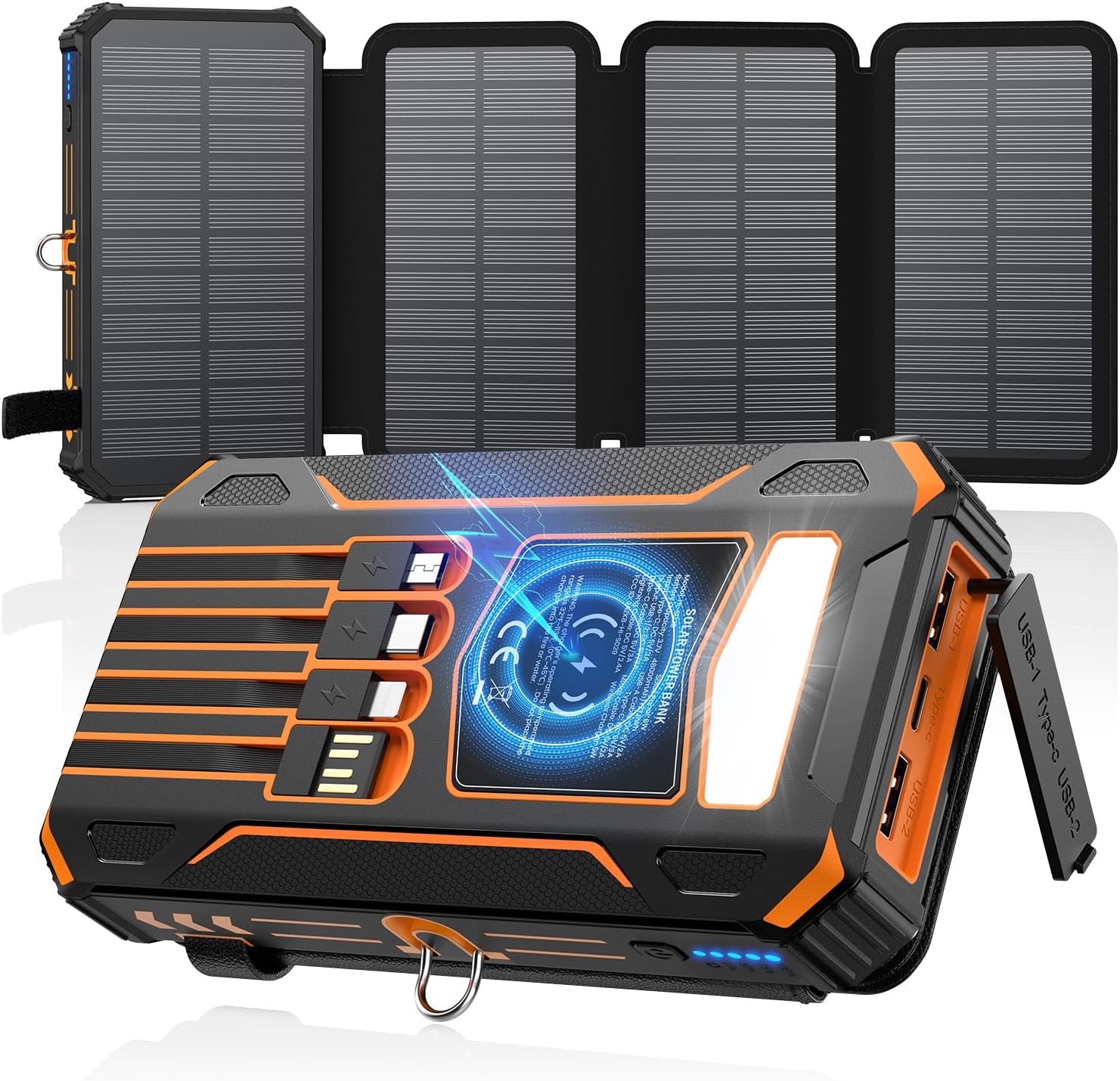
As far as maximum capacity solar chargers go, the SOARAISE 48,000mAh Solar Power Bank is your best bet for off-grid trips lasting a week.On the second day, a 10,000mAh battery pack dies. Every electronic device—phone, camera, e-reader, headphones—drains a little battery quickly.This SOARAISE just won’t give up.To start, the 48,000mAh lithium-polymer battery has more than enough power to charge ten phones or power a tablet and a phone simultaneously.Next up: a folding solar array with four panels—that’s right, four times the surface area of banks of single panels—that can be used for off-grid emergency top-ups.
Last but not least: PD/QC 3.0 rapid charging with four integrated cables: USB-C, Lightning, Micro-USB, and USB-A. No longer are misplaced cords an issue.The catch is about 1.5 pounds, which is a lot for a daypack. Never be checked for a lithium battery; it’s strictly for TSA carry-on. Charge your battery before your journey because solar input is slow.Perfect for: people who travel for weeks without a power source, utilize many devices, and digital nomads. Ultralight hikers should not use this.
3: FlexSolar 60W Foldable Solar Panel

The ideal mid-range foldable panel for charging laptops while traveling is the FlexSolar 60W.The maximum power output of most travel panels is 18W, which is sufficient for a phone but won’t charge a work MacBook.The FlexSolar takes care of that.First, a 60W adapter with PD3.0 and 40W USB-C will immediately charge the majority of laptops. No need for a power plant.After that, there’s the intelligent chip plus QC3.0 USB-A, which can recognize every device automatically and push the safe maximum speed without any manual change.
Lastly, it is foldable and waterproof (IP67), making it ideal for usage on trails and easy to store in a checked luggage.The drawback is that they are not pocket-sized, but rather bigger and heavier than 28W-class panels. Downside: no internal battery means no juice when the sun goes down. It requires more configuration than simple USB chargers.Ideal for: those who nomadize their work, travel with laptops, and utilize as a base camp. Do not bring this if you are an ultralight hiker or if you are in a hurry.
2: BigBlue 28W Solar Panel (Dual USB-C + USB-A)

Travelers looking for a tried-and-true folding panel can consider the BigBlue 28W.In the shade, inexpensive solar panels do not work. Heat is what cooks them. Three drops are enough to strip a port. For many years, seasoned vacationers have relied on the BigBlue 28W.Firstly, it has a 5V/4.8A combined output from both the USB-C and USB-A ports, so you can charge three devices at once without experiencing any throttling.After that, there’s a shadow-free surface that uses N-type cells; unlike cheaper panels, this setup doesn’t let low light or partial shade reduce output.
Last but not least: an IP44 rating and built-in heat resistance—it can withstand slight rain and even hot dashboards.There is a catch, though: each connector can only handle 5V/3A of fast charging via USB-C PD. No internal battery means power goes out as soon as the sun goes down. Weighs more than ultra-light alternatives at over 1.3 pounds.Users looking for a tried-and-true panel might consider this option. People who use PD or who prefer to keep their belongings to a minimum should not utilize this.
1: BigBlue 35W Solar Panel with PD 25W USB-C

There was a pause.In 2026, the lightest fast-charging travel panel available, the BigBlue 35W, was voted best portable solar charger for travel.There is always a compromise with any trip panel. Light panels are USB-A sluggish. Heavy panels are fast panels. You choose the middle ground.Both are rejected by the BigBlue 35W.To start, there’s the PD 25W USB-C with PPS adaptive charging, which is a programmable power supply that dynamically changes the voltage and current. There isn’t another panel that performs this.
Secondly, it’s 25% more powerful than the previous 28W panel while weighing only 1.54 pounds, and it packs 35 watts of power.Thirdly, it is fully submersible and folds down to 8.29 by 4.84 inches; it is also paperback size and has an IP68 waterproof rating.The problem is that Type-C1 is incompatible with Apple products; iPhones utilize Type-C2 connectors for charging. No internal battery means power goes out when the sun goes down. Not included: carabiner clips.Who it’s ideal for: adventurers who can’t decide between portability and speed.Intended for those on a tighter budget.
Things to Consider Before Buying a Portable Solar Chargers for Travel:
You need to evaluate several factors before investing in a portable solar charger for your travels. Understanding power capacity, charging speed, size, and weight will help ensure you choose the right model for your adventures.
Monocrystalline and Polycrystalline Rigid Panels
Monocrystalline panels are known for their high efficiency and compact size, making them ideal for limited spaces. In contrast, polycrystalline panels offer a more budget-friendly option but generally yield less energy under the same conditions.
Thin-Film and CIGS Flexible Technology
Thin-film technology provides lightweight and flexible solar solutions, perfect for travel. CIGS panels, a subtype of thin-film, boast even greater flexibility and adaptability for various applications.
Thin-film and CIGS panels are ideal for those requiring portability and versatility. Their lightweight build allows easy integration into backpacks and camping gear, enabling energy generation in unconventional settings, such as on roofs of tents or moving vehicles.
Integrated Solar Power Banks for Minimalists
Integrated power banks combine solar charging with battery storage, appealing to travelers prioritizing convenience. You can charge devices directly while storing excess solar energy for later use.
These power banks simplify your travel experience by eliminating the need for multiple devices. You can charge phones, tablets, and small electronics seamlessly throughout your journey, all while reducing reliance on traditional power outlets.
Weight, Dimensions, and Packability
Weight and dimensions play a crucial role in portability. Opt for a solar charger that balances power efficiency with lightweight design, allowing for easy transport during your travels. Weight and dimensions affect how easily you can carry the solar charger. A compact option fits more conveniently in your bag without adding significant weight, imperative for long journeys or hiking expeditions. Prioritizing packability will help keep your travel gear manageable.
Durability and Weather Resistance Ratings
Assessing durability and weather resistance is critical for outdoor travel. Select a solar charger constructed with high-quality materials that can withstand bumps, drops, and various weather conditions. Durability ensures your charger can endure the rigors of travel, while weather resistance ratings indicate how well it performs in rain or extreme temperatures. Investing in a charger with these qualities guarantees reliable performance regardless of the environment, securing your device’s charge when you need it most.
Limitations Regarding Weather and Charging Speed
Weather conditions largely impact solar charger performance. Cloudy days or storms can significantly reduce charging efficiency, leading to slow energy accumulation. Understanding this limitation helps you plan your charging needs effectively.
Charging speed is not always optimal, especially during overcast days. Even on sunny days, performance may vary due to the angle of sunlight or obstructions. Frequent travelers should consider extra battery packs to ensure their devices remain powered when solar energy is insufficient.
Assessing Your Device Energy Consumption
Calculate your devices’ power needs. Knowing the wattage and battery sizes of your electronics helps determine the right charger for your travel needs.
Matching Charger Capacity to Trip Duration
Select a charger based on how long you’ll be away. Consider how much power you’ll consume daily to ensure your device stays charged throughout your trip.
To avoid running out of power, estimate your daily energy use. Factor in how frequently you use devices and their respective power ratings. A charger with higher capacity will keep your electronics functional during extended trips, while a lower-capacity charger may leave you scrambling for power when you need it most.
Selecting Compatible Connectors and Ports
Choose a charger with the correct connectors for your devices. Compatibility ensures you won’t be left without a way to charge when needed.
Examining your devices for charging ports is necessary. Different devices may require USB-C, micro-USB, or other types of connectors. Ensuring your portable charger includes the necessary connectors prevents frustrating situations while traveling, allowing for smooth and hassle-free charging on the go.
Optimal Positioning and Sun Tracking Techniques
Positioning your solar charger directly towards the sun significantly improves efficiency. Adjusting the angle throughout the day captures maximum sunlight, allowing for quicker charges.
Utilizing External Batteries for Energy Storage
Using external batteries provides a reliable way to store energy generated from your solar charger, ensuring devices remain powered even when sunlight is limited.
These additional batteries act as buffers, enabling you to charge multiple devices efficiently. When the solar charger produces excess energy, it can effectively fill the external battery. Later, accessing stored energy during non-sunny periods keeps your devices operational without needing immediate sunlight.
Managing Heat Dissipation During Peak Sunlight
Heat can hinder the performance of your solar charger. Keeping the device cool is necessary for maintaining optimal charging efficiency.
Placing your solar charger where it receives airflow can help mitigate overheating. Avoid surfaces that trap heat, like asphalt or metal. Ensuring the charger has sufficient space around it prevents excessive heat buildup, promoting a more effective charging experience during peak sunlight hours.
Cleaning Surface Residue for Maximum Intake
Dust and debris can obstruct sunlight absorption. Wipe the solar panels with a soft, damp cloth regularly to remove any residue. This simple action maximizes energy intake and keeps your charger efficient.
Proper Storage and Transport Protocols
Store your portable solar charger in a protective case to avoid damage. Avoid exposure to extreme temperatures and keep it away from sharp objects. Following these protocols will help ensure the device functions optimally for years.
Proper storage entails using a protective cover during transport and placing the charger in a dry, cool location. Ensure that it is stored in a way that prevents bending or creasing of the solar panels. Regularly inspect the charger for any signs of wear or damage, addressing issues before they impact performance.
Summing up
Following this guide can help you make an informed decision when purchasing portable solar chargers for travel. Focus on key factors such as efficiency, weight, durability, and compatibility with your devices. Scrutinize customer reviews and warranties to ensure you choose a reliable product that meets your travel needs.
Leave a Reply