
Shopping for the best QLED TVs can feel overwhelming when every screen promises brighter colors and sharper detail. This guide cuts through the hype to help you find a TV that fits your room, budget, and viewing habits. We compare picture quality, gaming features, and smart TV performance, so you can choose with confidence and avoid an expensive letdown. Get ready to discover which models truly stand out.
Contents
- Top 7 QLED TVs:
- 7: INSIGNIA 65″ QF Series QLED Fire TV
- 6: Roku 65″ Plus Series QLED Mini-LED TV
- 5: TCL 65″ QM6K QLED Mini LED TV
- 4: Samsung 65″ QN70H Neo QLED TV
- 3: Hisense 65″ U7SG Mini-LED TV
- 2: Hisense 65″ U8QG Mini-LED TV
- 1: TCL 65″ QM8L SQD-Mini LED QLED TV
- Things to Consider Before Buying a QLED TV:
- Standard QLED and Mini-LED Options
- Screen Sizes and Resolution
- Room size, brightness, and lighting
- Refresh rate, gaming, and smart features
- Set a budget and measure your space
- Match specifications to your viewing habits
- Key advantages
- Potential drawbacks
- Check ports, warranty, and software support
- Compare picture quality and total cost
- Conclusion
Top 7 QLED TVs:
7: INSIGNIA 65″ QF Series QLED Fire TV

The Insignia 65-inch QF Series is the most cost-effective option for a large QLED display.Simple, flat-colored LED screens are standard on most budget 65-inch TVs. Quantum dots are employed by the QF Series.One example is a 4K screen that uses quantum dot color with a direct LED backlight, which produces more uniform and vibrant colors.Up next, you’ll find the premium formats seldom seen at this level: Dolby Vision HDR and Dolby Atmos audio.
A voice-activated Alexa remote and AirPlay compatibility for iOS devices round out the Fire TV lineup.Downside: It’s only 60Hz, so fast-paced sports won’t seem as fluid. Deep blacks without local fading. Only three HDMI inputs.Ideal for: bedrooms, guest rooms, and first-time buyers of huge screens. Do not read this if you are a gamer or enjoy watching movies in a dark room.
6: Roku 65″ Plus Series QLED Mini-LED TV

When it comes to minimalist mini-LED TVs on a budget, nothing beats the Roku 65-inch Plus Series.New TVs feel like homework due to their cluttered menus. Simplicity is key to the Plus Series.The first is a QLED screen with mini-LED illumination, which produces richer highlights and deeper blacks.Finally, the Roku Smart Picture Max automatically adjusts the contrast, brightness, and saturation to suit any given scenario thanks to its artificial intelligence capabilities.
Last but not least: a built-in subwoofer for Dolby Vision and Dolby Atmos, as well as a Bluetooth Headphone Mode for those late-night listening sessions.There is a drawback to using a 60Hz panel for fast-paced games. Sponsored material appears on the home screen. Less expensive sets have more precise dimming.Who it’s best for: people who want to cut the cord, families, and those who want a steep learning curve. Attention all console gamers: 120Hz is not for you.
5: TCL 65″ QM6K QLED Mini LED TV

When it comes to sports, gaming, and movie nights, the TCL QM6K is the greatest all-around value.Standard televisions distort dark scenes and muddy fast-motion footage. Both are fixed by the QM6K.To start with, there’s the QD-little LED, which combines little LEDs with quantum dots to produce dazzling light in more than a billion different hues.Following that, we have native 144 Hz with 480 m/s. With fast breaks and VRR, gaming remains tear-free.
Dolby Vision, HDR10+, and IMAX Enhanced all work together to make TCL Halo Control dimming even more effective in enhancing black levels.Downside: subtitles may appear with haloing. Textures appear muted in older, lower-resolution files. Light from windows and lamps shines off the shiny screen.Those who desire a single TV for all their entertainment needs, casual gamers, and sports enthusiasts will love this. Avoid in extremely bright areas or if you’re a DVD collector.
4: Samsung 65″ QN70H Neo QLED TV

The greatest option for giving old media a fresh appearance is the Samsung QN70H Neo QLED.Even on a 65-inch screen, cable news, older episodes, and compressed streaming don’t seem sharp enough to be considered 4K. Problem solved by the QN70H.To start, even sources with low resolution will appear clearer thanks to the NQ4 AI Processor’s 4K Upscaling, which reconstructs information.The next generation, the Quantum Mini LED, will bring both brilliant light and crisp dark sceneries.
At long last, Color Booster Pro and 100% Color Volume with Quantum Dot allow you to get brilliant shades regardless of the lighting conditions.Downside: I can only see HDR10+, not Dolby Vision. In this case, 120Hz is behind the quicker sets. Dimming zones are less compared to the flagships.The ideal choice for those who have a Samsung phone, view content in 4K, or are upgrading from 1080p.Intended audience: ardent gamers and Dolby Vision enthusiasts.
3: Hisense 65″ U7SG Mini-LED TV
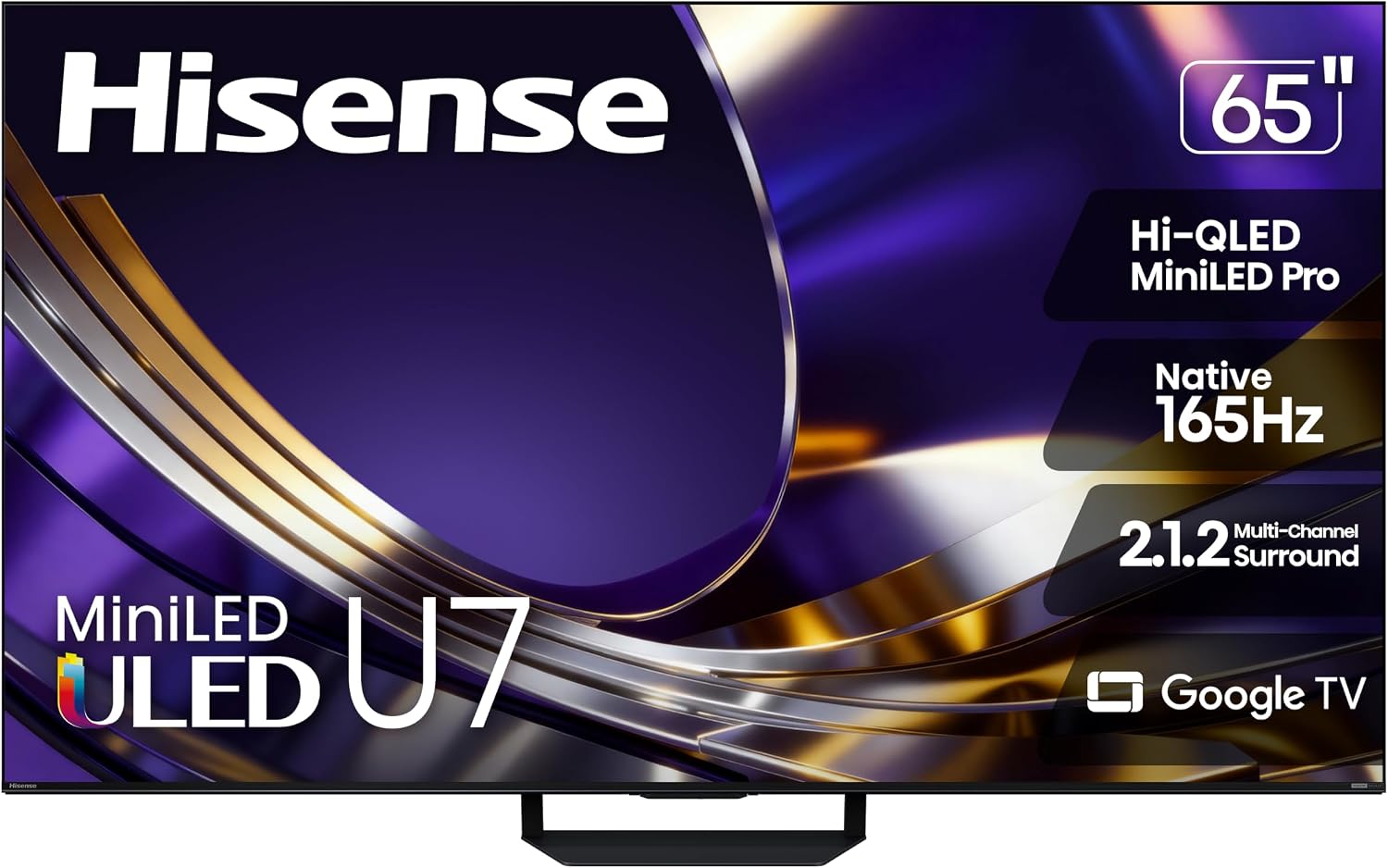
The Hisense U7SG is the top-rated QLED TV for environments with plenty of natural light.The sun’s rays in the afternoon cause the majority of screens to reflect the light. Return fire from the U7SG.An anti-reflection screen with two layers is the first. The image remains crisp throughout the day due to the low light levels caused by windows and overhead lights.Coming up next: a peak brightness of up to three thousand nits and three thousand local dimming zones, meaning precise shadows and powerful highlights.
At long last: 165 Hz native with 330 Hz VRR. Gaming feels instantaneous, whereas sports appear flowing.Downside: because to its matte appearance, it can appear somewhat foggy. The second-best option is trailed by peak brightness. Despite the 2.1.2 speakers, a soundbar is still required.Ideal for: playstation gamers, sunny living spaces, and afternoon sports. Do not watch if you have a matte screen or if you have a dark at home theater.
2: Hisense 65″ U8QG Mini-LED TV

The top QLED for home theater sound without a soundbar—the Hisense U8QG.The sound quality of a thin TV speaker is subpar. The theater in is constructed by the U8QG.At the top of the list is a 4.1.2-channel Dolby Atmos system, which includes surround channels, an integrated subwoofer, and two speakers that direct sound upwards.After that, there are dazzling highlights and almost no halos, with a peak brightness of up to 5,000 nits and as many as 5,600 local dimming zones.
At last, AMD FreeSync Premium Pro at native 165 Hz and Filmmaker Mode to watch movies the way the directors intended.Limitation: just three HDMI ports. An off-center light bloom is visible. Dolby Vision content is reportedly dim for certain consumers.Ideal for: videophiles, those living in small apartments, and those who enjoy high dynamic range (HDR). Do not use in configurations that have four or more HDMI devices.
1: TCL 65″ QM8L SQD-Mini LED QLED TV

In terms of quality light-emitting diode (QLED) televisions, the current market leader is the TCL QM8L.You have to make a choice with even the best televisions: either it’s too dark for movie nite or too bright for the day. This QM8L just won’t make a decision.Firstly, the brightest TV on this list—up to 6,000 peak nits. HDR highlights are striking even when the space is brightly lighted.Secondly, there can be contrast ratios of up to 7,000:1 and up to 4,000 dimming zones. Deep blacks remain, crisp brights remain.
Thirdly, an Ultra Color Filter that uses 5-nanometer particles instead of the usual 60 — for incredibly precise color reproduction.The fourth feature is an extendable Bang & Olufsen audio system and 144 Hz with Game Accelerator 288 VRR.Downside: this place has the highest price at the moment. We need additional TCL speakers for full surround. With HDR content, its 6,000-nit peak becomes relevant.Who it’s great for: movie buffs, HDR enthusiasts, and perfectionists everyplace. Does not work with: tiny bedrooms or limited funds.
Things to Consider Before Buying a QLED TV:
Choosing a QLED TV offers an enticing opportunity to enhance your home entertainment experience. However, several factors influence the decision-making process. Understanding your viewing habits, the size of your space, and the specific features that matter to you will help you make an informed choice.
Standard QLED and Mini-LED Options
Standard QLED TVs excel in brightness and vivid color reproduction, making them suitable for bright rooms and varied lighting conditions. Alternatively, Mini-LED options provide greater local dimming capabilities, resulting in improved shadow detail and contrast ratios. Purchasing a Mini-LED model can enhance your viewing experience when watching dark scenes or high-dynamic-range content. Prices between the two types may vary, but the benefits of Mini-LED often justify the investment for discerning viewers.
Screen Sizes and Resolution
Screen size and resolution are critical factors when selecting a QLED TV. Manufacturers typically offer sizes ranging from 43 inches to over 85 inches, accommodating various room dimensions and viewer preferences. Higher resolutions, such as 4K and 8K, indicate greater detail and clarity, especially on larger screens. Viewing distance also influences resolution choice; closer seating may benefit from 4K or higher to fully appreciate the detail. Adjusting your screen size and resolution based on these elements ensures an optimal viewing experience.
Room size, brightness, and lighting
Room characteristics significantly affect how well a QLED TV performs. A larger room generally requires a bigger screen to maintain optimal viewing distances, while smaller spaces may benefit from more compact models. Brightness in the room is another factor; darker environments can enhance contrast and color vibrancy, while bright rooms might require a TV with better peak brightness capabilities. Assess light fixtures and window placements, as these all influence the QLED’s visibility during daytime hours.
Refresh rate, gaming, and smart features
Refresh rates can change the way fast-moving visuals are perceived, especially during gaming. A higher refresh rate ensures smoother motion, which is particularly beneficial for action-packed games. When considering smart features, evaluate the operating system and app compatibility, as these elements enhance user experience and access to content. Many QLED TVs provide robust gaming features, such as low input lag and variable refresh rates, essential for a seamless gaming experience.
Set a budget and measure your space
Deciding on a budget significantly influences your options. Take time to assess your finances, factoring in other potential expenses like installation and accessories. Measuring your space comes next; the dimensions of your room will dictate the size of the TV. A 55-inch model could look right at home in a mid-sized living area, while larger screens may be more suitable for spacious environments. These initial steps facilitate narrowing down your choices.
Match specifications to your viewing habits
Determining how you use your TV plays a significant role in selecting the right model. If you enjoy gaming, look for features like low input lag and high refresh rates, which will enhance your experience. For movie enthusiasts, high dynamic range (HDR) compatibility becomes important for color and detail. Those who frequently watch sports might prioritize motion clarity, while casual viewers may settle for basic specifications. Aligning features with your habits streamlines the selection process.
Key advantages
Vibrant color reproduction sets QLED TVs apart from several other display technologies. Their ability to produce bright images, even in well-lit environments, appeals to many viewers. Enhanced contrast ratios also contribute to deeper blacks, improving overall picture quality. With impressive longevity, QLED panels generally last longer than OLED panels, making them a practical investment. Compatibility with HDR formats ensures you can enjoy a wide array of visual content in high dynamic range.
Potential drawbacks
Viewing angles present a notable limitation for QLED TVs, as colors may shift when viewed from the side. Black levels can sometimes struggle to compete with OLED displays, which may deter those seeking a true cinematic experience. Although they perform well in bright settings, QLED technology might not be ideal for dark-room viewing due to the backlight bleeding effect. Lastly, prices can vary significantly, with premium models often exceeding the budgets of casual buyers.
Check ports, warranty, and software support
Inspecting the back and sides of QLED TVs for ports is necessary for ensuring compatibility with your devices. Key connections to consider include HDMI, USB, and optical audio ports. A comprehensive warranty can enhance your peace of mind, as it protects you from manufacturing defects. Additionally, look for software support, including operating system updates and app availability, since some brands have a more robust ecosystem that can affect your viewing experience over time.
Compare picture quality and total cost
Evaluating picture quality involves more than just resolution; factors such as contrast ratio, color gamut, and brightness play significant roles. Spend time watching various content types, from movies to sports, to gauge performance under different conditions. Alongside, total cost is essential; factor in potential additional expenses like mounting hardware or smart home integration. Balancing these elements can illuminate which model offers the most value for your needs.
Conclusion
Making an informed decision when purchasing a QLED TV requires consideration of various factors, including picture quality, brightness levels, and viewing angles. Prices can vary significantly, making it essential to assess your budget alongside desired features. Pay attention to compatibility with other devices you own, as well as potential warranty and customer support options. Evaluating these elements can lead to a purchase that meets your entertainment needs and enhances your viewing experience for years to come.
Leave a Reply