
Tired of risking your safety on shaky ladders just for a clear view? Finding the best robot window cleaner can transform your home maintenance from a dangerous chore into an incredible success. These smart home gadgets deliver a streak-free shine while you relax comfortably. Stop struggling with messy tools and enjoy the revolutionary ease of automated glass cleaning. Let’s explore the top-rated models that will make your glass sparkle today.
Contents
- Top 7 Robot Window Cleaner:
- 7: Tosima W5 Window Cleaning Robot
- 6: ECOVACS WINBOT Mini
- 5: ECOVACS WINBOT MINI2
- 4: HUTT Window Cleaning Robot
- 3: ECOVACS WINBOT W2 PRO Omni
- 2: ECOVACS WINBOT W2S Omni
- 1: ECOVACS WINBOT W3 Omni
- Things to Consider Before Buying a Robot Window Cleaner:
- Suction-Based Single-Surface Cleaners
- Magnetic Dual-Surface Systems
- Window Frame Detection and Obstacle Sensors
- Suction Strength and Safety Backup Power
- Safety Advantages for High-Rise Maintenance
- Limitations in Corner Precision and Speed
- Pre-Cleaning Inspection and Safety Tethering
- Calibrating Path Modes for Maximum Coverage
- Maintenance of Microfiber Pads and Hardware
- Conclusion
Top 7 Robot Window Cleaner:
7: Tosima W5 Window Cleaning Robot

For those shopping on a tighter budget, we recommend the Tosima W5.You want to get off the rungs, but you’re hesitant to invest a lot of money on a device you’ve never used. That bar is lowered by the W5.The first is an adaptable suction system with a 6400Pa rating that changes as needed to firmly grip the glass without requiring constant attention.Following that, a bidirectional ultrasonic spray with a dual-spiral cleaning design will mist the glass uniformly rather than soaking just one region.
The air-pressure anti-drop sensor scans the window border and stays put thanks to AI edge identification.Bad: You can’t do much with the 65 ml tank. Only controllable by remote; no app. Ideal for regular, flat glass.Ideal for: those who are trying it out for the first time or are on a tight budget. Big, multi-story assignments and app management are not my strong suits.
6: ECOVACS WINBOT Mini

For quick, frequent cleanings, nothing beats the ECOVACS WINBOT Mini, the greatest lightweight option.You only use most window robots twice a year since they are cumbersome and take a long time to set up. The little car snatches and runs.Before anything else, there’s the small, lightweight body that you can lift with one hand and attach to the glass in a matter of seconds. No complicated assembly is required.
Next, there are three different cleaning modes that have been fine-tuned for common messes like dust and fingerprints, so you can get a quick touch-up done in minutes instead of an afternoon.Lastly, it runs quietly enough to use while on the phone or when the kids are napping.Downside: not designed for stubborn filth or years of accumulation. Reduced run coverage. Pads can’t clean themselves.Those who want it easy and clean frequently will like it the most. This is not the place for: extensive window repairs.
5: ECOVACS WINBOT MINI2

When dealing with challenging glass surfaces, such as narrow panes or mirrors, the ECOVACS WINBOT MINI2 is the way to go.Large square robots are unable to traverse towering mirrors or squeeze through divided windows. Where they fall short, the MINI2 is tailor-made to take you.First, a small, sleek frame that other robots have a hard time navigating around thin panes and French-style windows.
Following that, you’ll find five intelligent cleaning modes that may be adjusted to suit different types of glass, such as narrow, wide, or reflective surfaces.Last but not least: WIN-SLAM 4.0 navigation, which meticulously covers the surface instead of aimlessly meandering around.Negative: it takes longer for large glass walls because it is optimized for smaller surfaces. Focus on light tasks. Miniature tank.Ideal for houses that have glass doors, mirrors, and divided windows. Large picture windows and thick external dirt are not suitable.
4: HUTT Window Cleaning Robot
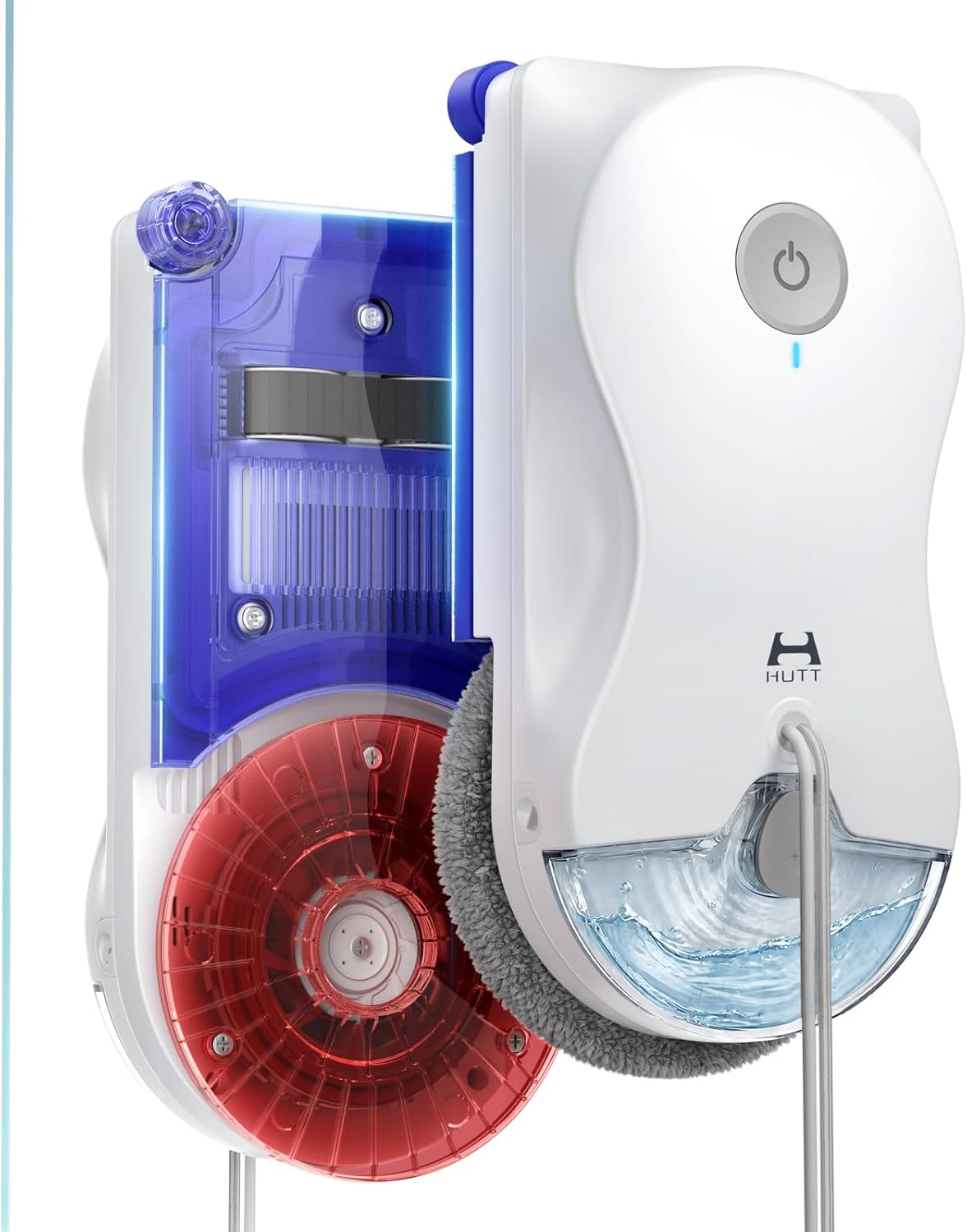
The HUTT Robot Window Cleaner is ideal for cleaning corners and frameless windows.Robots with round pads can’t turn around since they spin in a circle. HUTT corrected this by redesigning the form.To start, it has a revolutionary round-square dual-stage design that cleans both the open glass and the corners that average robots miss.The next step is a 14-sensor NAVI 7.0 system that automatically measures the window and follows its edge, along with a suction pressure of 6500Pa and a constant pressure of 55N.
Lastly, a 220 kg safety rope and a 30-minute power-off backup ensure that it will not fall in the event of an outdoor power surge.Downside: it’s a more recent model with less experience. It’s unnecessary to use corner-first design for plain framed windows.Frameless glass, glass railings, and windows with many corners are the best candidates. Not for: small windows or those seeking a tried-and-true model.
3: ECOVACS WINBOT W2 PRO Omni

For balconies without an outlet, the ECOVACS WINBOT W2 PRO Omni is the ideal all-arounder.Unless you have a balcony, most high-end robots won’t do you any good. In order to cut the cord, the W2 PRO is used.To start, it has two power modes: one that allows you to clean continuously without an outlet (battery mode) and another that will last up to 110 minutes when used without an outlet.Following that, the robot doesn’t stop cleaning in the middle of a window because it can be recharged on the go using a portable charging station.
A triple-nozzle sprayer with twelve levels of safety features is now available; it uniformly distributes water while locks it to the glass using these precautions.Drawbacks: the station makes the store bulkier. Pricier option. It takes more time to set up than a grab-and-go model.This robot is perfect for those with limited space, multiple windows, or just want a handyman on hand. Intended use: short touch-ups indoors.
2: ECOVACS WINBOT W2S Omni

Ideal for expansive glass walls and expansive picture windows—the ECOVACS WINBOT W2S Omni.Crawling endlessly across a massive window, a robot that is fantastic on a small glass manages to miss the edges. Built for scale, the W2S stands tall.To start, the TruEdge edge-to-edge accuracy cleans the frame line without ringing it by pushing the scrubber all the way to the edge.The following step is multi-zone navigation, which involves mapping a large span and operating it in portions to cover a large area without retracing.
The 6-in-1 station with three wide-angle nozzles is the last piece of the puzzle; it supplies the robot with water and electricity across a long distance.Downside: not suitable for everyday use due to high price tag. There must be room on the sill or counter for the station. Too much for housing complexes.Open floor plans, large windows, and glass walls work best. Not suitable for: limited space or limited funds.
1: ECOVACS WINBOT W3 Omni

In 2026, the most cutting-edge, hands-free robot window cleaner available was the ECOVACS WINBOT W3 Omni.Streaks are left when every other robot pulls a dirty pad across clean glass. That step was eliminated by the W3.First, there’s the self-cleaning station with Vortex Wash; it uses 16 high-pressure jets to re-clean the pads halfway through the cleaning process, ensuring that it’s constantly using a new pad.The second is the autonomous navigation with 1 mm precision obstacle avoidance using WIN-SLAM 5.0, which can even go past handles and latches.
Finally, there’s TruEdge scrubbing, which follows the contours of the edge and pushes into the corners to match the professionals below.For the fourth, there’s a wide-angle spray with three nozzles and twelve levels of safety that cleans uniformly and stays put on high glass.The most costly option here is a drawback. In terms of storage space, the station has the biggest footprint. A little more time to get up to speed.Ideal for: one-time tasks or cleaning the entire house. Ideal for those on a tighter budget or with a single window.
Things to Consider Before Buying a Robot Window Cleaner:
Cleaner windows can enhance your home’s appearance and let in more light. Before investing in a robot window cleaner, consider various features such as price, cleaning ability, and ease of use. This decision can impact both your cleaning routine and your overall satisfaction with the device.
Suction-Based Single-Surface Cleaners
These models utilize suction technology, making them effective on flat glass surfaces. Equipped with powerful suction, they adhere well, ensuring a thorough clean without the need for assistance. Many users appreciate their ease of use, particularly on larger windows.
Magnetic Dual-Surface Systems
Employing strong magnets, these devices clean both sides of the glass at once. This type adapts well to varying glass thickness, making it suitable for diverse applications, including high-rise buildings or double-glazed windows.
Magnetic dual-surface systems provide a unique solution for those with windows that are challenging to reach. Designed for versatility, they can tackle different thicknesses of glass, addressing cleaning tasks more effectively than single-surface models. Many options also come with smart features, enhancing usability in various environments, ensuring that maintenance of hard-to-reach areas is no longer a dilemma.
Window Frame Detection and Obstacle Sensors
High-quality window cleaners integrate advanced sensors for detecting window frames and obstacles. Efficient navigation ensures the device avoids falling or getting stuck, especially on ledges. Some models utilize laser technology for precise mapping, further enhancing their cleaning capability.
Suction Strength and Safety Backup Power
Suction strength determines the cleaning effectiveness of a robot window cleaner. Robust suction is important for removing stubborn dirt and debris. Backup power ensures that the device remains operational in case of power intermittence, preventing accidents during the cleaning process.
Strong suction capabilities not only enhance the cleaning performance but also accommodate different window types, whether double-glazed or tinted. For instance, models with adjustable suction settings can optimize their power based on the level of dirt, providing versatility. Safety features, like backup battery systems, add an extra layer of protection, allowing the cleaner to securely finish its task without sudden failures. Many advanced units feature notifications for low power, offering peace of mind while you concentrate on other tasks.
Safety Advantages for High-Rise Maintenance
Robotic window cleaners reduce risk during high-rise maintenance by minimizing the need for ladders and scaffolding. Their built-in safety features, such as sensors and emergency stop functions, prevent falls, making cleaning safer for both the operator and occupants.
Limitations in Corner Precision and Speed
Corners often prove challenging for robotic window cleaners, leading to potential gaps in cleaning. Speed can also diminish effectiveness; many models require time to navigate carefully, resulting in slower overall cleaning jobs. Limitations in corner precision and cleaning speed can be significant drawbacks. Automated systems may leave streaks or uncleaned areas, especially in complex window designs. Speed optimization often compromises thoroughness, especially when tackling corners. Regular maintenance of these robots is vital to ensure they navigate these tricky spots more effectively. Familiarizing yourself with a model’s specific capabilities can mitigate these issues and enhance overall performance.
Pre-Cleaning Inspection and Safety Tethering
Inspecting your windows beforehand ensures that the surface is free from loose items or significant dirt buildup. Attach the safety tether securely to an anchor point to avoid potential falls, particularly if cleaning is done at height. This measure increases your peace of mind while the robot operates.
Calibrating Path Modes for Maximum Coverage
Selecting the right path mode enhances cleaning efficiency by adapting to your window dimensions. Various modes, like “Zigzag” or “Spiral,” can optimize coverage based on the layout and condition of your glass surfaces.
Path modes often involve pre-set patterns that maximize cleaning effectiveness. The “Zigzag” mode is particularly effective for larger windows, as it systematically covers every inch and avoids missed spots. Adjustments may also include speed settings that cater to the specific cleaning needs of your windows, whether they are heavily soiled or maintained regularly, ensuring all cleaning tasks are met efficiently.
Maintenance of Microfiber Pads and Hardware
Regular maintenance of microfiber pads and hardware guarantees longevity and performance. Wash pads after each use and ensure no debris clogs the mechanisms.
Failure to maintain microfiber pads may result in streaks during cleaning sessions. Replacement pads should be kept on hand, as worn-out pads can hinder cleaning efficiency. Inspect hardware components regularly, as built-up dirt can affect the robot’s movement and cleaning capability, leading to subpar results.
Conclusion
Investing in a robot window cleaner requires consideration of various factors including window type, cleaning frequency, and your budget. Evaluating features such as suction power and navigation technology can help ensure you select a model that effectively meets your needs. Thoroughly researching customer reviews and product specifications will lead to a more informed purchase decision.
Leave a Reply