
The best smart motorcycle helmets help you stay connected without taking your focus off the road. If you’re tired of missing calls, struggling to hear navigation, or juggling bulky gear, this guide will help you find a safer, more comfortable fit. We compare key features like Bluetooth helmet audio, voice control, and battery life so you can choose with confidence. Get ready to ride smarter-let’s explore the top options.
Contents
- Top 7 Smart Motorcycle Helmets:
- 7: ILM Bluetooth Integrated Modular Motorcycle Helmet 953
- 6: Sena Outrush R Modular Smart Helmet
- 5: Sena OutForce Smart Helmet Full Face
- 4: Sena Cavalry 2 Mesh Intercom Enabled Motorcycle Half Helmet
- 3: Sena OUTRUSH 2 Modular Smart Motorcycle Helmet
- 2: Sena Impulse Modular Smart Helmet with Sound by Harman Kardon
- 1: Sena Phantom Full Face Smart Motorcycle Helmet
- Things to Consider Before Buying a Smart Motorcycle Helmet:
- Full-Face, Modular, and Open-Face Designs
- Built-In and Add-On Smart Technology
- Safety Certifications and Helmet Fit
- Connectivity, Battery Life, and Device Compatibility
- Define Your Riding Needs and Set a Budget
- Compare Models, Test Fit, and Verify Safety Ratings
- Benefits for Communication, Navigation, and Safety
- Limitations, Maintenance, and Potential Distractions
- Check Return Policies, Warranty, and Upgrade Options
- Set Up Features and Maintain the Helmet
- Final Words
Top 7 Smart Motorcycle Helmets:
7: ILM Bluetooth Integrated Modular Motorcycle Helmet 953

For first-time riders on a budget, the ILM 953 is the smartest modular helmet available.You’ll need to mount and charge your clip-on headset separately. The 953 incorporates all components.To start, you get a full week’s worth of short commutes worth of talk time and 110 hours of standby time every charge.The following features: an FM radio integrated into the device, and rider-to-rider communication up to 1,680 feet.
Lastly, the chin bar may be raised at gas stops to reveal a modular design including a split visor.Disadvantage: choose a size larger than your usual one because it gets snug. Deep sleep is an option for the battery after extended storage. Compared to Sena models, its Bluetooth is behind.Who it’s best for: budget-conscious commuters and first-time riders. Avoid: if you require a Mesh group intercom for your riders.
6: Sena Outrush R Modular Smart Helmet

If you’re looking for a cheap modular bike with the Sena name, go no further than the Outrush R.Most smart helmets that flip up are made by unrecognized companies. Sena is encased in a detachable shell in the Outrush R.To begin, there is high-definition intercom with one other rider and Bluetooth 5.0 for two-way communication.After that, you have an intercom range of about half a mile and a talk time of up to twelve hours.
Lastly, there’s Smart Intercom Pairing, which allows you to connect with just a QR code scan.Downside: Large groups cannot use Mesh. Instead of fiberglass, the shell is made of polycarbonate. Sound accompanies Sena’s high-end models.Commuters looking for an affordable flip-up Sena are the ideal target. Groups or tourers using mesh not allowed.
5: Sena OutForce Smart Helmet Full Face

One of the greatest full-face Sena for regular commutes is the OutForce.Everyone isn’t looking for a hinge. The OutForce maintains a minimalist approach: a sealed full-face with integrated communications.To start, it has a built-in 4-way Bluetooth intercom that allows you to chat to up to three riders at once without the need for installation or clamps.Up next: a three-button interface that allows you to connect your smartphone and access music, GPS, and phone calls.
Lastly, this 3.1-pound full-face helmet has a retractable sun visor and a micro-ratchet chin strap.Drawbacks: Bluetooth only, thus you can only join small groups; no Mesh. Not long enough for a tour with only 12 hours of battery life. A simple ABS shell.Commuters with full faces who bike with companions who have Sena devices work well. Long tours and large group rides are not for you.
4: Sena Cavalry 2 Mesh Intercom Enabled Motorcycle Half Helmet

If you ride a cruiser and still like mesh intercom, the Sena Cavalry 2 is your best bet for a half helmet.On a cruiser, you want the wind in your hair, but open helmets don’t usually come with radios.Firstly, there is an integrated Mesh Intercom that allows you to communicate with other Sena Mesh riders simultaneously without having to pair each one individually.Next up: liner-integrated speakers and Bluetooth 5.2 for hands-free calling, music streaming, and navigation.
At last, a composite fiberglass half shell that weighs a mere 950 grams—nearly nothing on a lengthy voyage.Downside: a half-helmet won’t shield your face or chin from flying debris. A full charge lasts about ten hours. Wind noise from highways is difficult to ignore.Ships that sail in Sena groups are the best. Those who prefer full-face protection or who ride sport bikes should not wear these.
3: Sena OUTRUSH 2 Modular Smart Motorcycle Helmet
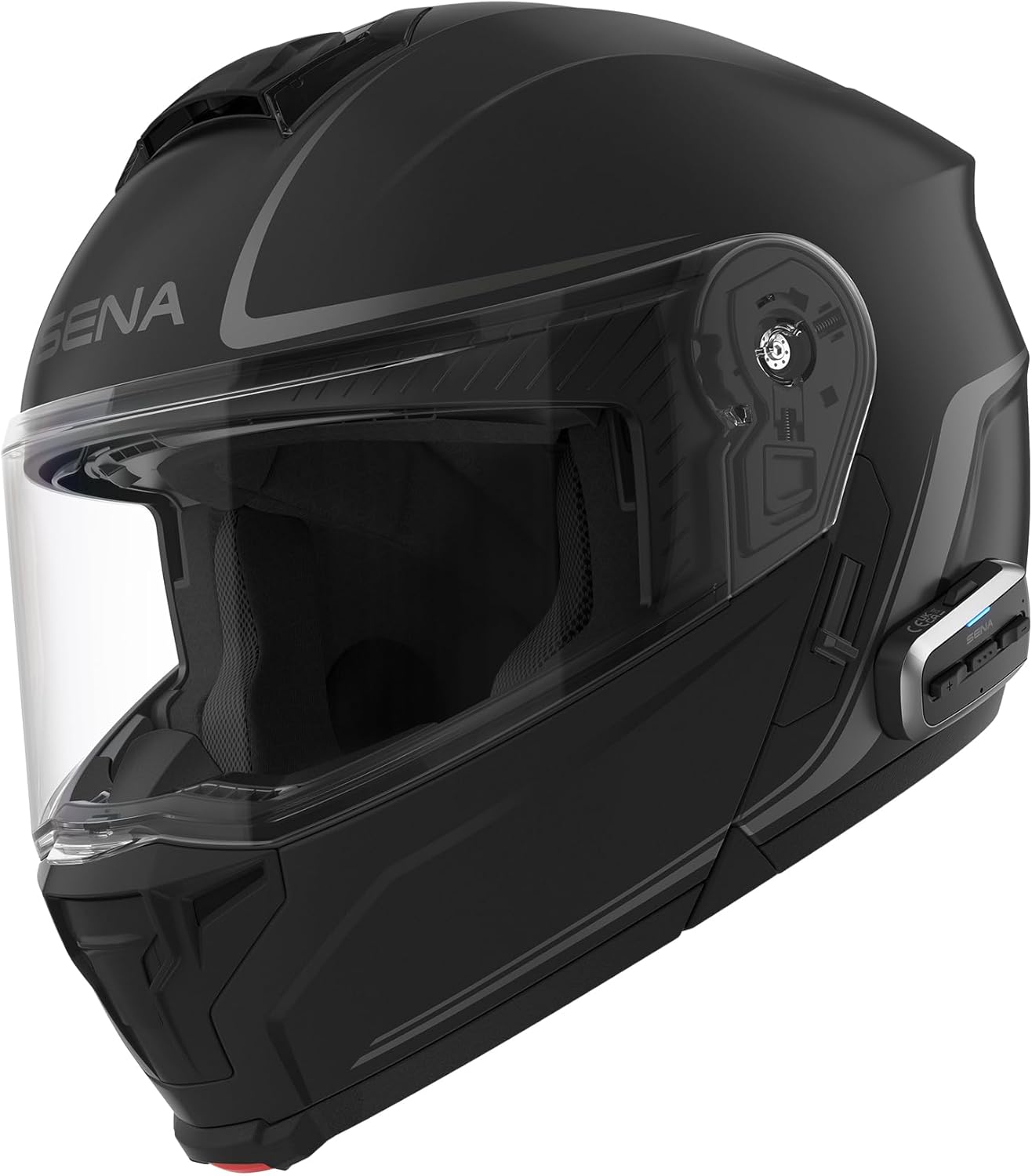
Among riders that ride for several brands, the Sena OUTRUSH 2 is the top modular.Run by your group are different brands. When it comes to communication, the majority of helmets are self-contained. Not the OUTRUSH 2.Mesh Intercom 3.0 is the first, and it’s a stable group chat for Sena users.On to the next feature: WAVE Intercom, which allows you to communicate with riders using any type of headset, regardless of the location’s mobile service.
With the chin bar up or down, you’re safeguarded by P/J dual homologation, and Intelligent Power Management turns it off when you park.Negative: Extended rides cause neck fatigue due to the 4 pound weight. WAVE is dependent on the Sena app and mobile coverage.This is the ideal option for riders whose buddies prefer other brands. This helmet is not suitable for riders who like a feather-light design.
2: Sena Impulse Modular Smart Helmet with Sound by Harman Kardon

For motorcyclists who want to use their voices while touring, the Sena Impulse is the top-tier modular system available.Spending a long time on a ride requires continual adjusting of music, calls, and directions. You can use your voice to control the Impulse.The first is the integrated voice assistant that allows you to make calls, send messages, and operate the phone without ever touching a button.And coming up next, an all-new microphone and speakers by Sound by Harman Kardon ensure crystal-clear calls and pristine music even when you’re cruising down the highway.
A composite fiberglass exterior, an integrated rear taillight, and mesh plus Bluetooth intercom round out the features.Downside: using your voice requires a connected phone. The battery life is reduced to around 11 hours while using a mesh. Using a special magnetic port, charging is possible.Those who desire high-quality music on long commutes or when traveling are the best candidates. Avoid: round-headed people or riders on shorter trips.
1: Sena Phantom Full Face Smart Motorcycle Helmet

If you’re a motorcyclist who values visibility and audibility, the Sena Phantom is your best bet for a smart helmet.Motorcyclists are constantly disregarded by drivers, particularly in the dark. Smart helmets typically allow you to converse. With the Phantom, you can turn heads.The first is an integrated front LED light and rear LED taillights with brake detecting capabilities; the latter will activate when you reduce your speed.Two, the 2nd Generation Sound system by Harman Kardon ensures crystal-clear audio, calls, and directions even when traveling at high speeds.
Lastly, for crystal-clear audio, there’s an AI-enhanced noise-canceling microphone, in addition to Mesh and WAVE Intercom.Fourth, it has a built-in tinted sun visor and a composite fiberglass casing that is DOT and ECE certified.Downside: an oblong shape won’t work for people with rounded crowns. More charging is indicated via lights and noise. Full functionality is dependent upon the Sena app.Who it’s best for: Technology-savvy riders and those who commute after dark. Do not purchase if you have a round head or do not value minimalism.
Things to Consider Before Buying a Smart Motorcycle Helmet:
Choosing a smart motorcycle helmet is more than just a trendy upgrade. With technology seamlessly integrated into these helmets, various factors come into play that can enhance your riding experience. From safety features to connectivity options, understanding what to look for can make all the difference on the road.
Full-Face, Modular, and Open-Face Designs
Full-face helmets provide the most coverage, protecting both the head and face, making them popular for riders seeking maximum safety. Modular helmets offer the flexibility of a flip-up face, ideal for those who want versatility without sacrificing protection. Open-face designs are lighter and provide greater visibility and airflow but lack the same level of facial coverage. Selecting the right type depends largely on the intended use, comfort, and desired features. Comfort, weight, and material quality can vary significantly among designs.
Built-In and Add-On Smart Technology
Smart motorcycle helmets come equipped with various built-in technologies, including Bluetooth connectivity for hands-free calls and navigation. Some advanced models feature augmented reality displays, offering real-time data such as speed and directions. On the other hand, add-on devices can upgrade traditional helmets with smart capabilities. These options can include action cameras, communication systems, or safety lights. Evaluating your preference for integrated versus peripheral features can significantly influence your purchasing decision and overall riding experience.
Safety Certifications and Helmet Fit
Prioritize safety certifications, which guarantee that your helmet meets necessary safety standards. Look for labels from DOT, Snell, or ECE that indicate rigorous testing for impact resistance and durability. Fit is equally important; a secure helmet not only enhances comfort but also improves protection. A well-fitted helmet should not shift when you shake your head. Try on several models to identify the best fit for your head shape and size.
Connectivity, Battery Life, and Device Compatibility
Consider connectivity options such as Bluetooth capabilities, which allow for hands-free communication and navigation. Battery life impacts usability; a longer-lasting battery saves you from frequent recharging during rides. Ensure that the helmet is compatible with your devices, such as smartphones or GPS units, to maximize your riding experience. Investigating user reviews can provide insights into real-world performance regarding connectivity and battery reliability.
Define Your Riding Needs and Set a Budget
Identifying personal riding needs begins with considering how, when, and where you typically ride. Casual commuters might prioritize lightweight designs, while long-distance riders may seek features like integrated communication systems. Setting a budget is equally important; smart motorcycle helmets can range significantly in price. A preliminary budget allows you to focus on models that deliver the features you need without overspending. Clarifying these aspects will streamline the selection process and keep you on track.
Compare Models, Test Fit, and Verify Safety Ratings
Researching several models is essential for success. Different brands offer various features and design philosophies, so gathering information through reviews and comparisons can be invaluable. Testing the fit is a significant component; a helmet should feel snug without causing discomfort during extended wear. Safety ratings, such as those from the DOT or Snell, should also be checked, as they reflect essential protective capabilities. Ensuring all these factors align will build confidence in your final choice.
Smart helmets enhance communication capabilities, allowing riders to connect seamlessly with mobile devices for calls or messages. Furthermore, integrated navigation systems can display directions directly on the visor, reducing the need to glance at a smartphone. Safety features, such as built-in cameras or sensors, assist in monitoring surroundings, providing an extra layer of protection. These functionalities are particularly useful in urban environments or busy traffic, offering both convenience and peace of mind while on the road.
Limitations, Maintenance, and Potential Distractions
Complexity can be a significant drawback of smart helmets, particularly regarding maintenance and updates. Riders may find themselves needing to charge devices frequently or troubleshoot software issues. Additionally, notifications and alerts can create distractions that take focus away from the road. While features like voice commands are intended to limit so-called “cognitive overload,” the reality is that any distraction can compromise safety. Making a choice may require balancing advanced technology with the fundamental need for concentration while riding.
Check Return Policies, Warranty, and Upgrade Options
Investigate the return policies of retailers before making a purchase, as some allow returns only in pristine condition. A manufacturer’s warranty can provide peace of mind; look for coverage that lasts several years to ensure long-term reliability. Consider potential upgrade options as technology evolves; some brands offer modular designs that facilitate hardware updates or software enhancements. Availability of accessories, such as replacement visors or battery packs, should also influence your choice.
Set Up Features and Maintain the Helmet
Familiarize yourself with the smart features during the initial setup to maximize functionality, as some require software updates before use. Regularly clean the visor and internal padding, ensuring visibility and comfort. Maintenance should also involve checking electronic components, such as Bluetooth connectivity, to verify they are functioning correctly. Store the helmet in a cool, dry place to prevent material degradation, extending its lifespan significantly.
Final Words
Choosing a smart motorcycle helmet requires careful consideration of various factors such as safety standards, connectivity features, and comfort. Analyzing battery life and compatibility with devices enhances your riding experience significantly. Checking for added features, like voice commands or navigation prompts, can make a substantial difference during your rides. Prioritizing fit and weight ensures that the helmet remains comfortable over longer distances, while assessing price points against desired functionalities aids in making a balanced decision.
Leave a Reply