
Searching for the best tower speakers to truly transform your listening experience? Stop settling for flat, lifeless audio that fails to fill your room. We’ve rigorously tested the top floorstanding speakers that deliver absolutely breathtaking, immersive sound quality for your music and home theater. This guide makes it simple to discover the perfect pair that will unleash the powerful, detailed audio you’ve been dreaming of. Let’s explore the top contenders that made our list.
Contents
- Top 5 Tower Speakers:
- 1. Polk Audio Reserve R700 – Best Tower Speaker Overall
- 2. Definitive Technology BP-9040 – Best Built-In Powered Bass Tower Speaker
- 3. Fluance Reference XL8F – Best Tower Speaker for Clean, Room-Filling Sound
- 4. Polk Monitor XT70 – Best Tower Speaker for Movie Night
- 5. Sony SS-CS3 – Best Budget Tower Speaker
- Things to Consider Before Buying a Tower Speaker:
- Passive vs. Active Speakers
- Wireless vs. Wired Options
- Room Size and Acoustic Considerations
- Compatibility with Existing Equipment
- Researching Brand Reputation
- Advantages of Tower Speakers
- Assessing Your Needs
- Testing Speakers in Person
- Regular Cleaning
- Proper Setup to Enhance Performance
- Summing up
Top 5 Tower Speakers:
1. Polk Audio Reserve R700 – Best Tower Speaker Overall

If you would like a tower speaker that delivers genuinely full-range authority without the angst, Polk Audio’s Reserve R700 is designed to anchor your system with authority. Gain some confidence! These Turbine Cone mid/bass drivers are uniquely designed to create sweet, clear midrange, with a breath-taking openness and transparency so you will hear the truth—your favorite music is brought to life as never before by lifelike vocals and instruments.
Low end is a highlight. The acoustically inert MDF bass-reflex cabinet offers full-range listening with a down-firing port and Power Port 2.0, and X-Port technology to eliminate port noise and deliver clear, clean bass even at the most extreme listening levels. Inside careful cross-bracing fights cabinet resonances, while the acoustically inert, anti-diffraction magnetic grille make sure that this sweet sound isn’t ruined by the look of fabric aggrandizing the stereo images.
Setup is straightforward and rewarding. Space every speaker slightly away from the back wall, start with the tweeters at ear level from your favorite seat and toe-in just enough for center vocals to solidify; only then should you migrate in a high-quality subwoofer, if your room cries out for more infrasonic weight — many listeners find even two R700s give all the authority required for music and film.
Bowers and Wilkins Reserve R700Sign up for more from TechSubscribe at TODAY newsletterIf you’re building a system that pulls double duty — hi-fi by day, cinema by night — the Reserve R700 gives boundlessly clear point-source clarity, dynamics that will make the hairs on your arms stand tall, and room-filling bass from a design-driven tower as elegant as it is ready for the future (and your space).
2. Definitive Technology BP-9040 – Best Built-In Powered Bass Tower Speaker

If you value deep room-filling bass and a vast sweet spot above all, the Definitive Technology BP-9040 tower is your no-holds-barred AV rule enforcer. You’ll enjoy an 8-speaker front/rear array (BDSS drivers, including a pair of front 1″ tweeter and dual 4.5″ mids, as well as a rear-facing 1″ tweeter and single 4.5″ mid) for lifelike detail that fills your room with wraparound sound. A built-in, powered 8” subwoofer and dual bass radiators deliver foundation-shaking bass without the need for a separate sub-woofer which many large soundbars require in order to track elements of action movies or have full range response with music.
You’ll love how Forward-Focused Bipolar Technology creates a wide, immersive soundstage and brings out room-filling performance no matter where you’re sitting in the room. Intelligent Bass Control enables you to dial in extra bass without disrupting vocals or dialog, bringing the rich sound of your favorite entertainment to the room without tempering with the crispness of its balance between high and low noises. Capable of 300W output and with wide high-frequency response extending all the way out to 40 kHz, the BP-9040 takes so much punishment as we intended for its two siblings and will remain unflappable at cinematic volumes while serving up airy detailing in your Hi Res Tracks.
You’re also good to go for modern surround. A dock on the top takes an optional A90 height module, so you can grow into three-dimensional Dolby Atmos or DTS:X sound without having to add more floor boxes.
If you’re looking for fewer parts, greater power and flexibility with a supremely cool factor, the 9040’s svelte design is just the ticket.” BP-9040 — Steve Guttenberg, Sound & Vision If you want all the thrills of five-speaker surround sound without the need for separate speakers turn look no further than our BP9080 The high-performance, built-in powered subwoofers deliver floor shaking bass.
3. Fluance Reference XL8F – Best Tower Speaker for Clean, Room-Filling Sound
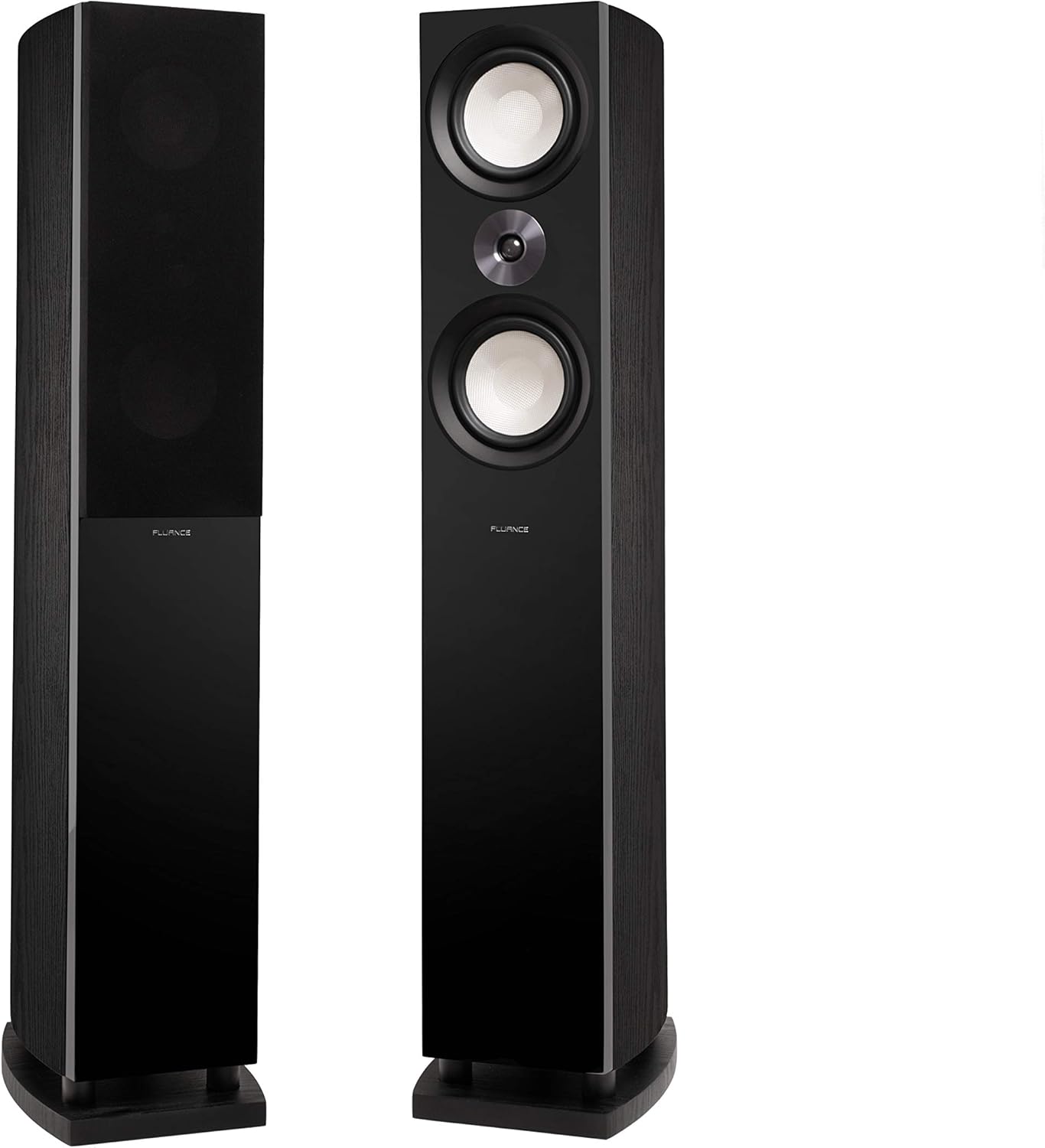
If you are seeking hassle-free, room-filling sound without the mess, perhaps the Fluance Reference XL8F delivers just that. What you’ll have here is a wired tower (doesn’t need to be powered) made for both stereo music and surround speakers, able to handle 160 watts, extending all the way out into your room’s far reaches up to 25kHz with airy detail in your fave tracks and even film scores.
Bass arrives with authority. The distinctive down-firing 8 inch subwoofers fill any room with powerful, yet tight and accurate bass to elevate the emotion of your music source without overpowering from a minimal space using ultra compact design. Kick drums hit with heft, synths have texture and action scenes land with real impact — without muddling vocals or obscuring instruments.
The midrange is where your music will live, and the woven fiber drivers keep it honest. Natural damping and a perfectly flat frequency response, meanwhile, produce voices and acoustic instruments that come across as if you’re in the studio with them — authentic vocals, clean guitars and dialogue make it easy to hear detail lesser towers muddle. Back up top, fine-tuned silk-dome neodymium tweeters deliver natural highs with total wall-to-wall imaging from generous off-axis dispersion which tends to both more of your room into the high-performance “sweet spot” and wide dynamics. Sit to the left, right or center — and feather-detail and balance are preserved.
Use a pair as your main left/right towers or build them into a full Fluance system and experience the power, clarity and immersive sound that you’ve come to expect from Fluance. If your main concern is to have clarity, depth and scale that fills the room (without filling it with too much speaker), then you can’t fail by upgrading your home audio experience with the XL8F.
4. Polk Monitor XT70 – Best Tower Speaker for Movie Night

If you like to relax with movie night, bring the Polk Monitor XT70 home and your living room becomes front row. You receive a high-performance tower with 1″ tweeter, dual 6.5″ dynamic balance drivers (front) and dual 8″ passive radiators that work together for full-range, superior sound; even in the lowest bass ranges where many other Bluetooth speakers drop off.
Thanks to the tweeter’s extended response (which is rated up to 40 kHz for Hi-Res tracks), you’ll hear vivid details and smooth, clear highs that sound harmonious instead of harsh—so effects, scores and vocals feel more true-to-life. The XT70 can play back up to 200 watts from your amp, reserving headroom for explosive action scenes yet preserving the poignancy of quieter moments.
Pair them as your front left/right in a home theater and you’re Dolby Atmos or DTS:X ready if you have a compatible AVR. Whether you stream lossless via a service such as Apple Music, Amazon Music HD or Tidal, or opt for Spotify and other standard resolution services, the XT70 maintains an enjoyable sense of cleanliness to its presentation. It’s a wired, passive design, so you pick the amp or receiver that suits your setup and budget.
You also get Polk’s contemporary build and finish — slick enough to disappear in your decor, sturdy enough to last through years of nightly binges. If you’re looking for a budget-friendly way to up-size your cinematic scale, squeeze the life out of expansive low frequencies and hear dialog while barely having to move your head then the Monitor XT70 creates an immersive soundstage that will make every movie night something to look forward to.
5. Sony SS-CS3 – Best Budget Tower Speaker

If you’re looking for a budget tower that sounds something like it costs twice as much money, the Sony SS-CS3 is your sleep spot. You receive a full three-way, four-driver design: ¾” super tweeter and 1″ tweeter add treble to a staggering claimed 50,000Hz for airy detail and wide soundstage for big cinematic viewing experience while dual 5.12″ woofers with Mica-reinforced cones provide bass you feel without distortion as missed audio dimensions get more presence from our roofers allowing vocals, guitars and effects to be enjoyed as hit makers intended. The enhanced crossover helps all hold together to give you clear clarity instead of just dirty noise.
You’ll be running these as wired stereo floorstanders, and they’re sold separately — order two if you want a pair. Role up to 145 W peak power, they can be paired with most budget AV receivers or stereo amps. With Hi-Res Audio support, your high-res music files can reveal all the extra information hiding in your streams and lossless libraries, without any harshness at the top end.
In a living room or gaming rig, expect fuller movie soundtracks, even more precise positional cues and music that sounds engaging at everything from casual to Ataris-gone-hybrid listening levels. Position them a little away from the walls, toe them in slightly towards your chair and you’ll free up a wider, more immersive stage. Add a subwoofer later if you desire more low-end slam; the SS-CS3’s neutral midrange will be happy to play nicely with one.
You’re looking for value and reliability, upgrade without breaking the bank. A room-friendly tower that delivers smooth, high-quality sound with confident mids, and incredibly low bass in the SS-CS3 from Sony.
Things to Consider Before Buying a Tower Speaker:
Just because a tower speaker looks impressive doesn’t mean it fits your room, budget, or listening habits; evaluate sound signature, power handling, sensitivity, room size, placement options, connectivity, and build quality to match your needs. Consider whether you prioritize deep bass, clarity, or home theater immersion, check impedance and amplifier compatibility, account for future upgrades, and read reviews or audition models to ensure the speaker delivers the performance you want.
Passive vs. Active Speakers
You’ll pick passive towers if you prefer matching separate amps and receivers: they give flexibility for bi-amping and future upgrades, and typically work well with 50–300 W per channel. Active towers put amplification and DSP inside the cabinet, often 100–500 W total, which tightens crossover control and room correction; choose active when you want simplified setup and manufacturer-optimized tuning.
Wireless vs. Wired Options
You can opt for Bluetooth (aptX/LDAC) or Wi‑Fi streaming for convenience and multiroom setups, but be aware Bluetooth latency (often 100–200 ms) can disrupt video lip-sync. Wired connections—RCA, XLR, or speaker wire—deliver stable, low-latency transmission and full-resolution audio (24‑bit/96–192 kHz) for critical listening or home theater use.
Wireless standards differ: LDAC can stream up to 990 kbps and 24‑bit/96 kHz, while aptX Adaptive prioritizes lower latency; Wi‑Fi and proprietary systems (Sonos, HEOS) support gapless multiroom and higher bitrates with less interference. You should test latency for TV use, evaluate network reliability in your home, and weigh convenience against audio fidelity and synchronization needs.
Recognizing how driver configuration, amplification type and connectivity interact with room size, source devices and listening priorities helps you choose the tower that fits your gear and listening habits.
Room Size and Acoustic Considerations
In small rooms (under ~200 sq ft) you’ll favor towers with controlled bass or pair a compact tower with a 8″ subwoofer; in medium rooms (200–400 sq ft) choose towers with 8–10″ woofers and 35–40 Hz extension or a sub; for large rooms (400+ sq ft) you’ll need 10″+ woofers or multiple subwoofers to fill low frequencies. Place towers 2–3 ft from the front wall, toe them toward the listening position, and keep speaker spacing roughly equal to your listening distance (1–3 m) to minimize room modes below ~120 Hz.
Compatibility with Existing Equipment
Check your amp’s RMS output at the same impedance as the speakers; if your receiver delivers 60 W/ch into 8 Ω and the towers are 88 dB sensitive, you’ll need headroom—look for 100–150 W capable amps or a subwoofer to handle peaks. Verify binding-post types (banana/spade), preamp/subwoofer outputs (LFE and high-level), and whether your AVR supports low-impedance stable loads or bi-amping if the speakers offer that option.
More detail: confirm speaker impedance curves for minimum dips (some nominal 6 Ω speakers fall to 3–3.5 Ω at certain frequencies) and match to an amp rated for that load; use 14–12 AWG speaker cable for runs over 10 m to avoid loss, set sub crossover near 80 Hz for AVR integration, and avoid driving amps into clipping—clipping at low power can damage tweeters and woofers more than clean higher-power operation.
Researching Brand Reputation
Scan professional reviews (Rtings, What Hi‑Fi, Stereophile), user forums, and retailer return rates to gauge consistency. Look at warranty length—many manufacturers offer 1–5 years—and check for accessible service centers in your region. Pay attention to long-term owner reports on driver reliability and cabinet durability to assess whether a brand stands behind its products.
Dig deeper by comparing independent measurements and customer service experiences: verify reported frequency curves, impedance stability, and sensitivity against published tests. Search for multi-year owner threads for issues like cone breakup or crossover failures, and note if a brand publishes component specs or uses in-house drivers versus outsourced parts. Prioritize brands with clear warranty terms, responsive support, and documented measurement data when you want predictable performance over time.
Advantages of Tower Speakers
You get fuller, room-filling sound with towers: many models extend bass to ~35 Hz and deliver sensitivities of 88–96 dB, so your movies and music hit harder and cleaner. Towers also simplify setup by combining cabinets and crossovers into one unit, reducing the time you spend matching subwoofer phase and bookshelf timbre while improving stereo imaging for front L/R channels.
Assessing Your Needs
Decide how you use the speakers: if you have a 150–300 sq ft living room and watch movies, prioritize bass extension to ~40 Hz and a subwoofer; for nearfield music in 80–150 sq ft, prioritize imaging and midrange clarity. Match sensitivity (86–95 dB) to amp power (50–200 W) and set a budget tier—this prevents mismatched expectations and oversized purchases.
Testing Speakers in Person
Bring familiar tracks (vocals, orchestral, bass-heavy) and listen at 75–85 dB from your typical seating distance (2–3 m). Start with on-axis imaging, then move off-axis to check tonal balance; note bass tightness, transient response, and any audible distortion at higher levels. Use identical source files and volume for fair A/B comparisons.
Do back-to-back A/Bs with the same amplifier and cables, and use a pink-noise sweep plus an SPL meter app to spot dips or peaks. Tap the cabinet to check resonance, inspect driver cones and ports for quality, and ask about return periods and warranty; manufacturers often suggest 20–100 hours break-in but rely on blind listening more than burn-in claims.
Regular Cleaning
You should wipe cabinets with a slightly damp microfiber cloth weekly and perform deeper cleaning every 3–6 months; remove grilles per the manual, vacuum driver surrounds on low suction, and clean vinyl or lacquer finishes with a mild soap solution—avoid solvents, ammonia, or alcohol that can strip coatings and adhesives.
Proper Setup to Enhance Performance
Position towers at least 6–12 inches (15–30 cm) from the rear wall, form an equilateral triangle with your listening seat (speaker separation ≈ listening distance), toe them in about 10–15° toward your ears, and place the tweeter roughly at seated ear height (about 36–40 inches/90–100 cm); use 12–14 AWG cable for runs over 10 feet and set subwoofer crossover near 80 Hz for seamless integration.
Recognizing room acoustics’ role, measure with a calibration mic and software like REW to set crossover, phase, and EQ; add 2–4 corner bass traps and 1–2″ absorbers at first-reflection points, adjust toe-in while listening to familiar tracks, and verify results with pink noise and frequency sweeps.
Summing up
Now weigh room size, sound signature, power handling and sensitivity against your amp and listening habits. Consider placement, bass extension, driver quality, and cabinet construction. Check connectivity, impedance, frequency response, warranty and return policy. Balance features with budget and brand support to ensure your tower speaker delivers the performance and reliability you expect.
Leave a Reply