
Searching for the best wireless speaker can often feel frustrating. You want crisp sound and reliable Bluetooth, not a device that dies halfway through a song. Imagine filling your home with breathtaking audio that brings every beat to life. We tested the most popular portable models to help you save time and money. Let’s look at the winners that actually deliver amazing performance.
Contents
- Top 5 Wireless Speaker:
- 1. JBL Charge 5 – Best Wireless Speaker Overall
- 2. Sonos Era 100 – Best Wireless Speaker for Home Audio
- 3. Sonos Roam 2 – Best Ultra-Portable Wireless Smart Speaker
- 4. Bose SoundLink Flex – Best Rugged Travel Wireless Speaker
- 5. JBL Go 4 – Best Budget Wireless Speaker
- Things to Consider Before Buying a Wireless Speaker:
- Bluetooth Speakers
- Wi‑Fi Speakers
- Smart Speakers
- Sound Quality
- Battery Life
- Portability
- Connectivity Options
- Advantages
- Researching Brands
- Reading Reviews
- Testing Sound Quality
- Proper Usage
- Conclusion
Top 5 Wireless Speaker:
1. JBL Charge 5 – Best Wireless Speaker Overall

The JBL Charge 5 is an excellent choice if you’re looking for a single wireless speaker that can manage both casual listening and lively outdoor gatherings. The optimized long-excursion driver, dedicated tweeter, and dual bass radiators that make up JBL Original Pro Sound ensure that vocals are crystal clear, lows are punchier, and the stereo sound is intact even at high volumes. Its spacious and well-balanced design makes it suitable for use in any setting, be it a bedroom, backyard, or park.
Another reason it’s so bearable is its battery life. With a maximum playtime of 20 hours, you won’t have to worry about constantly adjusting the volume or checking the battery life. You can charge your phone or other devices directly from the speaker thanks to its built-in powerbank. This is really convenient when you’re out all day and don’t want to interrupt your music to find a charger.
Everything is kept easy with Bluetooth streaming. You and a companion can take turns playing music without having to continually unpair and reconnect thanks to the ability to wirelessly link up to two tablets or phones. With PartyBoost, you can connect more JBL speakers that are compatible for a louder and wider arrangement, perfect for larger gatherings.
Even if the weather doesn’t play ball, you’re protected. You can take the Charge 5 with you on pool parties, beach excursions, and unexpected downpours thanks to its IPX7 waterproofing and dustproof protection.
2. Sonos Era 100 – Best Wireless Speaker for Home Audio

The Sonos Era 100 is designed for those who desire a small speaker that enhances the sound quality of their home audio without making setup a major hassle. The dual tweeters and improved acoustic design make the stereo separation more noticeable, making the instruments and vocals stand out more.
The Era 100 is so diminutive and unassuming that it will blend in with its surroundings, whether you’re listening on a nightstand, desk, bookshelf, or counter. It doesn’t need to be at a “perfect” listening position to fill a space with balanced sound.
The adaptability of connectivity makes it simple to incorporate into your daily life. When guests wish to listen to music from their phones, you can easily switch to Bluetooth or use Wi-Fi to stream from your favorite services for stable playback. The Sonos Line-In Adapter allows you to connect your speaker to a variety of audio sources, not limited to streaming, by means of an auxiliary cable. This includes turntables and other analog devices.
Quick and easy setup is possible with the Sonos app: just plug it in, link your mobile device to Wi-Fi, and you’re good to go. The Era 100 is an excellent choice if you’re looking for dependable home audio that’s also easy to expand in the future and utilize on a daily basis.
3. Sonos Roam 2 – Best Ultra-Portable Wireless Smart Speaker

Designed to be ultra-portable, the Sonos Roam 2 is perfect for those times when you need a speaker but don’t want to sacrifice the authentic “home audio” experience. Your music will sound full and rich despite the speaker’s diminutive stature thanks to its precision-engineered drivers’ exceptional clarity and bass.
One major selling point is how long it lasts. Its IP67 classification makes it dustproof and waterproof, so you can take it to the pool, the beach, or the campground without worrying about getting it wet. A day trip or late-night get-together won’t be a problem with the 10 hours of playback duration provided by the rechargeable battery.
Where you’re listening also affects Roam 2. Whether you’re in a cozy living room, a wide-open patio, or some other outdoor setting, the sound will remain balanced thanks to automatic Trueplay tuning. You may position it either upright or on its side according to your space needs, and the tactile buttons make it easy to handle with fewer inadvertent presses.
Sonos Voice Control and Amazon Alexa, both of which are Wi-Fi enabled, are available for smart feature control. You can connect it to additional Sonos speakers in different rooms of your house and enjoy multiroom audio as well, all thanks to Wi-Fi. Additionally, charging is versatile; for on-the-go simplicity, you may use the provided USB-C cable or place it on a compatible wireless charger.
4. Bose SoundLink Flex – Best Rugged Travel Wireless Speaker
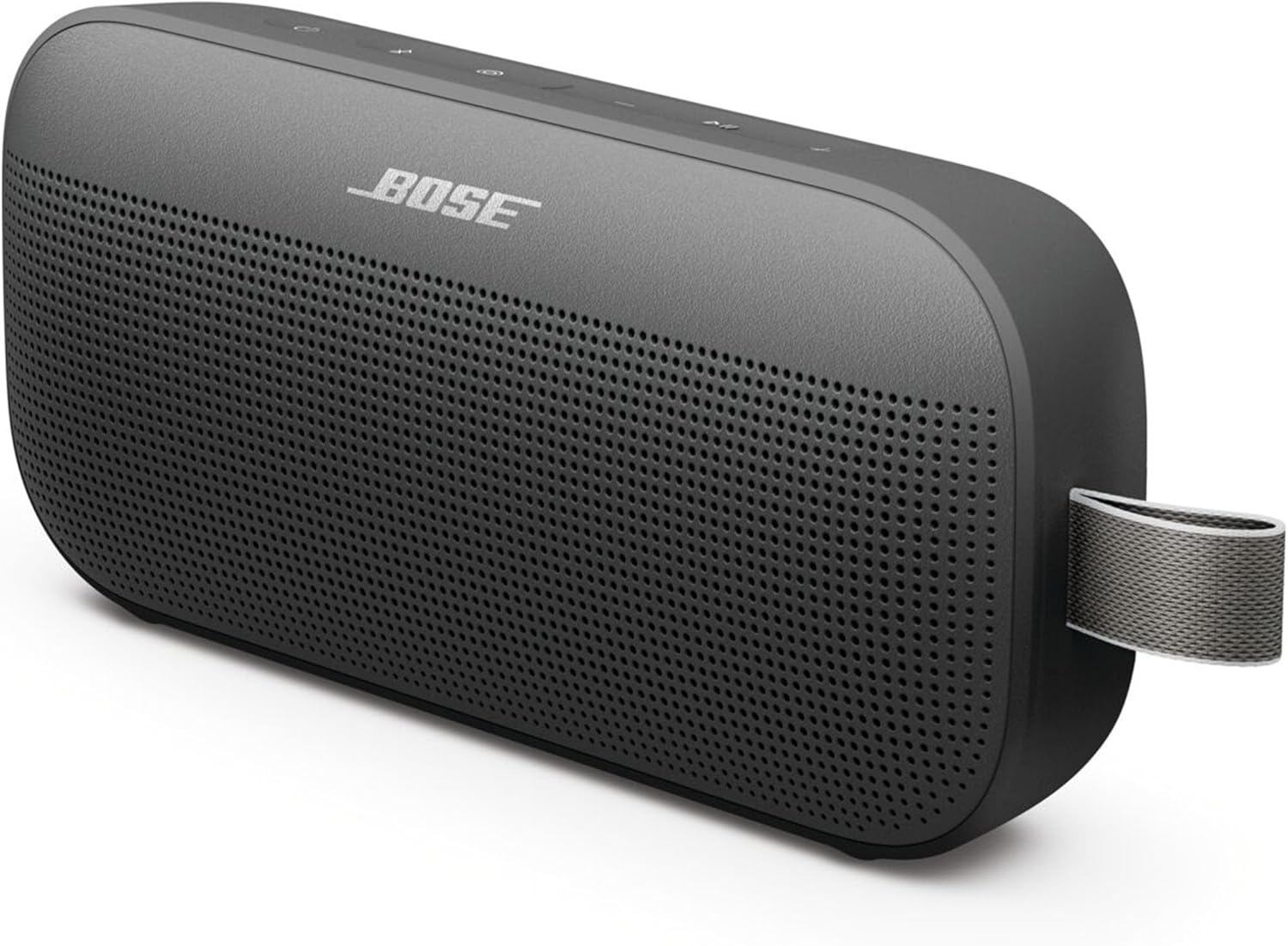
Bose SoundLink Flex is designed for life on the go if you’re looking for a durable speaker that can withstand a beating without sacrificing sound quality. You receive the powerful Bose sound without the cumbersome size thanks to its crisp, balanced audio and deep bass.
One of the main selling points is how portable it is. You can easily clip the speaker onto a backpack or beach bag thanks to its convenient utility loop, and its compact size means it can be held in one hand. You can go all day without worrying about finding a charger thanks to the 12-hour battery life, which is more than enough for travel, pool time, or outdoor exploration.
Where it truly excels is in its durability. Its IP67 certification ensures that it is both watertight and dustproof, protecting it from debris like sand and unexpected downpours. You want something that can withstand drops, shocks, and regular bumps when you’re moving from one place to another, and this silicone-wrapped body has just that.
You can connect two compatible Bose speakers to create a larger sound system for a group. Select Stereo Mode to separate the left and right channels, or Party Mode to increase the volume and fill the room. The SoundLink Flex is an excellent choice if you’re looking for a sturdy, dependable speaker that can keep the music playing no matter where you are.
5. JBL Go 4 – Best Budget Wireless Speaker

The JBL Go 4 is an affordable wireless speaker that is lightweight and compact, yet it packs a powerful audio punch despite its diminutive size. You can listen to music anywhere—in the kitchen, on the move, or at your desk—thanks to its compact design and JBL Pro Sound, which features deeper bass.
The battery life is designed for light use and short journeys. The standard battery life is up to 7 hours, and if you ever find yourself in need of a little more time to play, you can use the Playtime Boost feature to extend it by an additional 2 hours. That means you won’t have to worry as much about running out of juice when enjoying a picnic, going to the beach, or even just getting around the house.
Another major plus for the price is how long it lasts. You won’t need to worry about dropping or damaging the Go 4 because it has an IP67 rating, which means it is waterproof and dustproof. No worries about using it at the pool, on days at the beach, or in inclement weather.
Additionally, you have choices if you ever desire a more substantial sound. For stereo playing, just couple two Go 4 speakers. Or, for a broader and louder arrangement, use Auracast to wirelessly connect other compatible JBL speakers. So, it’s a cheap option, but it can still handle more volume when you have guests over or just want to fill the room with sound.
Things to Consider Before Buying a Wireless Speaker:
Most often, you should assess battery life, connectivity (Bluetooth version, Wi‑Fi, multiroom), sound profile and power to match your space; consider codecs, portability, build and IP rating, smart assistant support, ease of pairing and app features, plus warranty and price-to-performance so your speaker fits how and where you’ll use it.
Bluetooth Speakers
Bluetooth speakers give you straightforward pairing and mobility, and Bluetooth 5.0 commonly extends real‑world range to roughly 30-100 feet indoors. You’ll see codecs like SBC, AAC, and aptX affecting quality and latency; aptX Low Latency can cut lip‑sync lag to ~40 ms when supported. Popular examples include JBL Flip for durability and UE Boom for 360° sound-choose based on battery life, codec support, and IP rating.
Wi‑Fi Speakers
Wi‑Fi speakers use your home network to deliver higher bitrates and stable multiroom playback, ideal when you stream FLAC or use Tidal/Spotify Connect; Sonos and Chromecast speakers are common examples. You’ll benefit from synchronized playback across rooms and lower interruptions, but setup often requires an app and a reliable router to avoid dropouts.
For more detail, you should check protocol support-AirPlay 2, Chromecast, Sonos proprietary, or UPnP-since compatibility affects multiroom flexibility and streaming sources. Many Wi‑Fi models accept lossless files and provide room tuning (Sonos Trueplay, Yamaha EQ settings); if you run a NAS or DLNA server, confirm file format support and whether the speaker can act as a network client or requires a bridge.
Smart Speakers
Smart speakers combine voice assistants with audio playback, letting you control music and smart devices hands‑free; you’ll find Echo, Nest, and HomePod families across price levels. You should weigh assistant accuracy, ecosystem integration (Alexa skills vs Google routines vs Siri shortcuts), and whether high‑quality audio or privacy controls matter more for your daily use.
Going deeper, examine microphone array quality, on‑device processing (for wake‑word speed and privacy), and how firmware updates are handled-Echo devices offer the largest third‑party skill ecosystem, Nest integrates tightly with Google services, and HomePod focuses on spatial audio and iPhone continuity. Match assistant features to the smart home devices you already own for smoother automation and fewer compatibility compromises.
Sound Quality
You should prioritize objective and subjective measures: look at driver sizes (1-4″ for portable units), frequency response (closer to 20 Hz-20 kHz is better), measured SPL (90-110 dB for party use), and THD (<0.5% at reference levels). Compare single‑driver omnidirectional models to stereo dual‑driver designs for imaging, and review spectrum plots or measurements from trusted sites to verify bass extension and treble clarity.
Battery Life
You should expect 8-24 hours depending on battery capacity and usage: small speakers with 2,000-6,000 mAh typically provide 6-10 hours, while 10,000-20,000 mAh packs push beyond 15 hours; charging usually takes 2-4 hours and fast charge features trade weight for quicker top‑ups.
Battery endurance changes with volume, EQ and extras-playing at 80% volume, enabling RGB lights or heavy bass modes can cut runtime by half; check charge cycles (200-500), whether the battery is user‑replaceable, and if the speaker can act as a 5V power bank for phones to maximize utility on long outings.
Portability
You should match size and weight to your use case: under 1 kg for pocketable units, 1-3 kg for robust portable speakers, and larger for dedicated party models; verify dimensions for bag fit, look for IP ratings (IPX7 for submersion or IP55 for dust/water resistance), and prefer models with integrated handles or straps if you’ll carry them frequently.
Think about transport practicalities: airline carry rules for lithium batteries, build materials for drop resistance (metal grille vs molded plastic), availability of replacement batteries, and whether accessories like padded cases or shoulder straps are sold by the manufacturer to protect the speaker during travel.
Connectivity Options
You should align connectivity to your devices: Bluetooth 5.0 offers longer range and better stability than 4.2, aptX/aptX HD or LDAC provide higher‑fidelity Bluetooth streaming when supported, and Wi‑Fi, AirPlay 2 or Chromecast enable multiroom and lossless streams with lower latency for video.
Also evaluate practical limits: Bluetooth range is typically ~10 m and degrades with walls, multipoint pairing support varies widely, and wired inputs (3.5 mm, optical, Ethernet) provide reliable connections for TVs and stationary setups; check for firmware updates and a companion app that improves connectivity and adds features.
Advantages
You gain significant convenience and versatility: many portables deliver 8-24 hours of playtime, Bluetooth range of ~10 meters, and codecs like aptX/AAC that improve quality. Sonos-style Wi‑Fi systems let you sync multiple rooms with sub-50 ms drift, while smart integrations give voice control and app EQ. For casual listeners and outdoor use, you can buy reliable models between $50-$300 that balance battery, ruggedness, and sound without running cables.
Researching Brands
You should map brands to strengths: Bose and KEF for clarity and staging, JBL and UE for portable loudness (JBL Flip 6 ~12h), Sony for bass emphasis and long battery (SRS‑XB43 ~24h), and Anker Soundcore for value. Examine warranty length (1-2 years) and firmware update frequency; brands that push regular updates fix connectivity and codec bugs you might otherwise encounter.
Reading Reviews
You’ll combine professional tests with user feedback: consult Rtings, Wirecutter, What Hi‑Fi and YouTube measurements for frequency response and distortion numbers, then scan Amazon and Reddit for consistent real‑world issues like dropouts or swelling batteries. Focus on repeatable complaints across dozens of reviews rather than isolated opinions to judge reliability and performance.
Dig deeper into review data by comparing objective metrics: look for frequency response graphs, total harmonic distortion (THD) values under 1% at reference levels, and measured SPL (dB) figures from sites like Rtings or AudioScience Review. Also check long‑term reliability threads and firmware changelogs; if multiple reviewers note a firmware fix for pairing, that’s a sign the brand addresses post‑release problems.
Testing Sound Quality
You should audition speakers with familiar tracks across genres-hip‑hop for bass impact, acoustic for mids and vocals, and classical for detail and imaging-at 60-80% volume. Check bass tightness, mid clarity, and treble smoothness, then push to higher volumes to detect distortion. Bring your device and files to avoid compression artifacts from streaming.
When testing, run A/B comparisons with a known reference and use a frequency sweep or pink noise to spot dips and peaks; expect a good portable to stay within ±6 dB across most of the audible band and keep THD below 1% at moderate SPLs. Listen for port noise or driver strain above ~85 dB, and evaluate stereo separation with tracks that place instruments across the soundstage.
Proper Usage
You’ll extend performance by managing battery and placement: avoid leaving the speaker at 100% or 0% charge for long periods-store at about 40-60% if unused for weeks-keep operating temperatures between 0-40°C, and place portable speakers 1-2 feet from walls for balanced bass; when pairing multiple units, use identical models or the manufacturer’s recommended firmware to prevent sync drift.
You should treat the battery like a typical lithium-ion pack-expect roughly 300-500 full charge cycles before noticeable capacity loss, prefer partial charges over full cycles, and use the supplied or certified charger to maintain stable voltage; for video, enable low-latency codecs (aptX LL or proprietary modes) to reduce lip-sync issues, and update firmware regularly to fix bugs and improve multiroom timing.
Conclusion
Presently you should prioritize battery life, sound quality, connectivity (Bluetooth, Wi-Fi, aptX), and form factor to suit your use, assess durability and water resistance for intended locations, compare features like voice assistants and multiroom support, and balance price against warranty and compatibility so your wireless speaker reliably meets your listening habits and environment.
Leave a Reply